
The Unseen Costs of Adaptive Reuse: A Critical Look at Materiality in Historic Conversions
Adaptive reuse projects are lauded for their sustainability and cultural preservation, but often the material implications and long-term maintenance of these conversions receive less scrutiny. This column examines the hidden costs and design trade-offs inherent in transforming historic structures, focusing on material


Adaptive reuse has become a celebrated strategy in contemporary architecture, frequently championed for its inherent sustainability and its power to weave new narratives into existing urban fabrics. The conversion of an old factory into loft apartments, a historic school into a community center, or a disused church into a performance venue is often presented as a win-win: preserving heritage while reducing embodied carbon and revitalizing neglected areas. However, this widely embraced approach often masks a complex interplay of material challenges, hidden costs, and design compromises that warrant closer scrutiny. While the surface appeal of adaptive reuse is undeniable, a deeper dive into the material implications reveals a more nuanced picture, often involving significant environmental and financial burdens that can undermine the very sustainability claims they purport to uphold.
The central thesis here is that a critical examination of materiality in adaptive reuse projects is overdue. Beyond the initial excitement of transformation, the lifecycle costs, long-term maintenance, and true environmental impact of introducing new materials into old structures are frequently understated or entirely overlooked. This column argues that without a comprehensive understanding of these factors, many adaptive reuse projects risk becoming monuments to short-term vision rather than truly sustainable and enduring contributions to the built environment.
Why Materiality Matters in Adaptive Reuse
The allure of adaptive reuse is understandable. By extending the life of an existing building, architects and developers aim to avoid the demolition waste and embodied energy associated with new construction. The National Park Service, for instance, highlights the economic benefits of historic rehabilitation, including federal tax credits for eligible projects, implicitly encouraging reuse over demolition. The U.S. Green Building Council (USGBC) also frames adaptive reuse as “the ultimate recycling,” emphasizing its potential for significant energy savings and reduced waste compared to new builds. These are compelling arguments.
However, the reality on the ground often involves a substantial intervention of new materials, not merely a light touch-up. Structural reinforcements, new insulation, updated MEP systems, and modern finishes are almost always required to bring historic buildings up to contemporary codes and performance standards. This introduces a fresh set of material choices, each with its own embodied energy, supply chain implications, and end-of-life considerations. For example, replacing single-pane historic windows with high-performance, double-glazed units might improve energy efficiency but involves the manufacturing and installation of entirely new components, often with different material compositions than the originals. The material efficiency of the original structure is often compromised by the new interventions.
What Sources Show About Material Challenges
Official guidelines and industry bodies generally promote the *idea* of adaptive reuse but offer less granular detail on the material science challenges. The National Park Service’s “Secretary of the Interior’s Standards for Rehabilitation” provides broad principles for historic preservation, advocating for the retention of historic features and materials where possible. However, when original materials are beyond repair or inadequate for new functions, the standards permit replacement with “compatible” modern materials. This compatibility often refers to aesthetic and structural fit, not necessarily environmental impact or long-term durability in the context of the overall project.
Architectural publications and professional bodies like the American Institute of Architects (AIA) have increasingly focused on embodied carbon. This focus reveals that while reusing a building structure saves significant embodied carbon, the new materials introduced during renovation can still carry a substantial carbon footprint. A critical examination published in *Architect Magazine* highlights the “material puzzle” of adaptive reuse, pointing out that specifying new, high-performance materials – even those considered “green” – still requires careful consideration of their manufacturing processes, transportation, and lifecycle. The article underscores that the true benefit lies not just in retaining the shell, but in making judicious material choices for the new additions.
For instance, the conversion of an industrial brick building into offices might require extensive internal modifications. New partitions, ceilings, flooring, and façade elements could be needed. If these new elements utilize materials like virgin steel for framing, extensive new concrete for slabs, or petrochemical-derived insulation, the embodied carbon savings from retaining the original structure can be significantly eroded.
Design Trade-offs and Unintended Consequences
The design process for adaptive reuse is a constant negotiation between preservation and performance. Architects must contend with existing structural limitations, irregular layouts, and often compromised material integrity. This frequently leads to design trade-offs:
- Structural Reinforcement: Historic buildings were often not designed for the loads or seismic requirements of modern occupancy. Reinforcing these structures can involve significant new steel or concrete, adding substantial embodied carbon and cost.
- Thermal Performance: Upgrading insulation to meet contemporary energy codes often requires intrusive measures that can conceal historic fabric or alter the building’s thermal mass characteristics. The choice between external insulation (altering the facade) and internal insulation (reducing interior space and potentially trapping moisture) presents complex material and aesthetic dilemmas.
- Moisture Management: Old buildings often “breathe” differently than modern, tightly sealed structures. Introducing modern vapor barriers and insulation without understanding the original building’s moisture dynamics can lead to condensation, mold, and decay of historic materials. This requires specialized material knowledge and often custom solutions.
- Accessibility: Integrating modern accessibility standards (ramps, elevators) into multi-story historic buildings can be architecturally challenging and materially intensive, often requiring new structural elements and significant interventions.
These trade-offs are not inherently negative, but they demand transparent accounting of the new materials introduced and their long-term implications. The client or institution, often driven by budget and programmatic needs, may prioritize immediate performance gains over the long-term material health of the building. Architects, caught between conservation ethics and client demands, must skillfully navigate these choices.
What Remains Unclear
Despite the growing popularity of adaptive reuse, a comprehensive, standardized methodology for assessing the *net* environmental impact of these projects—accounting for both retained and new materials throughout their lifecycle—is still evolving. While tools exist for embodied carbon calculation, their application to complex adaptive reuse scenarios, particularly regarding the interaction of old and new materials, needs refinement.
Furthermore, the long-term performance and maintenance costs of hybrid old-and-new material assemblies are not always well-documented. How do modern sealants and insulation perform when integrated with historic brickwork over fifty years? What are the implications for repair and replacement cycles? These questions are often answered through trial and error, or only become apparent decades after project completion.
What Readers Can Verify
For architects, developers, and policymakers, a more rigorous approach to material selection in adaptive reuse is essential. When evaluating or proposing adaptive reuse projects, consider the following:
- Material Audit: Conduct a thorough audit of existing materials, assessing their condition, embodied energy, and potential for reuse or recycling *before* specifying new components.
- Lifecycle Assessment (LCA): Push for comprehensive LCAs that compare the full environmental impact of adaptive reuse (including new material interventions) against demolition and new construction. Do not assume adaptive reuse is inherently superior without this analysis.
- Durability and Maintenance: Prioritize new materials with high durability, low maintenance requirements, and known end-of-life pathways. Favor materials that are compatible with the existing structure’s thermal and moisture dynamics.
- Local Sourcing: Seek out locally sourced materials to reduce transportation embodied energy.
- Transparency: Demand transparency from material suppliers regarding their products’ environmental declarations and supply chains.
The true success of adaptive reuse should be measured not just by its initial transformation, but by its enduring material health, minimal environmental footprint, and long-term economic viability. Without a critical and informed approach to materiality, the promise of adaptive reuse risks becoming a superficial veneer over complex and potentially unsustainable interventions.
- Embodied Carbon (Initial): Significant savings from retaining structure, but new materials add. | High initial embodied carbon from all new materials.
- Material Sourcing: Blends existing (often local) with new (potentially global). | Predominantly new, supply chain dependent.
- Waste Generation: Reduced demolition waste, but renovation waste can be substantial. | High demolition waste (if replacing), high construction waste.
- Longevity/Durability: Relies on existing structure’s integrity; new materials must match. | Designed for modern lifespan; material choices dictate durability.
- Maintenance Complexity: Can be complex due to hybrid old/new systems and materials. | Generally standardized, but depends on material quality.
Related news
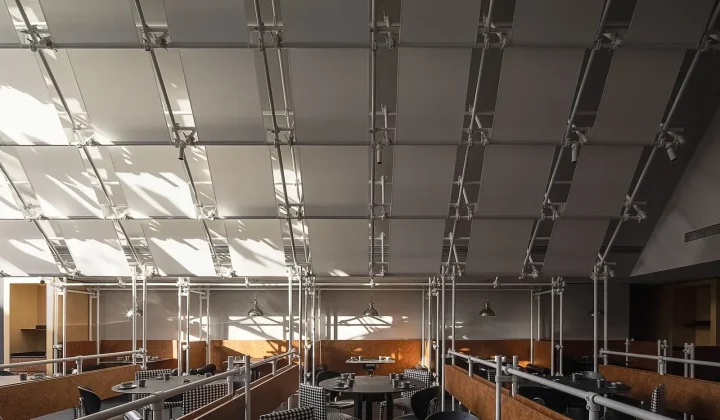
Scaffolding as Interior Architecture: Adaptable Systems Challenge the Divide Between Temporary and Permanent
A new article by Jonathan Yeung examines how modular scaffolding systems, from steel frames to Dieter Rams’ shelving, demonstrate that longevity in…
Read more
MIV Architects Proposes Wetland Pavilion That Prioritizes Non-Human Habitats Over Human Comfort
The Spanish firm’s “Nidos de Agua” concept for the Albufera natural park in Valencia aims to rebalance the relationship between building and…
Read more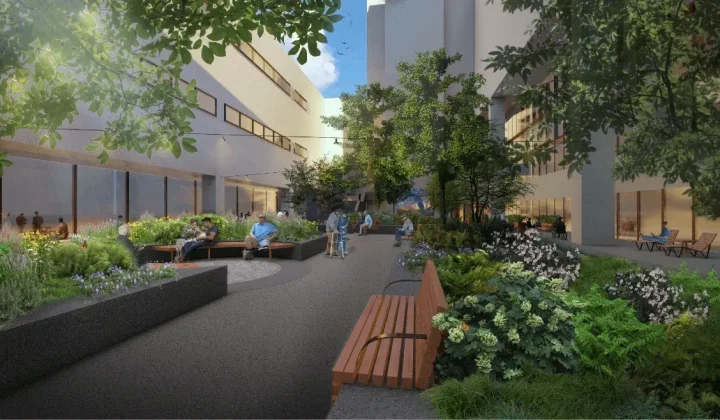
Nelson Byrd Woltz Begins Construction on Restorative Eagle Courtyard at Walter Reed Medical Center
Construction has started on a redesigned Eagle Courtyard at Walter Reed National Military Medical Center, led by Nelson Byrd Woltz Landscape Architects.…
Read more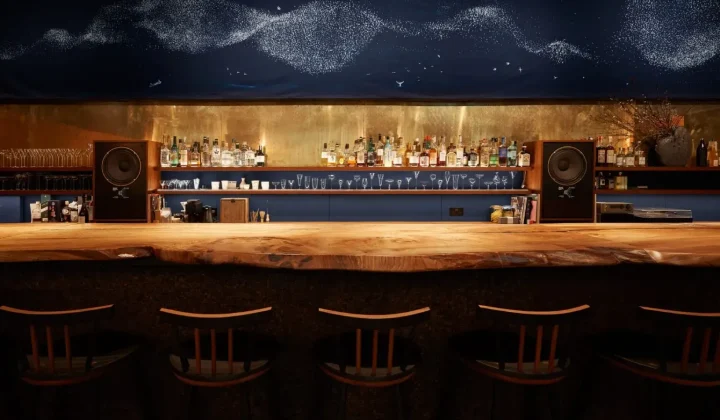
London’s listening bar boom reflects a deeper shift in hospitality design and music culture
A wave of Japanese-inspired listening bars is reshaping London’s nightlife, but owners and critics are asking whether the concept can survive commercial…
Read moreRelated wiki

Adaptive Reuse in Architecture
Reference page for reuse, retrofit, conversion, embodied carbon and design constraints.
Read more