IED Explores Inclusive Living and Social Responsibility at Milan Design Week 2026
The Istituto Europeo di Design (IED) celebrated its 60th anniversary at Milan Design Week 2026 with a series of installations and a new magazine issue, focusing on inclusive living, social responsibility, and the role of design in addressing contemporary urban challenges.
The Istituto Europeo di Design (IED), an Italian design school with campuses across Italy, Spain, and Brazil, marked its 60th anniversary at Milan Design Week 2026 by presenting a range of initiatives centered on inclusive living and social responsibility. Under the overarching theme “Living the Present,” IED showcased three distinct interventions across Milan, alongside the launch of a new magazine issue. These projects aimed to highlight how design can address pressing urban challenges and foster greater conviviality within contemporary cities.
The Glitch Camp: A Hub for Active Citizenship
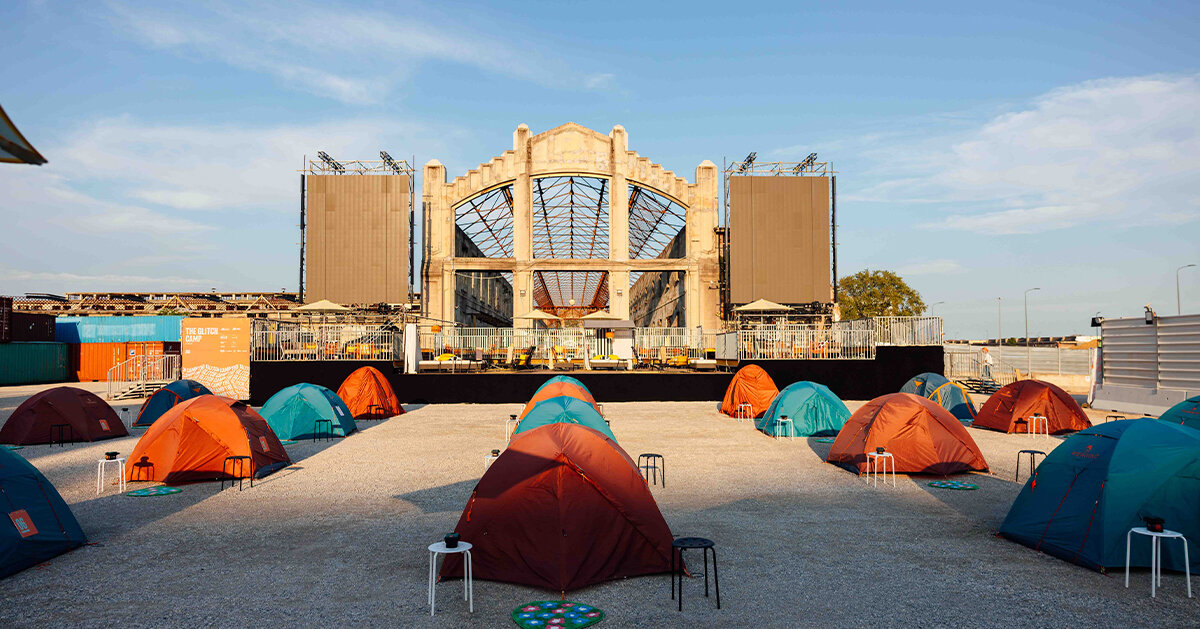
A key component of IED’s presence was the “Glitch Camp,” a project organized by the Francesco Morelli Foundation (which owns the IED Group) and IED, with contributions from Fondazione Cariplo. Now in its third year, the 2026 iteration of the camp took place at the post-industrial Ex Macello in Porta Vittoria. The Glitch Camp served as a temporary living and learning space for over 300 design students visiting Milan, emphasizing the connection between creativity and social responsibility.
Riccardo Balbo, President of the Francesco Morelli Foundation and Academic Director of the IED Group, articulated the camp’s mission: “Driving change and contributing to the betterment of future generations is possible if we listen to the places we inhabit.” He described the Glitch Camp as a “workshop for the common good,” where students from over 30 nationalities could build relationships, engage with the international design community, and act as catalysts for a more stable future. The camp provided functional and welcoming spaces, including lounges and communal areas, furnished with IKEA products and Ferrino tents. Following the event, the IKEA furnishings were slated for donation to the Arché Foundation, which supports women and children affected by violence, promoting low-impact hospitality and product circularity.
Notes on Plural Intelligences: A Publication Series
Parallel to the installations, IED launched the second issue of its editorial project, “Notes on Plural Intelligences,” as part of its 60th-anniversary celebrations. Titled “Now-Here Land,” this issue delves into the systems and relationships that shape contemporary cities, proposing new ways to navigate them. The publication explores IED’s vision of multiple forms of intelligence through design, with new issues scheduled for release every two months throughout the year, accessible for free download on the IED website.
VIVO: Responsive Temporary Housing
As an onsite response to emergencies, the “VIVO” installation showcased temporary housing solutions designed for individuals affected by natural disasters or other forms of displacement. Exhibited within the INTERNI MATERIAE event, VIVO proposed a 48-hour house assembly concept for Italian gyms, offering a rapid solution for groups needing temporary shelter. Visitors could explore a 1:1 scale portion of this housing system. VIVO originated from a BA in Interior Design thesis project by IED alumni Tommaso Cavalli, Chiara Gorni Silvestrini, Sofia Lipoli, and Andrea Lombardi. Curated by designer, professor, and IED alumnus Davide Angeli, the project has evolved into an open system focused on facilitating life reconstruction and continuity after displacement.
Fare Posto: Redesigning Reception Spaces
The “Fare Posto” installation, designed by MA in Interior Design students specializing in “Special Practices for Gathering Culture” at IED, re-imagined the initial reception spaces of the Center Sammartini. This project, conducted in collaboration with the City of Milan and the Center’s staff, with support from the Francesco Morelli Foundation, developed three proposals aimed at restoring visibility and a sense of belonging for marginalized individuals.
Key facts
- Event: Milan Design Week 2026
- Organizer: Istituto Europeo di Design (IED)
- Theme: Living the Present
- Key Initiatives: Glitch Camp, VIVO temporary housing, Fare Posto reception spaces, Notes on Plural Intelligences magazine
For spatial division, Alessia Martinez and Ekaterina Sharova’s “GENTLE FRAME” project utilized modular systems made from aluminum and recycled cork, exemplifying low-impact design to create clarity and order. For comfort improvement, “SYNESTESIA,” by Jahnavi Desai and Stefania Straziuso, proposed modular seating and work surfaces to foster interaction between staff and users, incorporating non-invasive lighting for a welcoming atmosphere. Mobile devices were also integrated through the “KALEIDOSCOPE” project by Federica Avon, Damla Dinckan, and Olga Matsiuk, combining visual and acoustic screening to ensure privacy in listening spaces. All prototypes were designed to make the spaces recognizable and functional, while also incorporating aesthetic elements.
These initiatives demonstrate IED’s commitment to exploring how design can serve as a tool for social improvement, addressing issues of inclusivity, emergency response, and community building within the urban fabric.
Source: Designboom – https://www.designboom.com/design/ied-accessible-milan-design-week-installation/
Key facts
- Source: Designboom
- Date: 2026-05-19T10:00:16+00:00
- Topic: IED makes design accessible in milan through installations and a magazine issue
Source
Designboom Original publication: 2026-05-19T10:00:16+00:00
Related news

Handwoven Teak and Cord Outdoor Seating Debuts from Masaya and Abril Zepeda
Nicaraguan furniture brand Masaya has introduced two new handcrafted outdoor chairs — a rocking chair and a lounge chair — designed by…
Read more
Place in Mind: Hendricks Churchill Launches Hospitality Group to Revive Historic Properties
The architecture and interior design studio Hendricks Churchill has launched Place in Mind, a new hospitality group focused on acquiring, restoring, and…
Read more
Adalberto Dias Architects Complete Restoration of Lisbon’s Patriarchal Cathedral and Archaeological Center
The restoration of the Sé de Lisboa by Adalberto Dias Arquitecto integrates a new archaeological center, preserved cloisters, and seven centuries of…
Read more
Vantieghem Talebi’s ‘House of Cards’ Brings Timber Geometry to Belgian Family Home
A new family house in Belgium by US- and Swiss-based practice Vantieghem Talebi uses a steeply pitched, card-house-inspired form clad in Douglas-fir…
Read moreRelated wiki
Adaptive Reuse in Architecture
Reference page for reuse, retrofit, conversion, embodied carbon and design constraints.
Read more