
Chilean Modular Housing Prototype Addresses Challenging Sites with Stilt Foundation
Ignacio Rojas Hirigoyen and Leonardo Gúzman Valencia have developed a modular housing prototype in Chile, featuring a stilted foundation and adaptable components to navigate challenging topographies and environmental conditions.
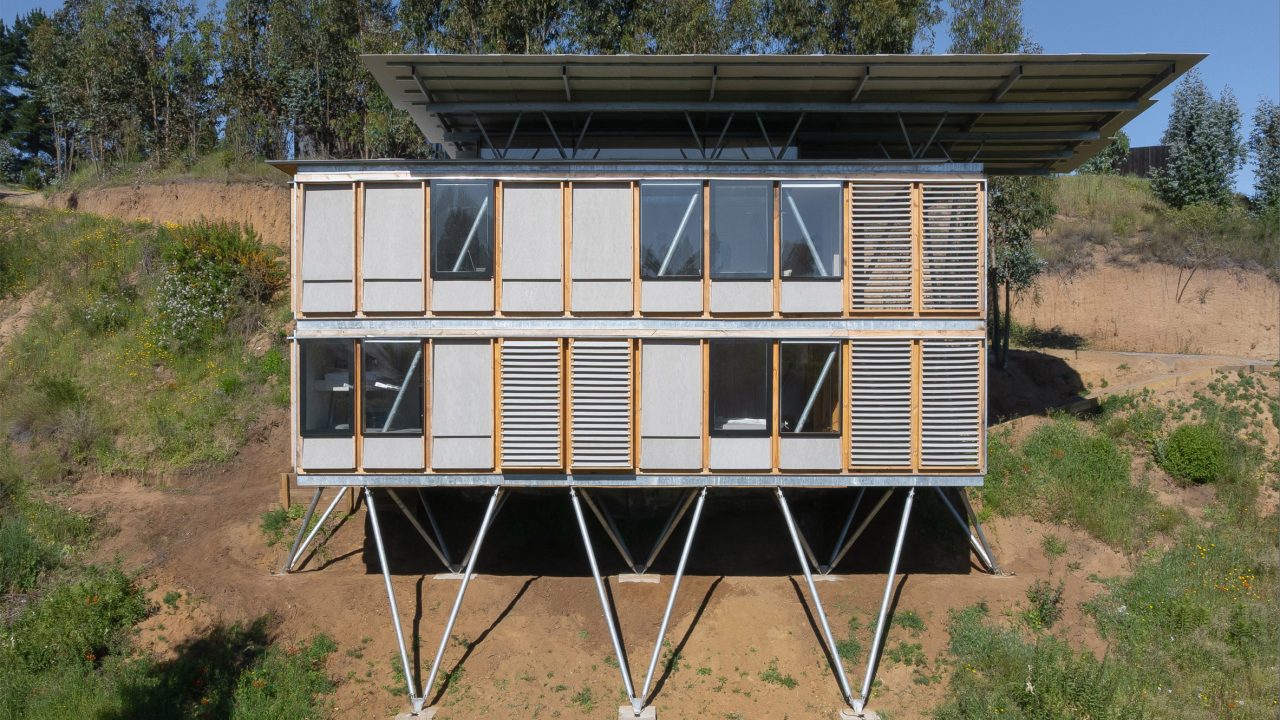
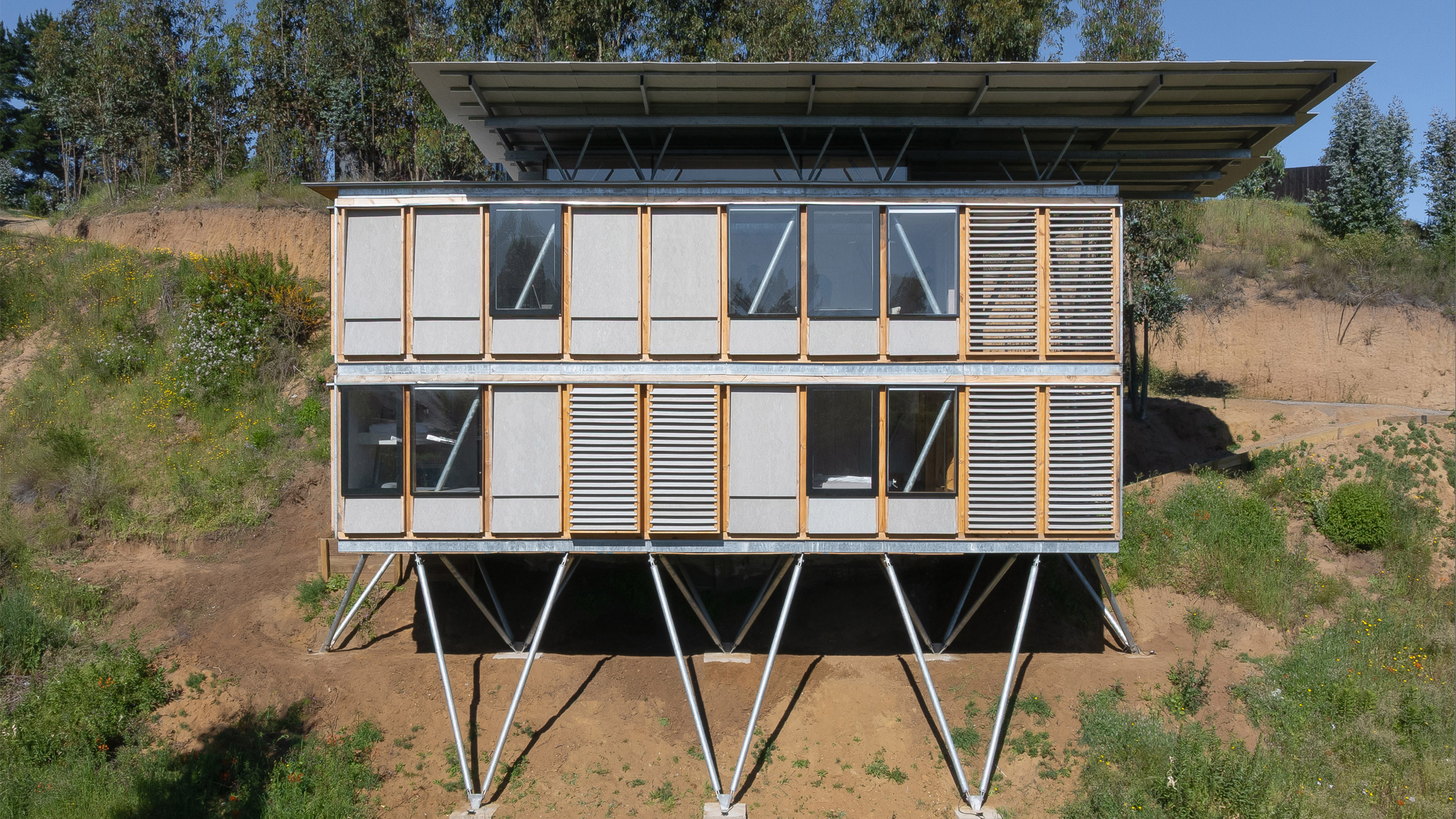
Architects Ignacio Rojas Hirigoyen and Leonardo Gúzman Valencia have unveiled a second-generation modular housing prototype in Chile, designed to overcome the complexities of challenging sites through an innovative stilted foundation and adaptable building components. The project, named Industrialized Building System Prototype II (IBSP II), builds upon lessons learned from an earlier 2023 prototype, expanding its scope to not only house people but also to integrate with dynamic environmental conditions.
The 120-square-meter (1,290-square-foot) single-family residence is situated on a steep, 5,000-square-meter (1.2-acre) site in Matanzas, Chile. The design deliberately separates the house’s structural framework from its enclosure, allowing each component to respond independently to site conditions and enable future flexibility.
Responding to Site and Climate
The core innovation of IBSP II lies in its lightweight yet robust structure of diagonal, self-supporting stilts. This foundation system effectively navigates the site’s significant topographical changes, minimizing invasiveness and establishing a precise relationship with the ground. Ignacio Rojas highlighted that this approach allows the building’s envelope to take on a more active role in climatic mediation, rather than merely acting as a boundary. “What matters is not only the technical refinement itself, but what it enables: an architecture that is more legible, more habitable and better prepared to adapt to variable conditions of climate, terrain and use,” Rojas stated.
The triangular arrangement of structural points ensures that the interior of the rectangular, two-story house remains free of internal supports. This open plan facilitates greater spatial flexibility within the two-bedroom dwelling. The choice of a difficult site, exposed to strong winds, salinity, and intense solar radiation, was intentional, serving as a critical testing ground for the prototype’s clarity, habitability, and adaptability in real-world conditions.
Modular and Adaptable Components
The house’s enclosure is formed by timber modular panels that integrate cladding, insulation, shading, and ventilation within the metal frame. This modular system emphasizes the envelope’s active role in environmental performance. The design team noted, “It is not simply a line of closure, but a climatically active facade unit capable of improving thermal and acoustic comfort, reducing energy demand, and mediating more precisely between interior and exterior.”
A layered metal roof floats above the enclosure, both physically separating and visually distinguishing each piece of the prototype. This deliberate deconstruction of the building into distinct components enhances long-term usability. Unlike traditional construction where structure and enclosure often form an undifferentiated mass, IBSP II’s components can be individually disassembled, replaced, or updated without destructive demolitions. This feature significantly simplifies maintenance and allows for future transformations, extending the building’s lifespan and adaptability to changing needs and technologies. Rojas emphasized that this approach prioritizes spatial and environmental quality, distinguishing it from many industrialized solutions that focus solely on reducing time and cost.
Efficiency and Future Potential
A notable achievement of the IBSP II project was the rapid assembly of the house structure in less than one day, using non-skilled labor. This demonstrates the system’s potential to efficiently address housing needs, particularly in contexts where rapid deployment and adaptability are crucial. The project’s success on a challenging site underscores its capacity to respond to the “concrete frictions of territory, climate and contemporary construction,” according to Rojas.
The development of IBSP II contributes to a growing trend in Chile of lightweight, elevated residences designed to integrate with diverse landscapes. Other recent examples include a prefabricated timber house by Iragüen Viñuela Arquitecto, a prefabricated steel ski chalet by Max Núñez Arquitectos, and a steel box truss-like house by Paralelo Transversal. These projects collectively demonstrate an architectural shift towards more resilient, adaptable, and resource-efficient building solutions in response to both environmental challenges and housing demands.
Key facts
- Project Name: Industrialized Building System Prototype II (IBSP II)
- Architects: Ignacio Rojas Hirigoyen, Leonardo Gúzman Valencia
- Location: Matanzas, Chile
- Area: 120 sq m (1,290 sq ft)
- Key Innovation: Stilted foundation for difficult terrain, modular and separable building components for adaptability
The IBSP II prototype offers valuable insights for architects, designers, and urban planners grappling with complex sites, climate change impacts, and the need for flexible, sustainable housing solutions. Its emphasis on component separation, climatic responsiveness, and ease of assembly and maintenance sets a precedent for future industrialized construction methods that prioritize long-term adaptability and environmental integration over conventional mass production.
Source: Dezeen, https://www.dezeen.com/2026/05/19/ibsp-ii-ignacio-rojas-hirigoyen-leonardo-guzman-valencia-chile/
Source
Dezeen Original publication: 2026-05-19T19:00:25+00:00
Related news

SIITUA III to Gather International Researchers on Territory, Urbanism, and Architecture in Lima
The third edition of the International Seminar on Research in Territory, Urbanism, and Architecture (SIITUA III) will take place in Lima, organized…
Read more
Christopher Kane brings streamlined, heritage-driven vision to Mulberry in London Fashion Week debut
The Scottish designer presented his first collection for the British leather goods house at London Fashion Week, blending sharp tailoring, archival references…
Read more
When Film Directors Become Interior Designers: Guadagnino, Lynch, Anderson and Almodóvar Step Off Screen
From Luca Guadagnino’s Zara Home collection to David Lynch’s Paris club and Wes Anderson’s train carriage, a wave of collaborations is blurring…
Read more
Jesus Mari Lazkano Examines Changing Landscapes Through Painting and Animated Film at Basque Luxury Studio
The Basque artist’s exhibition ‘Azken Natura’ brings together six large-scale paintings and a 22-minute animated film that traces the melting of the…
Read moreRelated wiki

Adaptive Reuse in Architecture
Reference page for reuse, retrofit, conversion, embodied carbon and design constraints.
Read more