
Zaha Hadid Exhibition at LUMA Arles Celebrates Her Early Artistic Process
A new exhibition at LUMA Arles, "I Think There Should Be No End to Experimentation," delves into Zaha Hadid's formative years, showcasing rare paintings, sketches, and archival materials that illuminate her groundbreaking creative journey ten years after her passing.
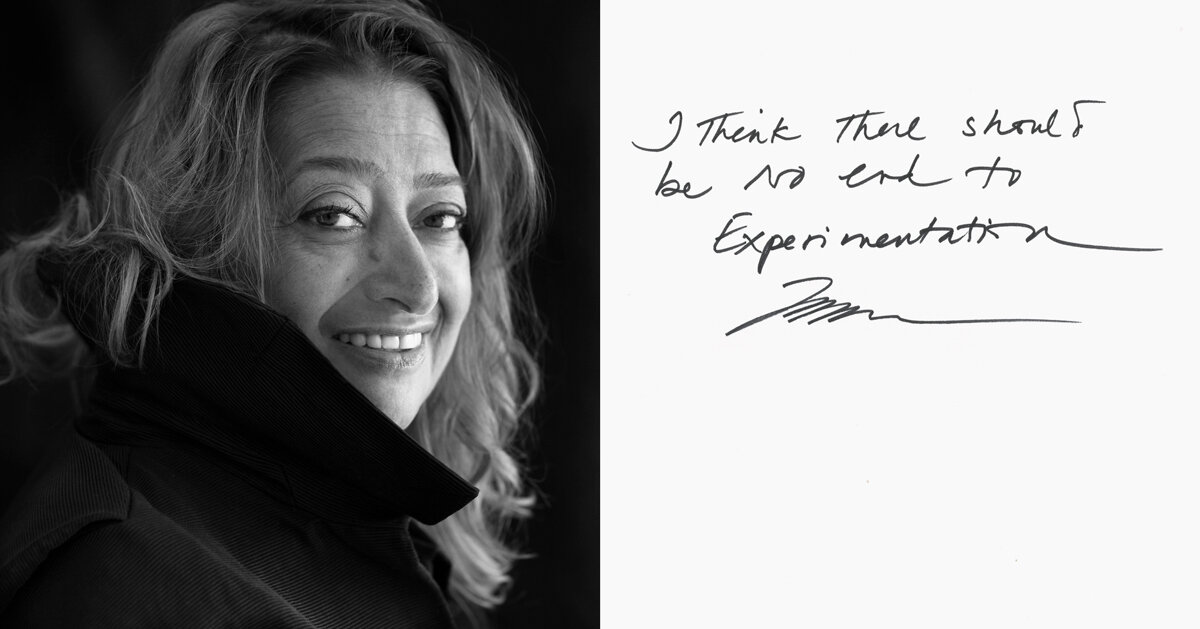
A significant exhibition at LUMA Arles is dedicating its sixth chapter of the Hans Ulrich Obrist Archives to the influential Iraqi-British architect Dame Zaha Hadid, ten years after her passing. Titled “I Think There Should Be No End to Experimentation,” the show focuses on Hadid’s formative creative process, moving beyond the digital tools of her later career to highlight her early calligraphic drawings, rapid sketches, and paintings used for spatial exploration.
Curated by Hans Ulrich Obrist and Arthur Fouray, the exhibition aims to offer a comprehensive look at Hadid’s artistic and architectural trajectory. It is presented within The Tower, a building designed by her contemporary and friend, the late Frank Gehry. The exhibition is divided into two main sections, offering distinct encounters with Hadid’s work and legacy.
The Hans Ulrich Obrist Archives, a series of annual exhibitions at LUMA focused on cultural figures, provides a rich foundation for this tribute. Obrist, a close collaborator of Hadid’s, has amassed extensive archival material, including hours of video interviews recorded between 2001 and 2013. This collection forms the core of the exhibition’s exploration into Hadid’s intellectual evolution and her approach to design.
Early Paintings and Sketches
In the Archives Gallery, visitors can engage directly with Hadid’s physical creations. This section features rarely exhibited paintings, early calligraphic drawings, and personal notebooks that offer a tangible connection to her hand and her design thinking. These works predate the extensive use of computer-generated imagery that became synonymous with her later projects, emphasizing a foundational reliance on manual artistic exploration.
A core theme explored is Hadid’s Constructivist origins, the development of her early unrealized projects, and how they were received, particularly in France. The exhibition also delves into her long-standing relationship and collaborations with Obrist, which began around the late 1990s with the “Cities on the Move” exhibition co-curated with Rem Koolhaas. Their conversations spanned a decade, touching upon themes from utopian urbanism to the evolving role of technology in design.
Archival Interviews and Homages
The Cherry Tree Gallery presents the first part of the exhibition, where Hadid’s legacy is animated through a convergence of audio, visual, and archival materials. A central element here is the extensive digital repository of interviews recorded by Hans Ulrich Obrist. These recordings, spanning from 2001 to 2013, are presented across multiple screens and audio stations, transforming the gallery into a dynamic record of Hadid’s thoughts and ideas.
These interviews capture her reflections on a wide range of subjects, including utopian urbanism and the intersection of design and technology. Notable dialogues include early discussions on typology and exhibition design from 2001, explorations of her fluid designs for cultural institutions in the Arab states from her London studio in 2007, and a 2013 conversation with Obrist and Patrik Schumacher that traced her trajectory from Russian Constructivism to parametric urbanism. By prioritizing Hadid’s own voice, the exhibition aims to subvert the passive retrospective model, allowing her to narrate her own radical career path.
Surrounding these video installations are tribute posters created by peers, friends, and admirers. These commissioned artworks offer varied perspectives on Hadid’s influence and history. Contributors include Sir Peter Cook, Stefano Boeri, Sumayya Vally, Iwan Baan, Lina Ghotmeh, Madelon Vriesendorp and Shumon Basar, Susan Hefuna, Hashim Sarkis, Simone Fattal, Francesco Vezzoli, Mehdi Moutashar, and Rirkrit Tiravanija, among others. Sumayya Vally’s contributions incorporate Arabic words translating to “horizon, trace, together,” while Iwan Baan provides a photograph of the MAXXI museum, one of Hadid’s iconic buildings. These diverse artistic responses collectively demonstrate the enduring impact of Hadid’s work on contemporary architectural imagination.
The exhibition design itself, conceptualized by acclaimed Japanese architect Kazuyo Sejima, includes a poetic demand for a window framing a living tree, a detail fulfilled by LUMA founder Maja Hoffmann and Frank Gehry, who designed a custom aperture to create a contemplative atmosphere.
For architecture and design enthusiasts, this exhibition offers a rare opportunity to delve into the foundational artistic practices of one of the most significant architects of the late 20th and early 21st centuries. It highlights the importance of manual artistic skill and iterative sketching in the development of complex architectural ideas, a process that underpins even the most technologically advanced designs. The focus on her early work provides context for her later achievements, including being the first woman to win the Pritzker Architecture Prize in 2004, winning the Stirling Prize twice, and receiving a Dame Commander of the Order of the British Empire.
Key facts
Exhibition Title | I Think There Should Be No End to Experimentation
Venue | LUMA Arles, The Tower
Curators | Hans Ulrich Obrist, Arthur Fouray
Focus | Early paintings, sketches, notebooks, and archival interviews of Zaha Hadid
Duration | 2026 – 2027
The exhibition’s emphasis on Hadid’s early artistic process serves as a valuable reminder for students and practitioners alike about the fundamental role of drawing and painting in conceptualizing space and form. It underscores that innovation often stems from a deep engagement with fundamental artistic principles, even as technology advances. For those interested in design culture and the history of architecture, this show provides a unique window into the mind of a visionary.
Source: Designboom – https://www.designboom.com/architecture/exhibition-rare-paintings-archives-zaha-hadid-ten-years-passing-luma-arles-hans-ulrich-obrist/
Key facts
- Source: Designboom
- Date: 2026-05-25T17:00:40+00:00
- Topic: major exhibition of rare paintings and archives honors zaha hadid ten years after her passing
Source
Designboom Original publication: 2026-05-25T17:00:40+00:00
Related news
SIITUA III to Gather International Researchers on Territory, Urbanism, and Architecture in Lima
The third edition of the International Seminar on Research in Territory, Urbanism, and Architecture (SIITUA III) will take place in Lima, organized…
Read more
Christopher Kane brings streamlined, heritage-driven vision to Mulberry in London Fashion Week debut
The Scottish designer presented his first collection for the British leather goods house at London Fashion Week, blending sharp tailoring, archival references…
Read more
When Film Directors Become Interior Designers: Guadagnino, Lynch, Anderson and Almodóvar Step Off Screen
From Luca Guadagnino’s Zara Home collection to David Lynch’s Paris club and Wes Anderson’s train carriage, a wave of collaborations is blurring…
Read more
Jesus Mari Lazkano Examines Changing Landscapes Through Painting and Animated Film at Basque Luxury Studio
The Basque artist’s exhibition ‘Azken Natura’ brings together six large-scale paintings and a 22-minute animated film that traces the melting of the…
Read moreRelated wiki
Adaptive Reuse in Architecture
Reference page for reuse, retrofit, conversion, embodied carbon and design constraints.
Read more