
Oorvi Sharma Advocates for Craftsmanship as a Cornerstone of Resilient Futures
Curator and designer Oorvi Sharma argues that embedding artisanal knowledge within contemporary systems is crucial for building enduring futures, moving beyond craft's traditional perception as mere heritage.
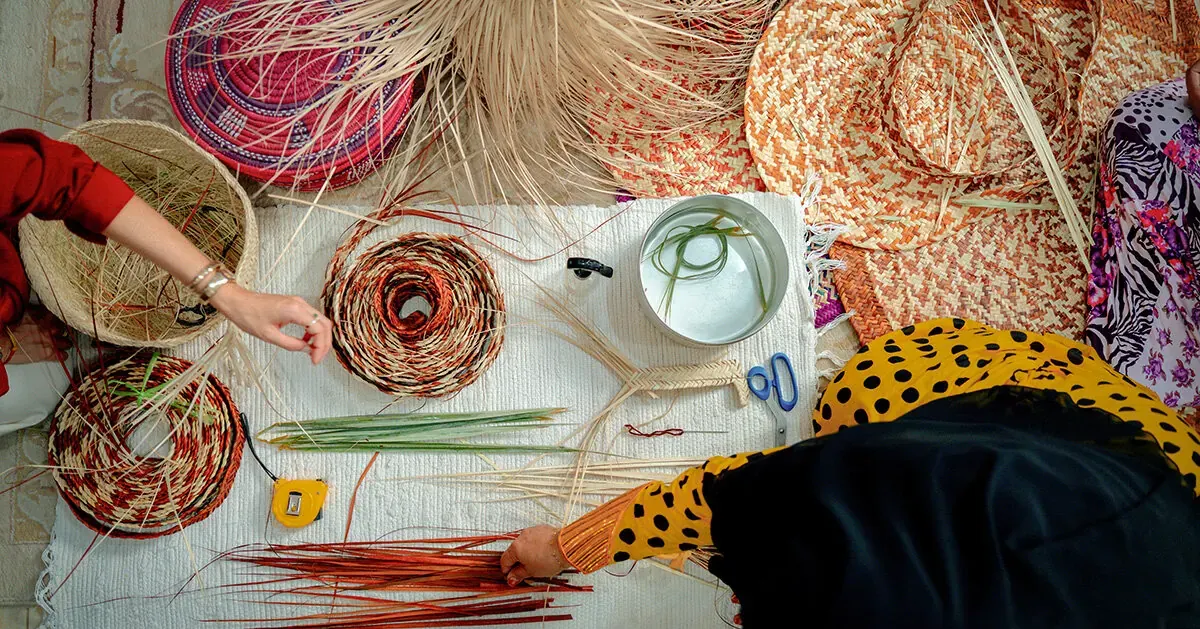
Oorvi Sharma, a curator and designer, has put forth a compelling argument that craftsmanship is not merely a relic of the past but a vital methodology for constructing resilient futures. In a recent essay, Sharma contends that the continued relevance and survival of craft depend on its integration into contemporary systems of cultural and economic production, moving beyond its often-limited framing as heritage.
The Enduring Value of Craft
Sharma posits that craft has survived not because it is a static tradition, but because it has consistently remained valuable through continuous adaptation. Resilience, defined as the capacity to absorb disruptions—whether economic, climatic, or technological—while maintaining social, material, and cultural roots, is a key characteristic of enduring knowledge systems. Craftsmanship, with its long history of recalibration across generations through an intimate dialogue with materials, climate, labor, ecology, and community, exemplifies this resilience. Unlike products designed for rapid obsolescence, craft knowledge evolves over extended temporal cycles, allowing for refinement over decades or even centuries, a stark contrast to the fast-paced, financially driven calendars of modern production.
Challenges and Opportunities in Institutional Frameworks
Despite its inherent value, craft often faces friction within institutional frameworks concerning issues of ephemerality, event-making, capital allocation, and the valuation of labor. However, Sharma’s own work, which spans exhibitions, heritage contexts, and cultural commissions, highlights how these very institutional frameworks can serve as powerful platforms for revealing craft’s continued significance. In an era dominated by acceleration and optimization, embodied making, a core tenet of craftsmanship, offers a crucial alternative. It underscores the necessity of endurance in innovation, suggesting that persistent ideas are those that evolve while remaining accountable to place, people, and material realities.
The Informal Handworker Economy
Globally, the informal handworker economy is substantial, estimated by the International Labour Organization to encompass some 45 million people. An additional 300 million individuals worldwide are estimated to work from home in craft-based handwork, with the majority being women. This sector contributes billions of dollars to global GDP, yet its workers often lack social protections. Artisanal knowledge, despite its holistic contributions, is frequently confined to narrow economic and cultural categories, reduced to heritage markets, luxury goods, or nostalgic objects. The Aspen Institute’s Artisan Alliance notes that artisan businesses are rarely recognized as drivers of economic growth, despite the sector’s significant global weight.
Emerging Frameworks for Craft
New avenues for craft are emerging through the reconfiguration of endangered traditions and generational making houses into “métiers” frameworks, often supported by cultural foundations and luxury conglomerates. Chanel’s le19M initiative, for example, aims to consolidate and invest in contemporary savoir-faire, bringing specialist métiers together to support the transmission, visibility, and evolution of artisanal knowledge. LVMH’s Métiers d’Art pursues a similar consolidation. However, Sharma points out that these initiatives, while valuable, often represent systemic flourishes rather than fundamental structural shifts, operating at the program and patronage level rather than reorganizing value flow through supply chains.
Repositioning Craft Knowledge
Sharma argues that the marginalization of craft is not inherent to the discipline but is a product of the systems that govern value recognition and distribution. The challenge, therefore, is not to preserve craft as a static tradition but to reposition craft knowledge as an active methodology for generating resilient futures. This requires shifting the site of intervention from the artisan to the institution. Institutions can move beyond treating craftsmanship as symbolic heritage by embedding specialist savoir-faire within contemporary systems of design, research, and production. This ensures artisanal knowledge remains an active participant in shaping culture, rather than merely representing it.
Propositions for Integration
Sharma’s curatorial and spatial practice has informed three key propositions for repositioning craft at the institutional scale. The first involves a fundamental shift in how value produced through making is perceived. Meaningful evolution occurs at the intersection of collaboration across trades, the identification of disciplinary voids, and the integration of embodied craft knowledge. Each of these conditions is dependent on the last: makers, designers, and institutions must engage in a shared process, not a sequential one. This proximity reveals problems that no single profession can solve alone, and craft knowledge becomes the method for addressing these issues, rather than an afterthought. When these elements align, the artisan transitions from being a subcontractor to becoming integral infrastructure.
The LVMH Métiers d’Art 9th Résidence Artistique in Paris served as a test case for this alignment. Held at La Main, the headquarters of LVMH Métiers d’Art, craftsmanship was central to both the exhibition and the residency. The project aimed to translate material research on denim fabric into spatial and narrative forms, showcasing the work of artist Shu Yonezawa, developed in collaboration with denim artisans in Okayama, Japan. The curatorial and scenographic direction responded directly to this material research, highlighting the interactions between storytelling, institutional frameworks, and the differing paces of production and presentation, particularly in relation to temporal
Key facts
Oorvi Sharma’s argument: Craftsmanship is essential for building resilient futures.
Global handworker economy: Estimated at 45 million people, with over 300 million in home-based craftwork.
Institutional role: Institutions can embed artisanal knowledge in design, research, and production.
Key proposition: Collaboration, identifying voids, and integrating craft knowledge are crucial for evolution.
Sharma’s perspective offers a critical re-evaluation of craft’s role in the modern world, advocating for its active integration into systems of design and production to foster a more resilient and sustainable future.
Source: Designboom – https://www.designboom.com/design/oorvi-sharma-craftsmanship-key-resilient-futures-essay/
Datos clave
| Punto | Detalle |
|---|---|
| Fuente | Designboom |
| Fecha | 2026-07-10T17:00:44+00:00 |
| Tema | oorvi sharma believes craftsmanship is key to building resilient futures |
Source
Designboom Original publication: 2026-07-10T17:00:44+00:00
Related news

HONG Designworks Completes Private Office in Xi’an That Balances Memory, Materiality, and Long-Term Use
The Xi’an office by HONG Designworks integrates a folded steel staircase, retained furniture from a previous workspace, and a restrained purple-gray palette…
Read more
Handwoven Teak and Cord Outdoor Seating Debuts from Masaya and Abril Zepeda
Nicaraguan furniture brand Masaya has introduced two new handcrafted outdoor chairs — a rocking chair and a lounge chair — designed by…
Read more
Place in Mind: Hendricks Churchill Launches Hospitality Group to Revive Historic Properties
The architecture and interior design studio Hendricks Churchill has launched Place in Mind, a new hospitality group focused on acquiring, restoring, and…
Read more
Adalberto Dias Architects Complete Restoration of Lisbon’s Patriarchal Cathedral and Archaeological Center
The restoration of the Sé de Lisboa by Adalberto Dias Arquitecto integrates a new archaeological center, preserved cloisters, and seven centuries of…
Read moreRelated wiki

Adaptive Reuse in Architecture
Reference page for reuse, retrofit, conversion, embodied carbon and design constraints.
Read more