
Studio i/thee Designs Architecture That Listens to Mud, Algae, Wood, and Weather
Experimental design studio i/thee creates public spaces by engaging with natural materials and environmental forces, fostering a philosophy of "cosentience.
Experimental design studio i/thee is redefining architectural practice by creating structures that actively listen to and engage with natural materials and environmental forces. Their approach, which they term ‘cosentience,’ seeks to connect living and non-living elements, resulting in designs that are tactile, strange, and often joyful. Through installations, shelters, and pavilions, i/thee builds through exchange rather than command, allowing materials like mud, algae, paper, and wood to shape the final form, carrying traces of gravity, touch, climate, and chance.
This philosophy imbues their work with an unusual tenderness, where a pavilion can behave like a puddle or a play structure can reawaken bodily curiosity in adults. Their architecture gains its form through contact, posing significant ecological questions through spaces that invite gathering, climbing, sitting, looking, and moving.
Puddle Pavilion
The most direct expression of i/thee’s ethos is evident in their Puddle Pavilion, a free-form canopy situated above Mud Creek in Bondurant, Iowa. Crafted from an algae-based bio-resin, the structure was cast directly onto the ground without formwork. The liquid resin spread organically, creating uneven edges and varied thicknesses before curing into a translucent sheet. Once elevated onto its supports, the resulting form resembled a puddle, providing shade and a resting point along the creek. This project is compelling because it retains the visible memory of its creation, with its surface evoking water caught mid-movement, its shape influenced by both gravity and the studio’s intervention. Beyond its functional use, the Puddle Pavilion serves as a material proposition, exploring construction alternatives to petroleum plastics and minimizing waste through its casting process.
The Dining Room
Extending their interest in landscape and process, i/thee’s The Dining Room at Lake Petocka in Bondurant utilizes rammed earth. This installation creates a public dining and picnic area defined by two earthen walls that appear worn away, revealing integrated benches, tables, and usable surfaces. Described as an earthen pavilion shaped by natural forces, the project incorporates weathering as a fundamental element of its architectural language. The walls convey a sense of age, as if slowly sculpted by time, offering the picnic area a feeling of deep history. The Dining Room transforms public seating into a dialogue with erosion, soil, and communal use, suggesting that civic spaces can be both durable and open to change.
ReEmber Playland
Softness and play are central to i/thee’s work, as seen in ReEmber Playland in Amboy, California. Designed as a recyclable adult playland for Teva’s ReEmber collection, the installation features interchangeable set pieces against the Amboy Salt Flats. It encourages users to climb, pose, rearrange elements, and move through a surreal desert playground. i/thee elevated this beyond a simple branded set, transforming it into a choreography of bodies and objects that invites users to loosen up. Adults are encouraged to test their balance, gestures, and sense of scale, with the landscape amplifying the feeling of estrangement. Play, in this context, becomes a method for enhancing people’s receptiveness to their surroundings.
Agg Hab
In a more speculative venture, i/thee, in collaboration with Roundhouse Platform, developed Agg Hab, a prototype dwelling in Texas. This structure was formed by casting papier-mâché strips into sculpted holes in the ground. Utilizing recycled paper and non-toxic glue, the project created shell-like structures, transforming a common craft material into an experimental eco-dwelling system. Agg Hab is significant for conferring architectural seriousness upon a low-status material. Paper, often associated with fragility and disposability, becomes structural. The earth acts as both mold and collaborator, resulting in a raw, honest aesthetic that opens possibilities for architecture derived from discarded matter and hand-based processes, moving away from industrial polish.
Peak-A-Boo
At the historic grounds of the 1969 Woodstock Music and Art Fair in Bethel, New York, i/thee created Peak-A-Boo, a wood-laminate pavilion designed as a flexible performance space. Formed from continuous arches and decks, the structure peeks through the trees with a geometry that appears both digital and handmade. Unlike the fluid surface of Puddle Pavilion or the eroded mass of The Dining Room, Peak-A-Boo employs rhythm through repeated arches, creating a porous frame for music, rest, and gathering. Its openness revitalizes the site’s social use while acknowledging its cultural memory. The project demonstrates how temporary architecture can sustain collective energy without becoming monumental.
Ghost House
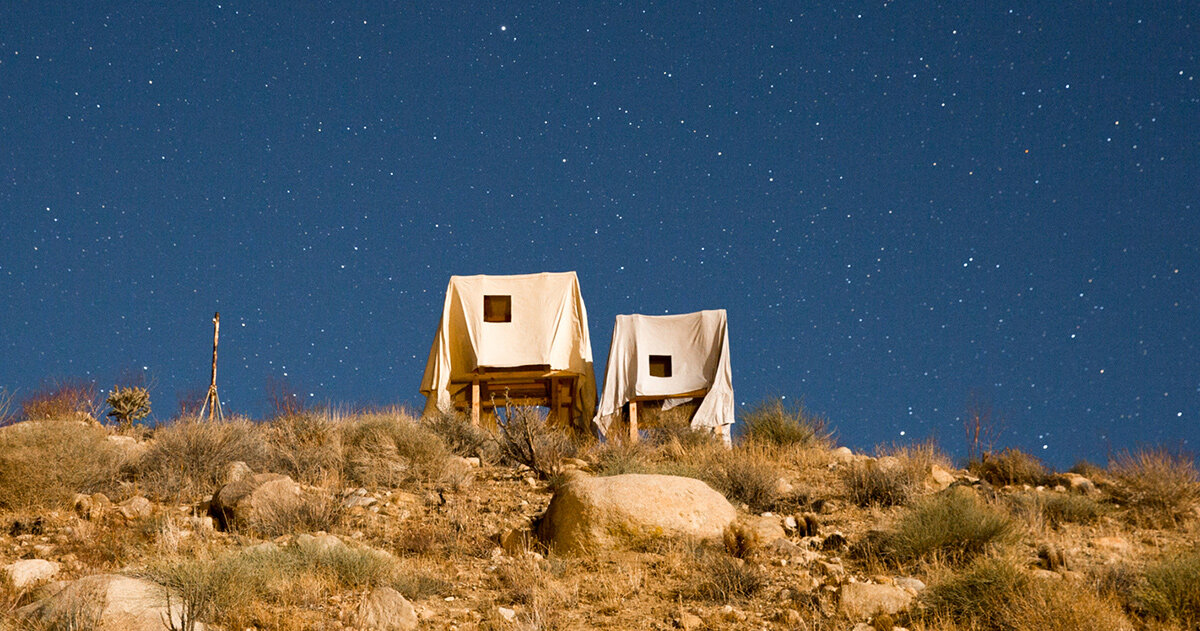
Another notable project is Ghost House, a 2018 installation in Morongo Valley where architecture serves as a record of wind. i/thee constructed two light wooden frames in the outline of small houses and draped them with custom-cut canvas sheets coated in a non-toxic adhesive. As strong mountain winds swept through the site, the fabric billowed, twisted, and hardened, preserving the imprint of a specific climatic moment. Later, cubic openings were cut into the hardened fabric, further shaping the dwelling’s form and interaction with the environment.
Key facts
- Puddle Pavilion: Bondurant, Iowa, USA | 2025 | Algae-based bio-resin
- The Dining Room: Bondurant, Iowa, USA | 2024 | Rammed earth
- ReEmber Playland: Amboy, California, USA | N/A | Interchangeable set pieces
- Agg Hab: Texas, USA | 2020 | Papier-mâché strips, recycled paper
- Peak-A-Boo: Bethel, New York, USA | 2022 | Wood laminate
- Ghost House: Morongo Valley, California, USA | 2018 | Canvas, non-toxic adhesive
Studio i/thee’s innovative approach challenges conventional architectural methods, offering a vision where design is a collaborative process with nature. Their work provides a critical perspective on material use, waste reduction, and the potential for architecture to foster deeper connections between people and their environment. For architects, designers, and urbanists, i/thee’s practice highlights the possibilities of embracing unpredictability and natural processes in design, leading to more resilient, responsive, and experientially rich built spaces. For the public, their creations offer unique environments that encourage engagement, play, and a renewed appreciation for the natural world.
Source: Designboom – https://www.designboom.com/architecture/studio-i-thee-mud-algae-wood-weather/
Source
Designboom Original publication: 2026-05-24T12:45:25+00:00
Related news

Handwoven Teak and Cord Outdoor Seating Debuts from Masaya and Abril Zepeda
Nicaraguan furniture brand Masaya has introduced two new handcrafted outdoor chairs — a rocking chair and a lounge chair — designed by…
Read more
Place in Mind: Hendricks Churchill Launches Hospitality Group to Revive Historic Properties
The architecture and interior design studio Hendricks Churchill has launched Place in Mind, a new hospitality group focused on acquiring, restoring, and…
Read more
Adalberto Dias Architects Complete Restoration of Lisbon’s Patriarchal Cathedral and Archaeological Center
The restoration of the Sé de Lisboa by Adalberto Dias Arquitecto integrates a new archaeological center, preserved cloisters, and seven centuries of…
Read more
Vantieghem Talebi’s ‘House of Cards’ Brings Timber Geometry to Belgian Family Home
A new family house in Belgium by US- and Swiss-based practice Vantieghem Talebi uses a steeply pitched, card-house-inspired form clad in Douglas-fir…
Read moreRelated wiki

Adaptive Reuse in Architecture
Reference page for reuse, retrofit, conversion, embodied carbon and design constraints.
Read more