
D1 Milano and Peter Tarka Reimagine Timekeeping with the ‘Impossible Watch’
A new collaboration between D1 Milano and digital artist Peter Tarka transforms a surreal digital composition into a wearable timepiece, featuring rotating discs instead of traditional hands.
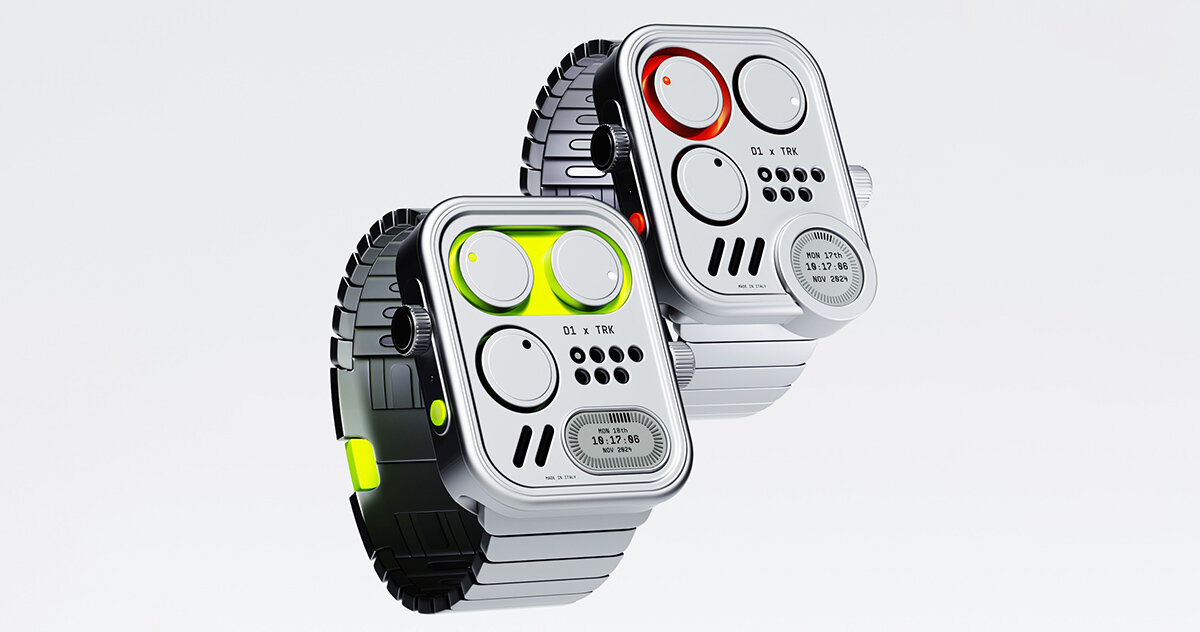
In a striking fusion of digital art and horological innovation, D1 Milano has partnered with digital artist Peter Tarka to introduce the ‘Impossible Watch.’ This new timepiece eschews conventional watch hands in favor of three rotating discs, translating Tarka’s surreal digital compositions into a tangible, wearable object.
A Wearable Digital Canvas
Peter Tarka, known for his vibrant 3D imagery characterized by floating forms and unconventional perspectives, brings his distinct visual language to the world of watchmaking. The ‘Impossible Watch’ is a direct manifestation of his digital creations, scaled down to fit on the wrist. The collaboration aims to bridge the gap between collectible art objects and functional accessories, using the familiar format of a wristwatch to present a graphic experiment in a surprisingly tangible form.
The dial of the ‘Impossible Watch’ is where this translation truly comes to life. Instead of traditional hour, minute, and second hands, three rotating discs command the display. This kinetic arrangement turns the act of reading time into a miniature visual performance. Complementing the analog display, seven dots indicate the days of the week, and a compact digital screen provides at-a-glance information for the day, date, and current time.
Materials and Functionality
D1 Milano has constructed the case and bracelet of the ‘Impossible Watch’ from lightweight aluminum. This material choice emphasizes the piece’s identity as a design accessory rather than a heavy, mechanical timepiece. The watch face is protected by a sapphire crystal featuring a blue anti-reflective coating, and it boasts 5 ATM water resistance, offering a practical level of durability for everyday use.
The watch incorporates a custom digital movement that supports its hybrid display. This allows the analog motion of the discs and the electronic digital readout to coexist within the same compact space. The overall visual effect is a unique blend of a dashboard interface, a digital artwork, and an intriguing puzzle. Blocks of color frame the display, and the discs rotate at varying speeds, making the timekeeping mechanism an integral part of the visual composition.
Bridging Screen Culture and Physical Design
The collaboration between D1 Milano and Tarka reflects a growing interest in objects that navigate the space between digital culture and physical design. While watches have historically symbolized precision, status, and personal style, the ‘Impossible Watch’ originates from a different conceptual starting point: the rendered image and the captivating visuals often found online.
Its reference point is the digital artwork, the looping visual that gains traction on social media for its intriguing blend of familiarity and physical impossibility. The ‘Impossible Watch’ thus emerges as a novel proposition from D1 Milano, a brand that champions design-forward timepieces over conventional horology. It redefines the wrist as a canvas for graphic experimentation, imbuing a digital artwork with physical presence, edges, a bracelet, and the essential function of timekeeping. Ultimately, the ‘impossible’ aspect shifts from mere illusion to exploring the potential reach of an image once it transcends the screen.
Key facts
| Feature | Detail |
|---|---|
| Name | Impossible Watch |
| Brands | D1 Milano, Peter Tarka |
| Time Display | Three rotating discs, digital screen |
| Materials | Aluminum case and bracelet, sapphire crystal |
| Water Resistance | 5 ATM |
Source: Designboom, https://www.designboom.com/design/three-rotating-discs-replace-hands-d1-milano-peter-tarka-impossible-watch/
Source
Designboom Original publication: 2026-06-23T01:15:19+00:00
Related news

Koto launches Haku, a mobile prefab hotel suite built on a wheeled chassis to bypass UK planning restrictions
UK architecture studio Koto has unveiled Haku, a fully mobile prefabricated suite that legally qualifies as a caravan, allowing landowners and hotel…
Read more
HONG Designworks Completes Private Office in Xi’an That Balances Memory, Materiality, and Long-Term Use
The Xi’an office by HONG Designworks integrates a folded steel staircase, retained furniture from a previous workspace, and a restrained purple-gray palette…
Read more
Handwoven Teak and Cord Outdoor Seating Debuts from Masaya and Abril Zepeda
Nicaraguan furniture brand Masaya has introduced two new handcrafted outdoor chairs — a rocking chair and a lounge chair — designed by…
Read more
Place in Mind: Hendricks Churchill Launches Hospitality Group to Revive Historic Properties
The architecture and interior design studio Hendricks Churchill has launched Place in Mind, a new hospitality group focused on acquiring, restoring, and…
Read moreRelated wiki

Adaptive Reuse in Architecture
Reference page for reuse, retrofit, conversion, embodied carbon and design constraints.
Read more