
Noguchi’s unbuilt playgrounds brought to life in hand-painted animated films
Five unrealized playgrounds by Isamu Noguchi become hand-painted animated films in "Noguchi's New York" at The Noguchi Museum, created by Montreal studio Eastend Western with more than 1,800 painted cels.
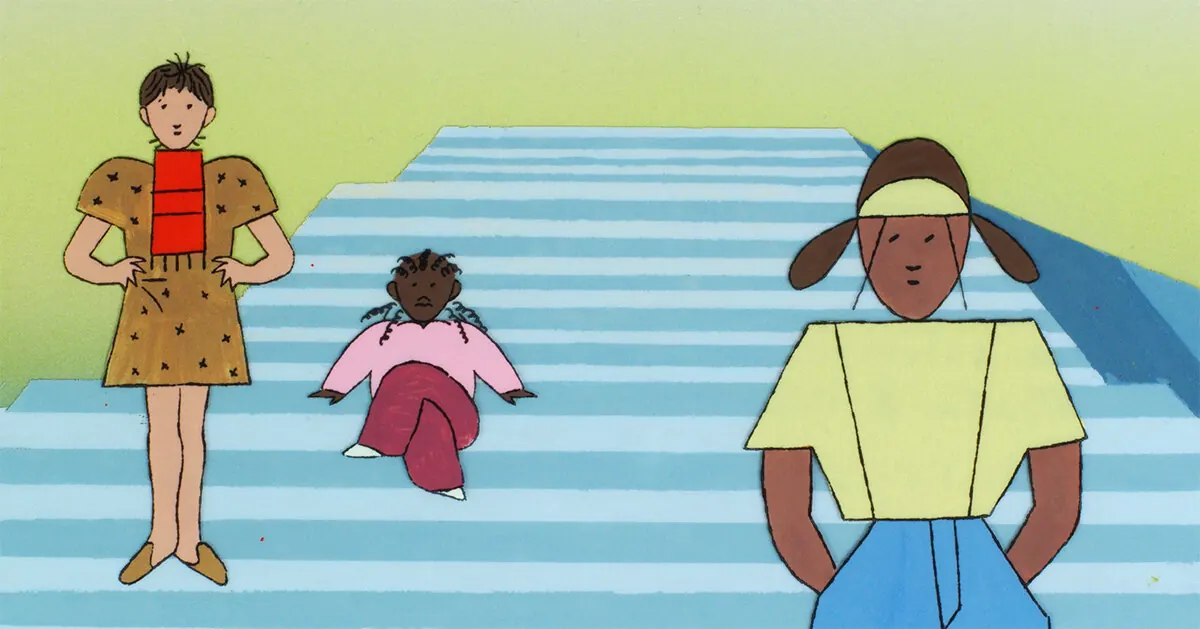
For decades, Isamu Noguchi’s unrealized playground designs survived as plaster models, drawings and blueprints — admired for their abstract sculptural beauty yet strangely detached from the purpose for which they were conceived: children at play. Now, in the Noguchi Museum’s 40th-anniversary exhibition “Noguchi’s New York,” five of those unbuilt proposals step beyond the archive through hand-painted animated films by Montreal-based studio Eastend Western.
The films reinterpret Play Mountain (1933), Playground Equipment (1940), Contoured Playground (1941), United Nations Playground (1952) and Riverside Playground (Adele Levy Memorial Playground, 1961–62). Across them, children swing from bright red climbing structures, drift across softly contoured earthworks, gather inside circular play spaces and slide through snowy landscapes. According to Designboom, which spoke with studio directors Nicolas Ménard and Jack Cunningham and curator Kate Wiener, the project grew from a curatorial problem: the surviving models “can read more like abstract sculpture than proposals for spaces,” as Wiener put it.
Five unbuilt playgrounds, five animated interpretations
The exhibition examines Noguchi’s relationship with New York City, including his long campaign for non-traditional playgrounds. Wiener told Designboom the show explores “the many ways he set out to, as he said, ‘make New York a little bit better place.'” Central to that vision was “a playscape without explicit directions where kids could explore, imagine, and discover in endless ways.”
The animated films, Wiener said, “bring these imagined spaces to life and help people better imagine what it may have been like to explore and play in them.” The five shorts do not simply show what the playgrounds looked like; they suggest how they might have been experienced.
Why animation, not a rendering
The curatorial team initially considered something closer to an architectural visualization. But Wiener noted that much remains unknown about the proposals — “their exact scale, location, materials, etc.” A polished rendering would have had to invent answers the archive does not provide.
“Animation felt like a perfect playful and timeless medium for this,” she said, preserving “a sense of openness and imagination rather than answer every question or prescribe a single interpretation.” The films never claim to reconstruct Noguchi’s proposals faithfully; instead, they inhabit them.
A hand-painted process that echoes Noguchi’s craft
Ménard and Cunningham used one of animation’s oldest techniques. Character movement was first planned digitally frame by frame, then outlines were transferred onto transparent celluloid sheets, painted by hand with vinyl acrylic paint, layered over softly airbrushed backgrounds and photographed beneath a rostrum camera. More than 1,800 individual cels were produced across the five films.
The directors deliberately left every brushstroke visible, letting the paint catch light differently from frame to frame. “Noguchi was a craftsman whose every mark was apparent on his sculptures,” they told Designboom. “We felt strongly that if we made them with a technique that would have been contemporary to his productions, we would have a better chance at creating a complementary visual world.”
The brief itself, prepared by Wiener with the history and thinking behind each playground, was, in their words, “the most fascinating brief we’ve ever received by a mile.”
Each playground gets its own atmosphere
Although the films share a visual language, each develops a distinct mood. Play Mountain imagines a magical winter day as children race down snow-covered slopes. Contoured Playground slows into a dreamlike meditation on curved earthworks turned into a snowy playscape. The United Nations Playground animation is almost architectural in its gaze, circling Noguchi’s sculptural forms, while Riverside Playground leans into environmental ambience.
The children themselves collapse time — some appear dressed in mid-century clothing, while others skateboard or wear contemporary outfits — suggesting playscapes designed to outlast any single era.
What remains unclear
The Designboom report, published August 3, 2026, does not specify the exhibition’s opening and closing dates at The Noguchi Museum in New York, nor how the films are installed — whether they run on loop alongside the models or in a separate screening space. Readers planning a visit should check the museum’s website directly for current schedules and ticket details.
Key facts at a glance
| Key fact | Detail |
|---|---|
| Exhibition | “Noguchi’s New York” at The Noguchi Museum, marking its 40th anniversary |
| Films | Five hand-painted animated shorts by Montreal studio Eastend Western |
| Technique | More than 1,800 hand-painted cels, vinyl acrylic paint, rostrum camera |
| Playgrounds covered | Play Mountain (1933) through Riverside Playground (1961–62) |
| Source | Designboom interview with Kate Wiener, Nicolas Ménard and Jack Cunningham, Aug 3, 2026 |
Source: https://www.designboom.com/art/hand-painted-animations-isamu-noguchi-unrealized-playgrounds-life-eastend-western-nicolas-menard-jack-cunningham-kate-wiener-interview/
Source
Designboom Original publication: 2026-08-03T10:50:17+00:00
Related news

How to Specify a Commercial-Grade Outdoor Swing Chair That Lasts Beyond Two Years
A procurement expert with 15 years in hospitality furniture sourcing explains why most outdoor swing chairs fail within five years of resort…
Read more
Freddie Mercury’s stage costumes go on display at V&A in free 2026 exhibition
The V&A marks the 80th anniversary of Freddie Mercury’s birth with ‘Splendid Things’, a free exhibition of eight iconic looks lent by…
Read more
Armenian Designer Shushana Khachatrian Debuts ‘The Woman’s Chair,’ a Deliberately Uncomfortable Reflection on Social Structures
Armenian designer Shushana Khachatrian's 'The Woman's Chair' uses polished stainless steel and a deliberately unstable geometry to question expectations around comfort, posture,…
Read more
27 Storeys Documentary Revisits Vienna’s Alterlaa and the Utopian Promise of Collective Living
Director Bianca Gleissinger returns to her childhood home in the Alterlaa housing complex to explore how a 1970s social housing project achieved…
Read moreRelated wiki

Adaptive Reuse in Architecture
Reference page for reuse, retrofit, conversion, embodied carbon and design constraints.
Read more