
OPAL Designs Mass-Timber Farming Education Center in Maine
US architecture studio OPAL has completed the Smith Center for Education and Research, a mass-timber facility in Maine designed to be highly energy-efficient and inspired by local agricultural buildings.
OPAL Designs Mass-Timber Farming Education Center in Maine
SLUG: opal-mass-timber-farming-education-center-maine
EXCERPT: US architecture studio OPAL has completed the Smith Center for Education and Research, a mass-timber facility in Maine designed to be highly energy-efficient and inspired by local agricultural buildings.
CATEGORY: projects
TAGS: OPAL, mass timber, sustainable design, educational buildings, architecture, Maine, agrarian architecture
SEO_TITLE: OPAL’s Mass-Timber Farming Education Center: Tradition Meets Modern Sustainability in Maine
SEO_DESCRIPTION: Explore the Smith Center for Education and Research by OPAL, a mass-timber farming education facility in Maine that blends traditional barn forms with modern energy-efficient design.
MEDIA_QUERY: OPAL Smith Center for Education and Research mass timber farming education center Freeport Maine
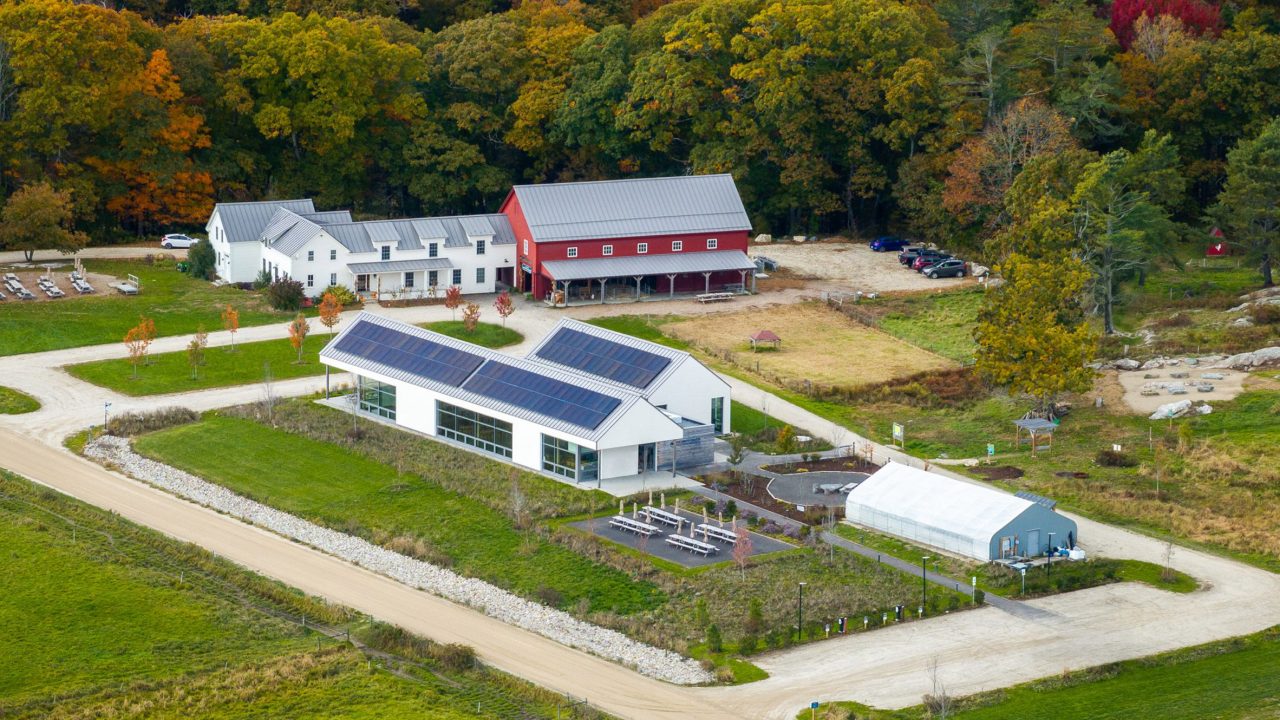
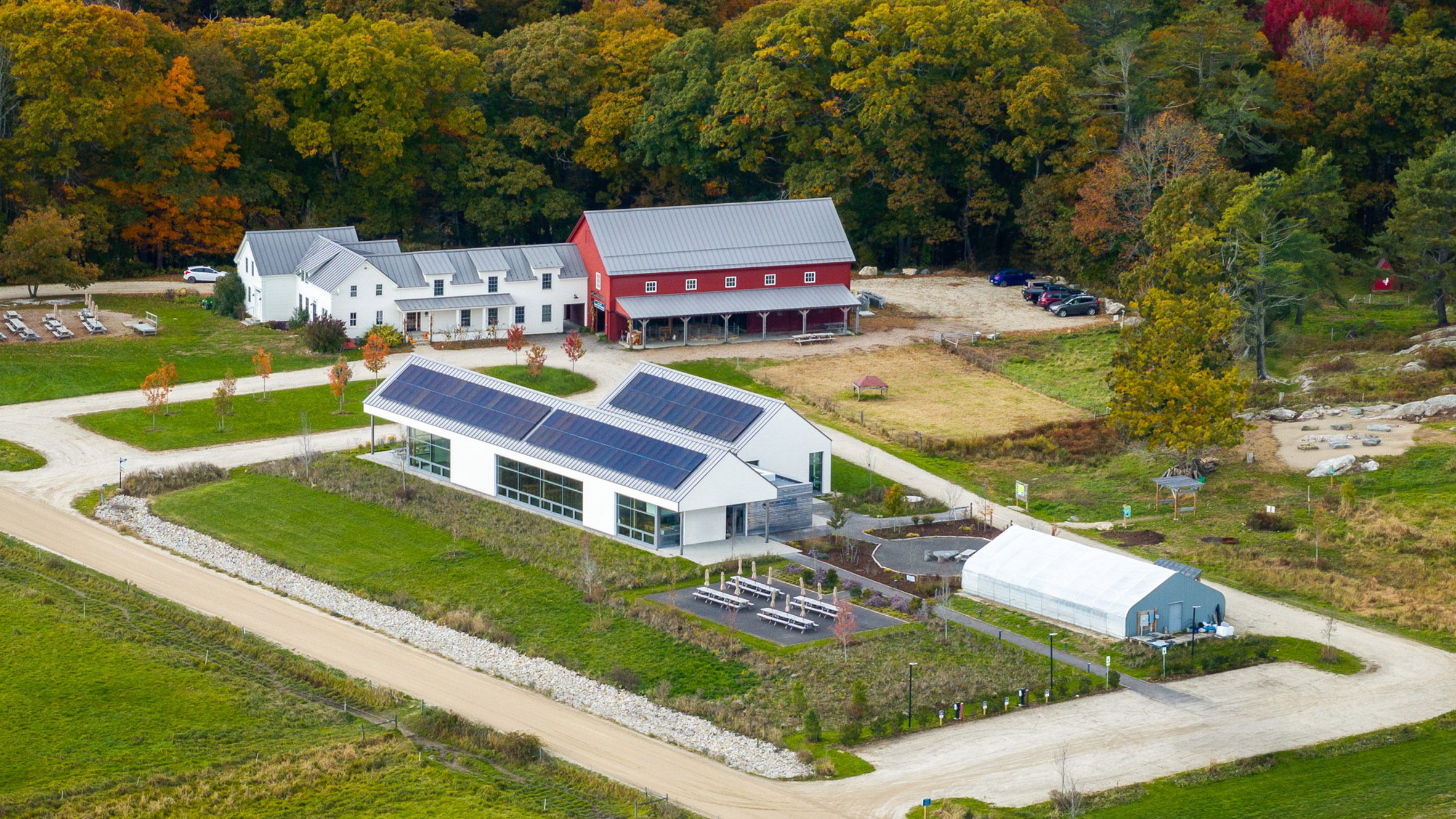
IMAGE_ALT: Exterior view of the Smith Center for Education and Research, featuring white clapboard and unfinished cedar siding, with large south-facing glazing.
The Smith Center for Education and Research, also known as Grange Life, is a new farming research and education facility in Freeport, Maine, designed by US architecture studio OPAL. The 8,800-square-foot (817-square-meter) building is situated on the 500-acre campus of the Wolfe’s Neck Center for Agriculture and the Environment, a non-profit farming organization. OPAL, which is based in Belfast, Maine, has focused on creating a building that is ecologically designed from its foundation, with the goal of offsetting its embodied carbon throughout its lifespan.
Drawing inspiration from the region’s agricultural heritage, the center’s design incorporates mass timber construction and is modeled after local barns. This approach aims to weave together tradition with a modern sensibility, reflecting the agrarian context of its surroundings. The studio stated that the building’s superinsulated, all-wood assembly significantly reduces energy consumption and sequesters carbon. Furthermore, climate-specific, triple-glazed curtain walls are designed to capture more solar energy than is lost through heat.
Key facts
- Feature: Detail
- Project Name: Smith Center for Education and Research (Grange Life)
- Architect: OPAL
- Location: Freeport, Maine, USA
- Building Type: Farming research and education center
- Construction: Mass timber
- Area: 8,800 sq ft (817 sq m)
- Published Date: 2026-05-25
Architectural Inspiration and Form
The architectural concept for the Smith Center is deeply rooted in the rich tradition of New England agricultural building forms, while simultaneously integrating a modernist aesthetic. The design features two primary gabled forms, which are scaled to mediate between the proportions of a traditional farmhouse and a larger dairy barn found nearby. These forms also follow the footprint of a former dairy barn on the site.
The exterior of the building is clad in a neutral palette, comprising horizontal white clapboard and unfinished cedar siding. This material choice helps the structure blend seamlessly into the agrarian landscape. Large expanses of south-facing glazing open up the interior spaces, offering expansive views of the surrounding fields and the ocean beyond.
Sustainability and Energy Performance
A core objective of the Smith Center’s design was to achieve significant reductions in energy use, targeting over 60% less energy than comparable buildings. The superinsulated, all-wood construction is central to this goal. The dual-pitched south-facing roofs are equipped with a 44 kW solar array, contributing to the building’s energy generation.
The studio highlighted that the building’s design “seamlessly integrates building ecology without sacrificing light, function or spatial quality.” The reduction in energy use is expected to allow the building to pay back its embodied carbon debt over its usable lifetime. This approach underscores a commitment to ecological design principles, demonstrating that high performance and aesthetic quality can be achieved in tandem.
Interior Layout and Functionality
Internally, the parallel gables create distinct peaked classroom spaces. These are connected by a lower, flat-roofed section that houses the building’s service areas. The circulation axes are oriented east to west, linking parking areas, new garden spaces, and existing farms with a central social hub. This hub is designed to be flexible, accommodating seminars, conferences, community events, and youth camps.
The focal point of the interior is a large meeting space on the south side. This space prominently showcases the glued-laminated timber (glulam) members made from fir, alongside unfinished pine ceiling slats, celebrating the building’s primary material. Concrete floors extend from this meeting room through a commercial kitchen, enabling the preparation of meals using produce from the farm, and continuing into the classrooms. The classrooms feature casework made from birch plywood. Galvanized steel awnings mark the entrances, and a reception desk crafted from reclaimed wood adds a sustainable and welcoming touch.
Community and Context
The Smith Center serves as a vital hub for the Wolfe’s Neck Center for Agriculture and the Environment, supporting its mission of farming education and research. The building’s flexible design allows it to host a variety of activities, fostering community engagement and educational opportunities. By integrating the building with the surrounding agricultural operations, the project aims to create a symbiotic relationship between the built environment and its productive landscape.
The project contributes to a growing trend of sustainable and contextually sensitive design in Maine. Other recent educational and research buildings in the state include the cedar-clad welcome center for the Katahdin Woods and Waters National Monument by Saunders Architecture, an ecology center for the College of the Atlantic by Susan T Rodriguez Architecture & Design, and the forthcoming GEM Factory of the Future at the University of Maine by Grimshaw.
The design aims to meet the clients’ needs for function and quality while achieving substantial energy savings. The success of the project lies in its ability to integrate ecological considerations without compromising the quality of light, function, or spatial experience within the building.
Source: Dezeen
https://www.dezeen.com/2026/05/25/smith-center-education-research-opal-maine/
Source
Dezeen Original publication: 2026-05-25T17:00:48+00:00
Related news

SIITUA III to Gather International Researchers on Territory, Urbanism, and Architecture in Lima
The third edition of the International Seminar on Research in Territory, Urbanism, and Architecture (SIITUA III) will take place in Lima, organized…
Read more
Christopher Kane brings streamlined, heritage-driven vision to Mulberry in London Fashion Week debut
The Scottish designer presented his first collection for the British leather goods house at London Fashion Week, blending sharp tailoring, archival references…
Read more
When Film Directors Become Interior Designers: Guadagnino, Lynch, Anderson and Almodóvar Step Off Screen
From Luca Guadagnino’s Zara Home collection to David Lynch’s Paris club and Wes Anderson’s train carriage, a wave of collaborations is blurring…
Read more
Jesus Mari Lazkano Examines Changing Landscapes Through Painting and Animated Film at Basque Luxury Studio
The Basque artist’s exhibition ‘Azken Natura’ brings together six large-scale paintings and a 22-minute animated film that traces the melting of the…
Read moreRelated wiki

Adaptive Reuse in Architecture
Reference page for reuse, retrofit, conversion, embodied carbon and design constraints.
Read more