
Rethinking Digital Fabrication: Oberdoerfer & Krebs Bend 3D Prints into Furniture
Danish design duo Oberdoerfer & Krebs are challenging the static nature of 3D-printed furniture by reheating and hand-bending prints to create unique, dynamic seating.
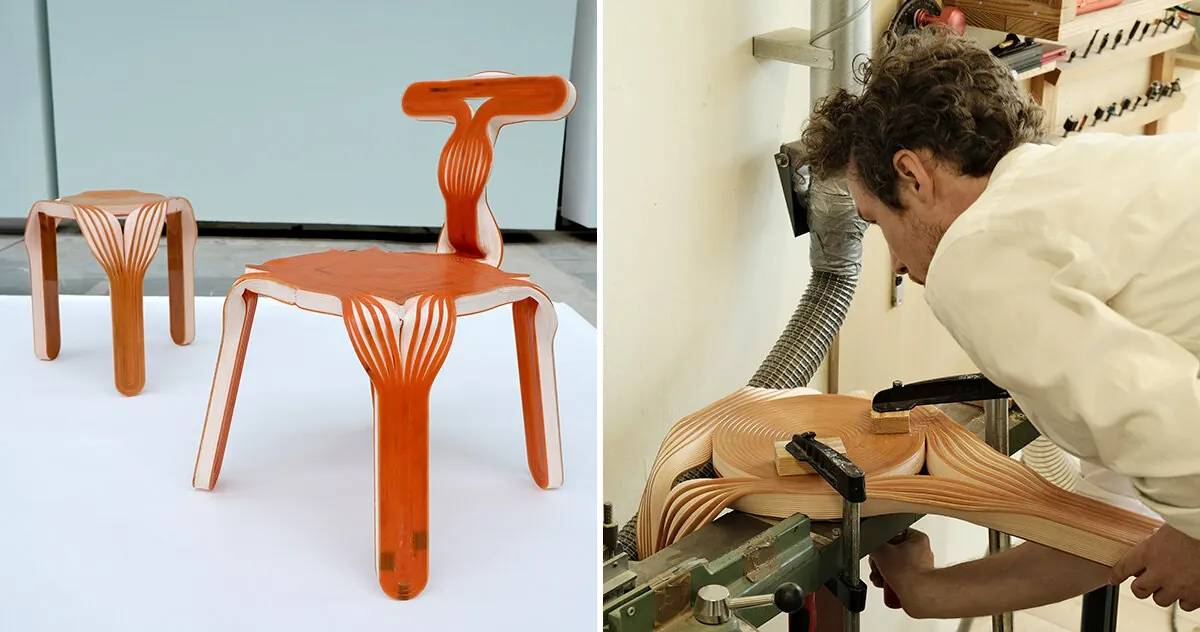
In a move that redefines the potential of digital fabrication, Danish design studio Oberdoerfer & Krebs is introducing a novel approach to furniture creation. Their Bend Chair and Bend Stool, presented at Ukurant during Copenhagen’s 3daysofdesign, are not merely products of a 3D printer but are instead finished through a process of reheating and manual shaping. This innovative method allows for a more fluid and tactile interaction with the digital manufacturing process, moving beyond the often-uniform output of traditional 3D printing.
Interrupting the Digital Flow
Traditionally, large-scale 3D extrusion in furniture design results in a continuous, side-profile silhouette. Oberdoerfer & Krebs, however, view the 3D printing process as an opportunity for intervention. Their work treats the toolpath not as a final instruction, but as a blueprint for subsequent manipulation. By integrating pre-programmed bend zones into the printing sequence, the studio can selectively soften specific areas of the printed object. This allows for a manual bending process where human touch and force complete the form, creating a tension between programmed geometry and the artist’s hand.
Material Innovation with LW-PLA
The studio utilizes expandable colorFabb LW-PLA filament, a material that can foam and expand in the middle layers during printing. This not only reduces material consumption but also significantly alters the object’s behavior based on temperature and printing strategy. The same filament can yield lighter, softer, or more rigid results, enabling the designers to sculpt through material states rather than solely through material changes. This adaptability provides a unique pathway for designing objects with nuanced physical properties.
From Graduation Project to Design Statement
The Bend Stool originated as Jasper Krebs’s third-semester project at the Royal Danish Academy in Copenhagen. It served as a testing ground for ideas that have since evolved into larger research initiatives. The combination of 3D printing with post-print reheating and bending introduces a fresh formal language into a field that can sometimes appear visually repetitive. The intricacy of the design lies first within the digital toolpath and then manifests through a simple, deliberate gesture after printing.
Beyond the Bend Chair
Oberdoerfer & Krebs’s exploration of control and form extends to other projects. Their UpsideDown series features wall-mounted racks created by intentionally deviating the 3D printer’s path. During printing, the nozzle extrudes plastic into open air, allowing it to sag under its own weight before the printer resumes its programmed course. Once cooled, the object is flipped, and these deliberate sags transform into functional hooks. This project playfully embraces the accidental forms that additive manufacturing often seeks to avoid, turning “failed” lines into useful elements.
Human Layers: A Fusion of Craft and Technology
For the Biennale for Craft & Design, the duo presented Human Layers, a series of vases that delve into vessel-making while retaining their focus on process. Inspired by the ikat textile dyeing technique, the vases translate the logic of pre-weaving pattern planning into pellet-extrusion 3D printing. Color is introduced through controlled flow, timing, and human intervention. Oberdoerfer & Krebs developed a method for managing multiple colors in pellet-based printing, calculating the precise placement of each hue on the surface. PLA pellets are tinted with liquid masterbatch, weighed, and added at specific intervals during the print. The resulting pieces exhibit a visual complexity where color shifts echo woven structures, harmonizing the rhythm of the printer with the judgment of the maker.
A New Frontier for Digital Fabrication
Across projects like Bend Chair, Bend Stool, UpsideDown, and Human Layers, Oberdoerfer & Krebs treat large-scale 3D printing as a field ripe for numerous small decisions, rather than a rigid, closed system. Their work expands the capabilities of printed objects through post-print bending, off-path extrusion, material foaming, and timed color applications. These innovations suggest a future for digital fabrication where craft is not lost but rather integrated into the machine’s process, particularly in the stages where the creation can still be guided and shaped.
Key facts
| Feature | Description |
|---|---|
| Designers | Oberdoerfer & Krebs (Jasper Krebs, Bruno Oberdoerfer) |
| Process | 3D printing followed by reheating and hand-bending |
| Materials | colorFabb LW-PLA filament |
| Featured Projects | Bend Chair, Bend Stool, UpsideDown, Human Layers |
| Presentation | Ukurant, 3daysofdesign Copenhagen; Biennale for Craft & Design |
This development is significant for architects and designers as it showcases a tangible method for infusing traditional craftsmanship and artistic intuition into mass-produced digital objects. It offers a pathway to create furniture and objects with unique character and tactile qualities, moving beyond the purely utilitarian output of some 3D printing applications and opening new avenues for material exploration and design expression.
Source: Designboom – https://www.designboom.com/design/hand-bent-3d-printing-oberdoerfer-krebs-digital-fabrication-bend-chair-ukurant-3daysofdesign/
Source
Designboom Original publication: 2026-06-27T19:45:36+00:00
Related news
Koto launches Haku, a mobile prefab hotel suite built on a wheeled chassis to bypass UK planning restrictions
UK architecture studio Koto has unveiled Haku, a fully mobile prefabricated suite that legally qualifies as a caravan, allowing landowners and hotel…
Read more
HONG Designworks Completes Private Office in Xi’an That Balances Memory, Materiality, and Long-Term Use
The Xi’an office by HONG Designworks integrates a folded steel staircase, retained furniture from a previous workspace, and a restrained purple-gray palette…
Read more
Handwoven Teak and Cord Outdoor Seating Debuts from Masaya and Abril Zepeda
Nicaraguan furniture brand Masaya has introduced two new handcrafted outdoor chairs — a rocking chair and a lounge chair — designed by…
Read more
Place in Mind: Hendricks Churchill Launches Hospitality Group to Revive Historic Properties
The architecture and interior design studio Hendricks Churchill has launched Place in Mind, a new hospitality group focused on acquiring, restoring, and…
Read moreRelated wiki
Adaptive Reuse in Architecture
Reference page for reuse, retrofit, conversion, embodied carbon and design constraints.
Read more