3D-printed concrete sculptures by Matyáš Chochola reinterpret Baroque allegories at Frieze Sculpture 2026
Czech artist Matyáš Chochola presents three large-scale 3D-printed concrete works at Frieze Sculpture 2026 in London, blending classical architectural fragments with Brutalism, sci-fi, and digital fabrication.
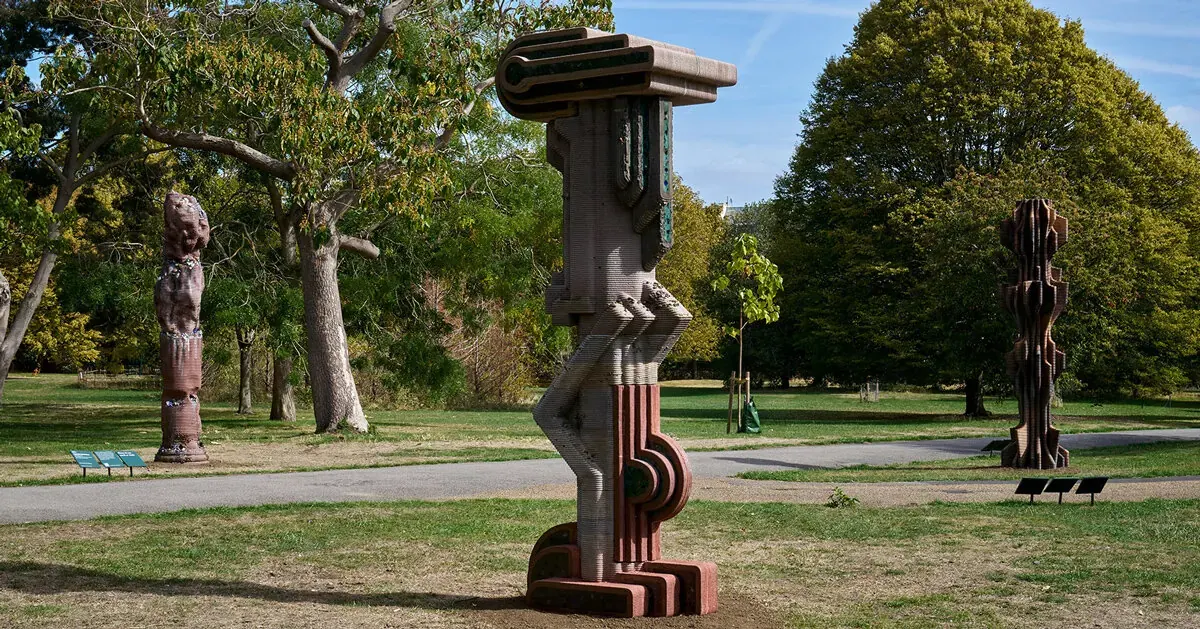
Czech artist Matyáš Chochola has unveiled three 3D-printed concrete sculptures at Frieze Sculpture 2026 in London, on view in The Regent’s Park until November 1, 2026. The works — BRUTALIST, METEOR, and MACE II — combine digital modeling, robotic fabrication, and manual finishing, bringing together architectural fragments, classical references, science fiction, and irregular forms. Each sculpture stands approximately three to four meters tall and weighs around one ton.
The pieces are part of Virtues and Vices of Our Time: 300 Years Later, a series of twelve works that reinterprets the Baroque allegories originally carved by Matthias Bernard Braun around 300 years ago. Braun’s 24 sandstone figures were created for Kuks Hospital in eastern Bohemia, where they formed part of an architectural ensemble representing the Christian moral order. Today, the original sandstone figures are protected inside the complex’s lapidarium, while concrete casts occupy their former outdoor positions. Chochola’s series continues this dialogue between original, reproduction, and reinterpretation, drawing on references to Antiquity, Cubism, Brutalism, mythology, science fiction, and contemporary popular culture.
Key facts
| Item | Detail |
|---|---|
| Artist | Matyáš Chochola |
| Exhibition | Frieze Sculpture 2026, The Regent’s Park, London (until November 1, 2026) |
| Works on display | BRUTALIST, METEOR, MACE II |
| Fabrication partner | Voxell (Czech Republic) |
| Technique | 3D concrete printing with robotic fabrication and hand finishing |
| Scale | Each sculpture approx. 3–4 m tall, weighing about 1 ton |
Digital fabrication and hand intervention combined
Developed with Czech company Voxell, the series uses 3D concrete printing as a framework for combining robotic fabrication with manual intervention. The printing process employs different orientations, non-planar paths, large overhangs supported by lightweight clay aggregate, and programmed irregularities. After printing, the concrete is ground, carved, and polished, while glass, bronze, brass, and pigments are added by hand.
This hybrid approach allows the artist to treat the printed concrete as a raw material rather than a finished product. The resulting works bear visible traces of both machine precision and human touch, reflecting Chochola’s interest in pushing the boundaries of digital fabrication into the realm of sculpture.
The three sculptures and their references
At Frieze Sculpture, BRUTALIST, METEOR, and MACE II form what Chochola describes as a ‘solemn triad.’ BRUTALIST combines a deconstructed classical column with Brutalism, the Memphis Group, twentieth-century architecture, and cinematic visions of the future. The work reads as both a fragment of a lost building and a futuristic monument.
METEOR connects classical architecture with cosmic and geological references. Inspired by Tomanowos, a meteorite discovered in Oregon and known by that name to the Chinook people, the sculpture incorporates hand-embedded glass shards into its concrete surface. The result suggests a collision between ancient stone and extraterrestrial material.
MACE II, a development of MACE I, draws on Brutalist architecture, fantasy, and 1980s science fiction. Its angular structure references both a monumental weapon and a futuristic technological relic. Printed in anthracite-tinted concrete, it is finished with metallic copper powder, giving it a metallic sheen that shifts with the light.
Context within the broader exhibition
Curated by Fatoş Üstek, Frieze Sculpture 2026 explores what the curator describes as a ‘vibrant hybrid ecology,’ placing sculpture in relation to its surrounding landscape and audience. The outdoor setting of The Regent’s Park provides a natural backdrop for the works, which are installed among the trees and paths. The combination of heavy concrete forms and the park’s greenery creates a tension between the industrial and the organic, the permanent and the temporary.
For architects and designers following developments in digital fabrication, Chochola’s sculptures offer a compelling example of how 3D concrete printing can move beyond building components into expressive, large-scale art. The works demonstrate that robotic fabrication does not have to result in uniform, machine-made objects; instead, it can serve as a starting point for material experimentation and handcraft.
What this means for the field
The Virtues and Vices of Our Time series is significant for its layered approach to material and meaning. By referencing Baroque allegories through the lens of contemporary digital fabrication, Chochola connects historical craftsmanship with current technological possibilities. The use of 3D concrete printing — a technique more commonly associated with construction and architecture — for artistic expression highlights the growing crossover between building technology and sculpture.
For readers following architectural technology, the project shows how robotic fabrication can be adapted for non-standard, one-off works that require both precision and artistic intervention. The combination of printed concrete with hand-applied glass, metal, and pigments suggests a model for future collaborations between digital tools and traditional craftsmanship.
Source: Designboom — https://www.designboom.com/art/3d-printed-concrete-sculptures-classical-fragments-sci-fi-forms-frieze-sculpture-matyas-chochola/
Source
Designboom Original publication: 2026-10-03T20:35:51+00:00
Related news
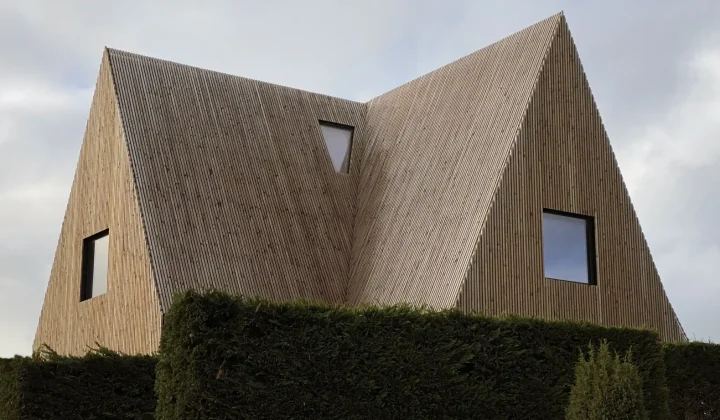
Vantieghem Talebi’s ‘House of Cards’ Brings Timber Geometry to Belgian Family Home
A new family house in Belgium by US- and Swiss-based practice Vantieghem Talebi uses a steeply pitched, card-house-inspired form clad in Douglas-fir…
Read more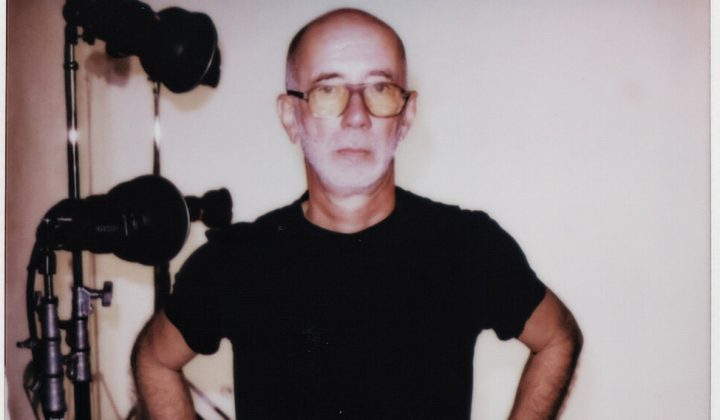
Carsten Höller Deploys World’s Largest Polaroid Camera for a Series of Artistic Games Across Europe
The artist’s 20-minute documentary, released by the Polaroid Foundation, follows the Polaroid 20×24 camera through Europe as friends and collaborators submit to…
Read more
CF Møller transforms historic psychiatric hospital into Mind Museum on Funen
Danish studio CF Møller has completed the Mind Museum in Middelfart, Denmark, converting a former psychiatric hospital building from 1888 into a…
Read more
Maze Studio Uses Gradual Ring Compression to Turn a 25-Square-Meter Café’s Level Change into a Spatial Experience
In Mashhad, Iran, Maze Studio transformed a 25-square-meter café’s elevation difference from the sidewalk into a continuous spatial sequence of rings that…
Read moreRelated wiki
Adaptive Reuse in Architecture
Reference page for reuse, retrofit, conversion, embodied carbon and design constraints.
Read more