Outdated Operations Cost Architecture Firms Time and Money
Many architecture firms are hindered by inefficient administrative and operational systems, leading to lost productivity, increased stress, and financial drawbacks, despite their design prowess.

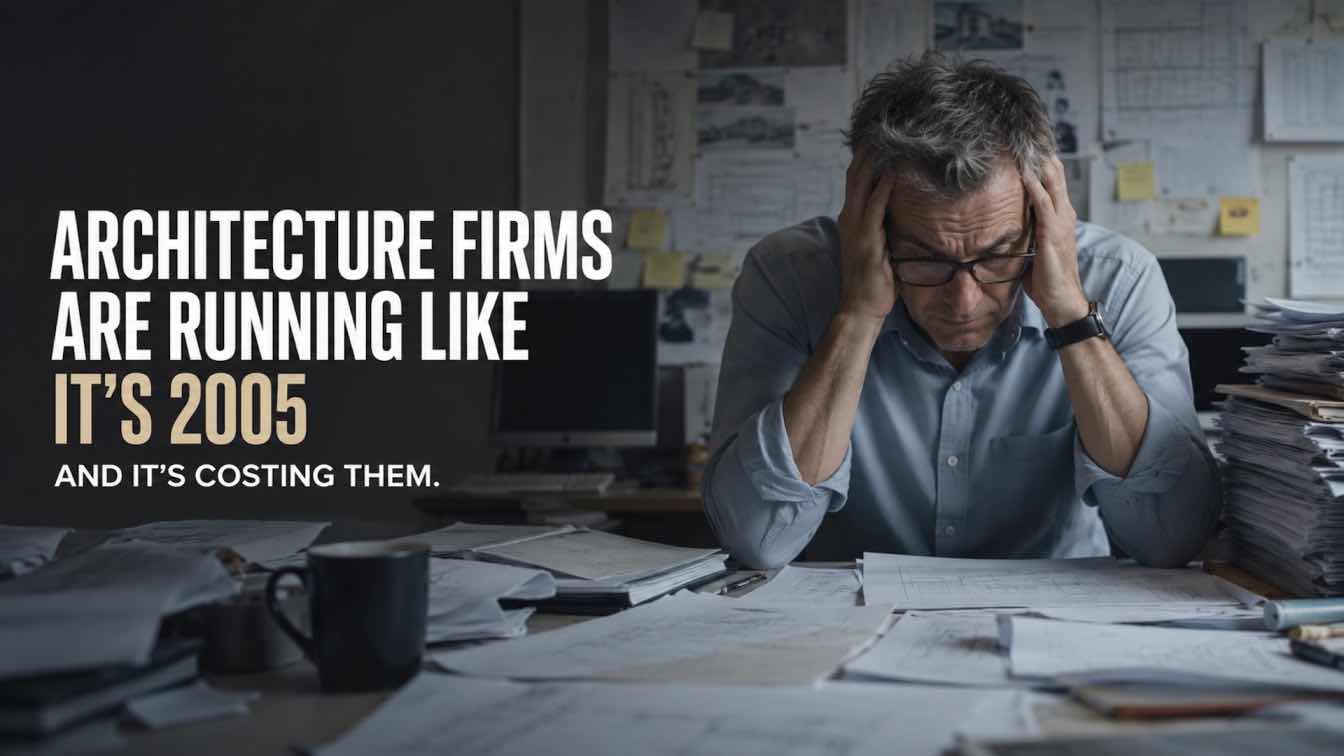
Architecture firms, renowned for their creative problem-solving in design, often grapple with internal operational systems that lag significantly behind their design capabilities. This disparity, where brilliant design work coexists with outdated administrative infrastructure, is proving to be a costly oversight.
The operational chaos typically manifests in scattered project files across personal drives, reliance on outdated spreadsheet systems for billing, and poorly managed physical inventory of materials and archives. While the focus remains on the creative output, these behind-the-scenes inefficiencies quietly accumulate problems, impacting the firm’s overall performance and profitability.
Operational Rigor Underestimated
A contributing factor to this operational deficit is a prevalent culture within some firms that views operational rigor as secondary to creative pursuits. Architects are trained to tackle complex spatial and systemic challenges, yet their internal business systems often remain disorganized, not due to a lack of individual capability but because operational discipline is not prioritized. This can lead to significant time wastage in searching for files, resolving avoidable billing discrepancies, and onboarding new staff without proper documentation.
Many mid-sized firms still see principals deeply involved in administrative tasks that could be delegated or automated, highlighting a missed opportunity for scaling and efficiency. The core principle is that robust operations do not impede good design; rather, they create the necessary space and stability for it to flourish.
Inventory Management Challenges
Architecture practices accumulate substantial physical assets, including sample libraries, physical models, large-format prints, equipment, and decades of archived materials. The management of this physical inventory is frequently handled poorly or not at all. This poses significant challenges during office relocations, project handoffs, or when clients request information from past projects. Questions like “Where is it?”, “Who has it?”, and “Is it still here?” become recurring issues. Firms operating across multiple locations or in high-cost real estate markets are increasingly turning to offsite storage solutions to manage archives and physical models, thereby freeing up valuable studio space for active work.
Underutilization of Technology
A significant issue is the underuse of technology on the operational side. Project management tools are often adopted, used inconsistently for a short period, and then abandoned under pressure from deadlines. In contrast, firms that have committed to integrating AI-driven operational systems are seeing substantial benefits. These systems handle repetitive administrative tasks such as scheduling, resource allocation, tracking project progress against budgets, and flagging potential project deviations. While not glamorous, these applications are crucial for saving time and reducing the low-level stress associated with uncertainty in project status.
Resistance to technology adoption often stems from a perception that increased automation compromises the creative nature of the practice. However, this presents a false dichotomy. The goal is not to automate the design process itself but to streamline the administrative and operational components that do not require creative judgment.
Client Communication Gaps
The way firms communicate with clients during projects is often improvised rather than systematized. This can result in ad-hoc update emails, meeting notes scattered across inboxes, and verbal decisions that are not formally documented. Clients notice this inconsistency, leading to increased chase for information, confusion about points of contact, and a perception of disorganization. Systematizing client communication, rather than making it impersonal, ensures that processes are followed, preventing critical information from falling through the cracks and fostering stronger client relationships built on reliability.
A Well-Operated Consultancy Model
The ideal vision for an architecture practice mirrors that of a well-operated consultancy: clear processes, thorough documentation, technology handling administrative burdens, and effectively managed physical and digital assets. In such an environment, creative work takes center stage because operational noise is minimized. This is not an unattainable ideal; firms that recognize that running a successful business and delivering excellent design are complementary, not competing, priorities are positioned for greater success than those who continue to treat operations as an afterthought. Implementing these changes simply requires a conscious decision to prioritize operational excellence.
Key facts:
| Aspect | Challenge | Solution |
|—|—|—|
| Operations | Outdated systems, scattered files, inefficient billing | Modern operational systems, AI tools |
| Inventory | Poor management of physical assets | Offsite storage, digital inventory |
| Technology | Underuse of project management and AI tools | Consistent integration and adoption |
| Client Communication | Improvised and inconsistent updates | Systematized communication processes |
Source: Amazing Architecture – https://amazingarchitecture.com/articles/architecture-firms-are-running-like-its-2005-and-its-costing-them
Datos clave
| Punto | Detalle |
|---|---|
| Fuente | Amazing Architecture |
| Fecha | 2026-06-11T21:20:58+00:00 |
| Tema | Architecture Firms Are Running Like It's 2005 and It's Costing Them |
Source
Amazing Architecture Original publication: 2026-06-11T21:20:58+00:00
Related news

Koto launches Haku, a mobile prefab hotel suite built on a wheeled chassis to bypass UK planning restrictions
UK architecture studio Koto has unveiled Haku, a fully mobile prefabricated suite that legally qualifies as a caravan, allowing landowners and hotel…
Read more
HONG Designworks Completes Private Office in Xi’an That Balances Memory, Materiality, and Long-Term Use
The Xi’an office by HONG Designworks integrates a folded steel staircase, retained furniture from a previous workspace, and a restrained purple-gray palette…
Read more
Handwoven Teak and Cord Outdoor Seating Debuts from Masaya and Abril Zepeda
Nicaraguan furniture brand Masaya has introduced two new handcrafted outdoor chairs — a rocking chair and a lounge chair — designed by…
Read more
Place in Mind: Hendricks Churchill Launches Hospitality Group to Revive Historic Properties
The architecture and interior design studio Hendricks Churchill has launched Place in Mind, a new hospitality group focused on acquiring, restoring, and…
Read moreRelated wiki
Adaptive Reuse in Architecture
Reference page for reuse, retrofit, conversion, embodied carbon and design constraints.
Read more