
SO–IL Unlocks Housing Potential in New York’s Zoning Labyrinth
Brooklyn-based firm Solid Objectives Idenburg Liu (SO–IL) is challenging New York City's restrictive zoning laws, transforming them from constraints into opportunities for innovative and community-focused housing designs.
New York City’s housing landscape, often characterized by a perceived scarcity of land, affordability, and supply, is deeply shaped by a century of layered zoning and building codes. Jing Liu, a founding partner at the Brooklyn-based firm Solid Objectives Idenburg Liu (SO–IL), describes this regulatory environment as an “algorithmic” system. While originally intended to promote collective health and well-being through density, light, and air regulation, these codes have frequently resulted in housing that prioritizes efficiency and demand over livability and occupant experience.
For over 15 years, SO–IL, led by Jing Liu and her husband Florian Idenburg, has been meticulously examining these zoning and building codes. Instead of viewing them solely as limitations, the firm approaches them as a source of latent possibilities. They identify “negative laws”—those dictating what cannot be done—and explore the critical gaps left for inventive solutions. By dedicating time, resolve, creativity, and funding, SO–IL has been able to exploit these loopholes, reworking requirements for egress, light, and outdoor space to conceive alternative housing models.
Por que importa
These innovative models aim to enhance access to natural light, airflow, green spaces, street life, and neighborly connections. More profoundly, they seek to create housing that reflects aspirations for identity and community. “Houses and housing are the envelopes of our existence,” Liu stated, explaining they are the containers for “who we want to be and how we want to be together.”
Key facts
| Project Name | Location | Completion Year(s) | Developer |
| :—————— | :———— | :—————– | :———- |
| 450 Warren Street | Brooklyn | (Not specified) | Tankhouse |
| 9 Chapel Street | Brooklyn | 2024 | Tankhouse |
| 144 Vanderbilt Ave. | Fort Greene, Brooklyn | 2025 | Tankhouse |
Recent Implementations in Brooklyn
SO–IL has recently brought these concepts to fruition in three Brooklyn projects developed by Tankhouse, a firm led by Sam Alison-Mayne and Sebastian Mendez. The projects—450 Warren Street, 9 Chapel Street, and 144 Vanderbilt Avenue—replace conventional, sealed apartment blocks with buildings that are notably thinner, more porous, and more socially integrated, employing strategies such as exterior circulation, courtyards, and thoughtfully angled floorplans. While sharing common principles, Liu emphasizes that these are not universal solutions but rather contributions to a more varied and interesting housing landscape.
9 Chapel Street: A Response to a Complex Site
Completed in 2024, 9 Chapel Street is situated on a challenging triangular site between major arteries leading to the Brooklyn and Manhattan Bridges. Its neighbors include a police station, a social services building, a cathedral, and the New York City College of Technology campus. Liu described the site as “leftover space,” necessitating a distinct approach to materiality. To counter the perceived lack of “airiness” in the surrounding structures, SO–IL clad the building in perforated, rippled metal screens. Balconies, terraces, window gardens, an exterior stair, and protected walkways extend this sense of lightness vertically, promoting outdoor engagement and neighborly interaction. The design team posed the question: “How do we stretch and make that community space and make entering into your domestic space feel generous?”
The building’s form is a dynamic composition of stepped and angled volumes, conceived during the pandemic through remote collaboration. The metaphor of a box scattered upon landing guided the design’s porosity, gaps, and irregular room layouts, which Liu noted as “very joyful.”
144 Vanderbilt Avenue: A Playful Pink Presence
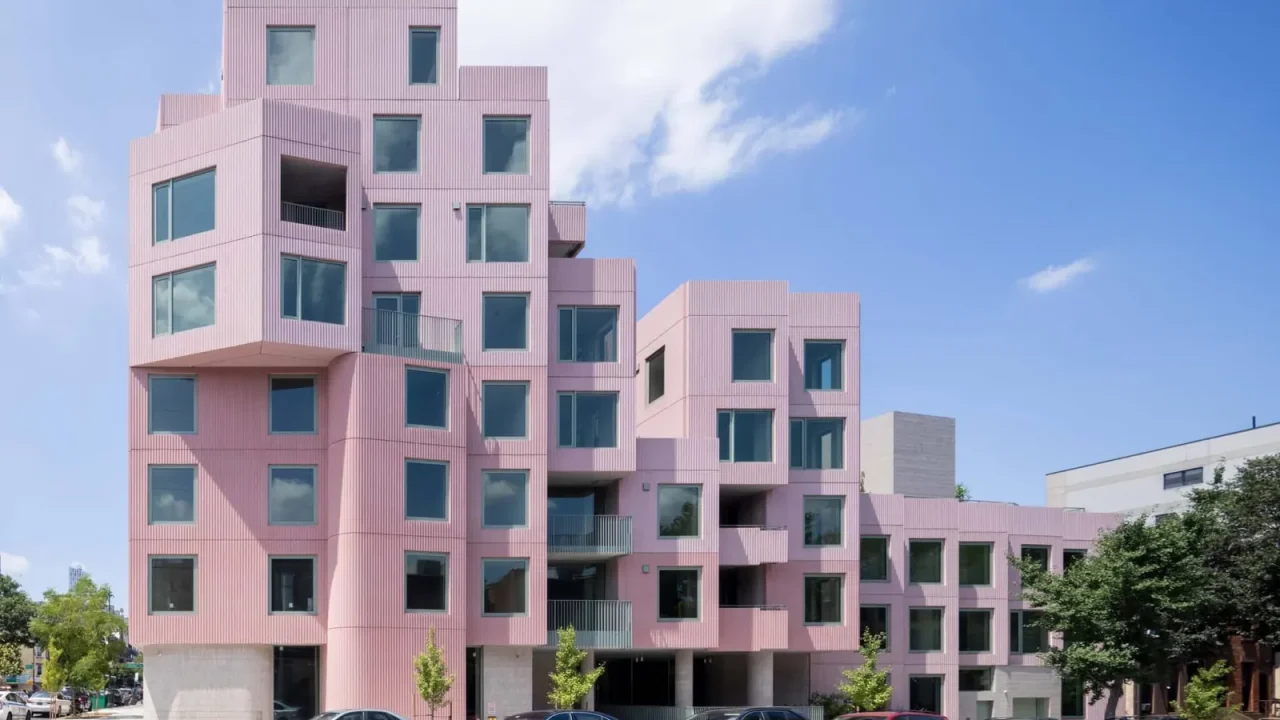
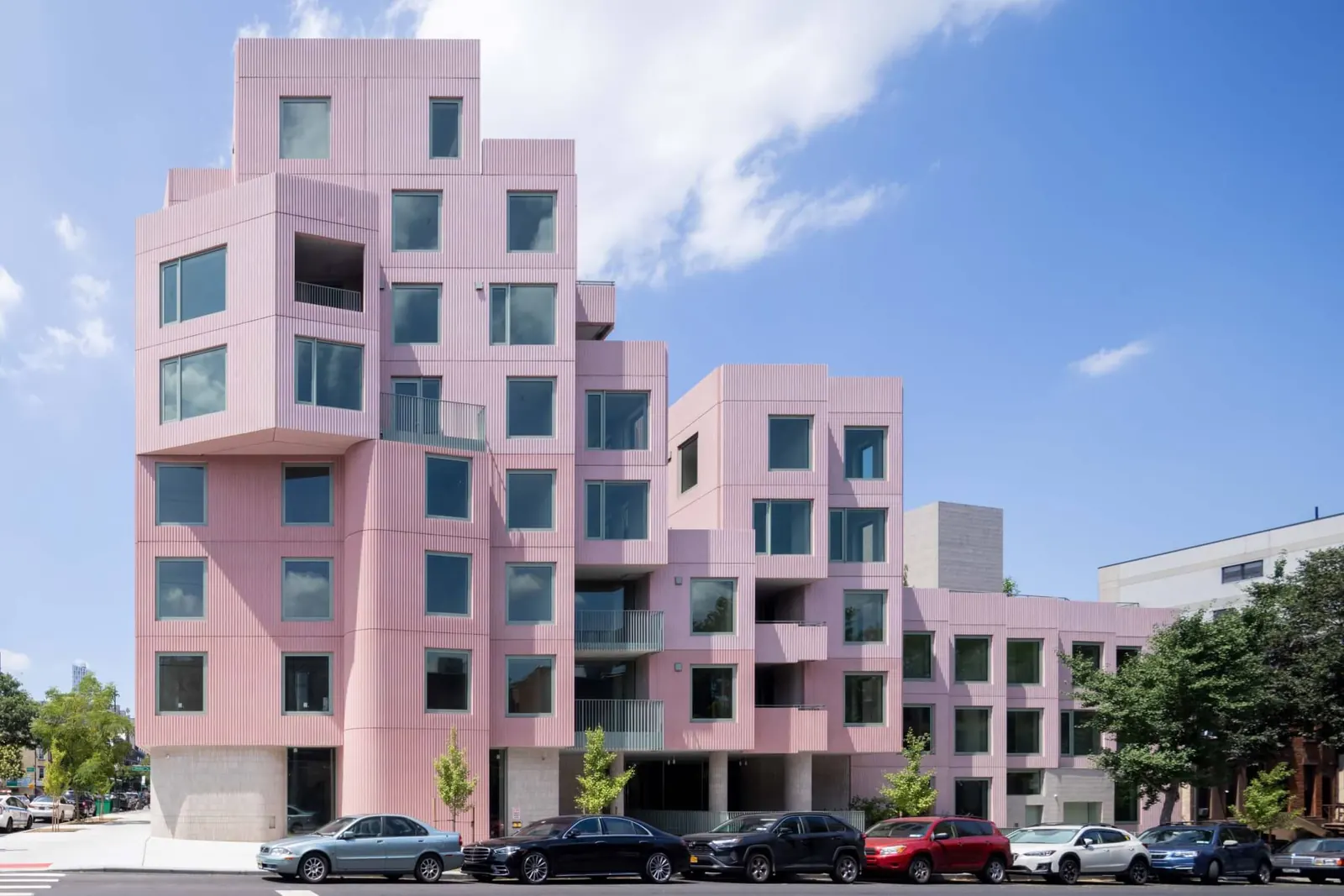
The most recent and largest of the trio, 144 Vanderbilt Avenue, completed in 2025, makes a distinct pink statement on the corner of Vanderbilt and Myrtle Avenues in Fort Greene. The building’s massing responds to its context, rising to 4 stories on the more residential Vanderbilt Avenue to harmonize with neighboring townhouses, and ascending to 8 stories on the commercial Myrtle Avenue. “Giving some depth and play is good when you can afford it,” Liu remarked.
Clad in three shades of rosy, ribbed precast concrete, the stacked and angled units feature oversized windows and varying heights and setbacks. These playful vertical assemblages appear to be supported by round concrete pilotis of different diameters, recessed behind the facade at ground level. This design provides visual and literal stability, while interspersed glazing creates a welcoming street-facing presence. The building’s varied angles and breaks in its envelope accommodate exterior corridors, terraced gardens, a central courtyard, and a tucked-away backyard, ensuring each unit has access to both the street and the tranquility of interior open space. Liu expressed a fondness for the second-floor units, which “overhang the streets, and you have that connectedness with the sidewalks.”
One unit has been repurposed as the design gallery Assembly Line, curated by interior design studio General Assembly. The inspiration for 144 Vanderbilt Avenue came from a modernist red-brick building Liu encountered in Slovenia, which featured retail at its core and a distinctive rounded projection, showcasing a residential building embracing a civic presence.
This approach by SO–IL highlights how architectural firms can leverage existing regulatory frameworks, turning potential obstacles into catalysts for more thoughtful, human-centered, and contextually responsive urban housing.
Source: The Architect’s Newspaper, https://www.archpaper.com/2026/06/so-il-finds-housing-new-york-zoning/
Datos clave
| Punto | Detalle |
|---|---|
| Fuente | The Architect's Newspaper |
| Fecha | 2026-06-23T19:31:09+00:00 |
| Tema | Solid Objectives Idenburg Liu finds innovative housing solutions in New York’s strict zoning landscape |
Source
The Architect's Newspaper Original publication: 2026-06-23T19:31:09+00:00
Related news

Koto launches Haku, a mobile prefab hotel suite built on a wheeled chassis to bypass UK planning restrictions
UK architecture studio Koto has unveiled Haku, a fully mobile prefabricated suite that legally qualifies as a caravan, allowing landowners and hotel…
Read more
HONG Designworks Completes Private Office in Xi’an That Balances Memory, Materiality, and Long-Term Use
The Xi’an office by HONG Designworks integrates a folded steel staircase, retained furniture from a previous workspace, and a restrained purple-gray palette…
Read more
Handwoven Teak and Cord Outdoor Seating Debuts from Masaya and Abril Zepeda
Nicaraguan furniture brand Masaya has introduced two new handcrafted outdoor chairs — a rocking chair and a lounge chair — designed by…
Read more
Place in Mind: Hendricks Churchill Launches Hospitality Group to Revive Historic Properties
The architecture and interior design studio Hendricks Churchill has launched Place in Mind, a new hospitality group focused on acquiring, restoring, and…
Read moreRelated wiki

Adaptive Reuse in Architecture
Reference page for reuse, retrofit, conversion, embodied carbon and design constraints.
Read more