The Line, Reassessed: What Can Be Evaluated Now on Sustainability and Mobility
With the currently verified sources, the safest way to reassess The Line is to separate broad urban principles from project-specific performance claims that still need primary documentation, technical methods, and operational evidence.

Short answer
The most responsible way to discuss The Line with the currently verified material is to separate general urban principles from project-specific performance claims. Dense, connected, less car-dependent development can support lower transport demand and more efficient infrastructure in principle. But that does not by itself verify how a specific megaproject will perform on carbon, resource use, ecology, access, or transport operations. <!– sources: 1,2 –>
A careful reassessment therefore leads to a limited conclusion: some of the ideas associated with The Line are recognizable within mainstream sustainability and mobility debates, but stronger project-specific judgments still require primary documentation and current reporting that are not present in the verified source set used here. Date-checked note: this article is intentionally limited to what can be supported by the currently verified sources provided for this assignment. It should not be read as a full status update on construction, phasing, or official performance targets. <!– sources: 1,2 –>
Context: why the claims remain hard to judge
UNEP's work on cities and resource efficiency supports a broad point that matters here: urban form, infrastructure coordination, and transport patterns can shape material use, energy demand, and emissions. That makes compact urbanism and reduced car dependence important ideas in sustainability discussions. <!– sources: 1 –>
At the same time, those principles do not settle the case for any individual project. Large-scale developments also have to be judged through boundaries and methods: what is counted, over what timeframe, and across which parts of the system. Construction inputs, infrastructure demands, and operational performance all matter. <!– sources: 1,2 –>
That is why The Line remains difficult to assess cleanly from limited public-facing material alone. Conceptual clarity is not the same as measurable performance, and transport or sustainability language can sound more precise than the underlying evidence actually is. <!– sources: 1,2 –>
What this article can and cannot do
This article can identify which kinds of sustainability and mobility claims are reasonable to discuss at a principle level, and which ones still require stronger support before readers should treat them as established. It cannot verify current project status, official targets, travel times, engineering specifications, or lifecycle outcomes, because those specifics are not supported by the verified sources supplied here. <!– sources: 1,2 –>
Sustainability: what can be discussed now, and what still needs proof
Compact form is a principle, not a verdict
A compact city form can support resource efficiency by reducing some forms of sprawl and by concentrating infrastructure and services. That general idea is compatible with UNEP's framing on cities and resource use. But compactness alone does not prove a low-impact outcome for a particular project. <!– sources: 1 –>
Carbon claims need boundaries
Any low-carbon or sustainability claim becomes much more meaningful when its scope is defined. Readers should ask whether the claim refers to operations, construction, transport, maintenance, or a fuller lifecycle picture. Without those boundaries, different environmental ideas can be blended into one headline without becoming truly testable. <!– sources: 1,2 –>
Embodied impacts remain a central open question
For very large construction projects, operational efficiency is only part of the picture. Material demand, structural systems, and supporting infrastructure can all shape overall impact. That is why embodied impacts deserve scrutiny alongside any discussion of efficient urban living. <!– sources: 1,2 –>
Land efficiency is not the whole ecological story
A smaller or more concentrated development footprint may sound environmentally favorable compared with dispersed growth. Even so, ecological assessment is broader than geometry. It also depends on landscape effects, infrastructure systems, and what environmental accounting includes or excludes. <!– sources: 1,2 –>
Mobility: where the language often outruns the evidence
Car-free claims need operational detail
In urban planning, car-free does not automatically mean friction-free. A place may reduce or exclude private cars in daily public space while still depending on service, maintenance, delivery, or emergency systems. Without a clear operating model, the phrase describes an ambition more than a complete mobility outcome. <!– sources: 1,2 –>
Fast movement depends on more than a headline promise
Travel-time language can appear exact while hiding major assumptions. Transport performance depends on network design, stop spacing, service frequency, capacity, reliability, and access conditions. Until those factors are publicly specified, fast internal mobility should be understood as a design intent rather than a verified result. <!– sources: 1,2 –>
Accessibility is lived, not just diagrammed
A planning concept may promise close access to daily needs, but lived convenience depends on circulation, service distribution, and how homes, transport, and amenities actually connect in use. That distinction matters in any ambitious urban proposal, especially one presented through a highly controlled concept image. <!– sources: 1,2 –>
Comparison table: what can be judged now
| Claim area | What can be discussed with current verified sources | What still needs stronger project-specific evidence |
|---|---|---|
| Compact urban form | Dense urban form can support resource efficiency in principle | Actual environmental performance of The Line |
| Lower car dependence | Reduced reliance on private cars is a recognized planning goal | How goods, services, emergency access, and daily movement would work in practice |
| Fast internal mobility | Integrated transit is important to any car-light urban model | Capacity, frequency, resilience, and realistic travel conditions |
| Low-carbon framing | Urban form can influence energy use and emissions | Carbon boundaries, lifecycle accounting, and technical methodology |
| Smaller land take | Concentrated development may reduce some forms of sprawl | Broader ecological effects and infrastructure footprint |
| Everyday accessibility | Proximity-based planning is a familiar urban design principle | Real user experience across circulation and operations |
Practical checklist for readers
When you read the next round of claims about The Line, focus on these questions:
- Does the claim define its scope clearly: operations, construction, transport, or full lifecycle?
- Is the wording backed by a method, metric, or reporting framework?
- Does a mobility claim explain service assumptions such as capacity, frequency, or access?
- Is a sustainability claim relying on compact form alone as implied proof?
- Are images and slogans doing more work than disclosed technical evidence?
- Is there independent reporting or primary documentation behind the claim? <!– sources: 1,2 –>
What readers should watch next
The most useful future evidence would be technical rather than promotional. Readers should watch for public material that defines environmental accounting boundaries, explains transport operations, and distinguishes aspiration from measurable commitments. Those are the documents that would make a sharper reassessment possible. <!– sources: 1,2 –>
Until that level of evidence is available in the verified source base, the sound editorial position is limited but clear: The Line can be discussed as a high-profile test case for compact, car-light urbanism, while many stronger sustainability and mobility conclusions remain unproven. <!– sources: 1,2 –>
Sources
Related news

Handwoven Teak and Cord Outdoor Seating Debuts from Masaya and Abril Zepeda
Nicaraguan furniture brand Masaya has introduced two new handcrafted outdoor chairs — a rocking chair and a lounge chair — designed by…
Read more
Place in Mind: Hendricks Churchill Launches Hospitality Group to Revive Historic Properties
The architecture and interior design studio Hendricks Churchill has launched Place in Mind, a new hospitality group focused on acquiring, restoring, and…
Read more
Adalberto Dias Architects Complete Restoration of Lisbon’s Patriarchal Cathedral and Archaeological Center
The restoration of the Sé de Lisboa by Adalberto Dias Arquitecto integrates a new archaeological center, preserved cloisters, and seven centuries of…
Read more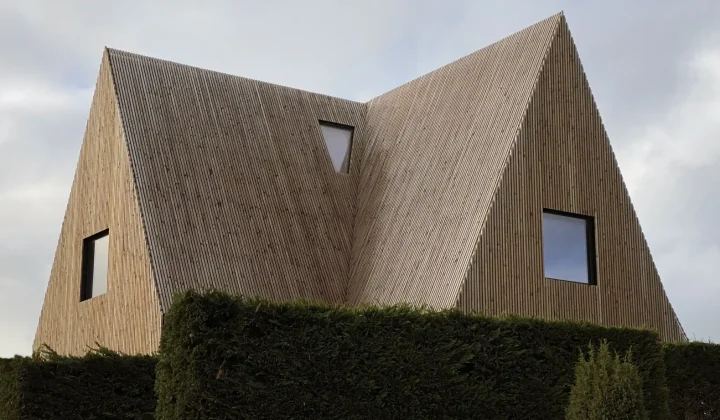
Vantieghem Talebi’s ‘House of Cards’ Brings Timber Geometry to Belgian Family Home
A new family house in Belgium by US- and Swiss-based practice Vantieghem Talebi uses a steeply pitched, card-house-inspired form clad in Douglas-fir…
Read moreRelated wiki

Adaptive Reuse in Architecture
Reference page for reuse, retrofit, conversion, embodied carbon and design constraints.
Read more