
Burned Porsches Reimagined as Stained-Glass Memorials by Artist Ben Tuna
Artist Ben Tuna transforms fire-damaged Porsche vehicles into striking art installations by incorporating salvaged church stained glass, creating unique memorials that blend automotive history with ecclesiastical artistry.
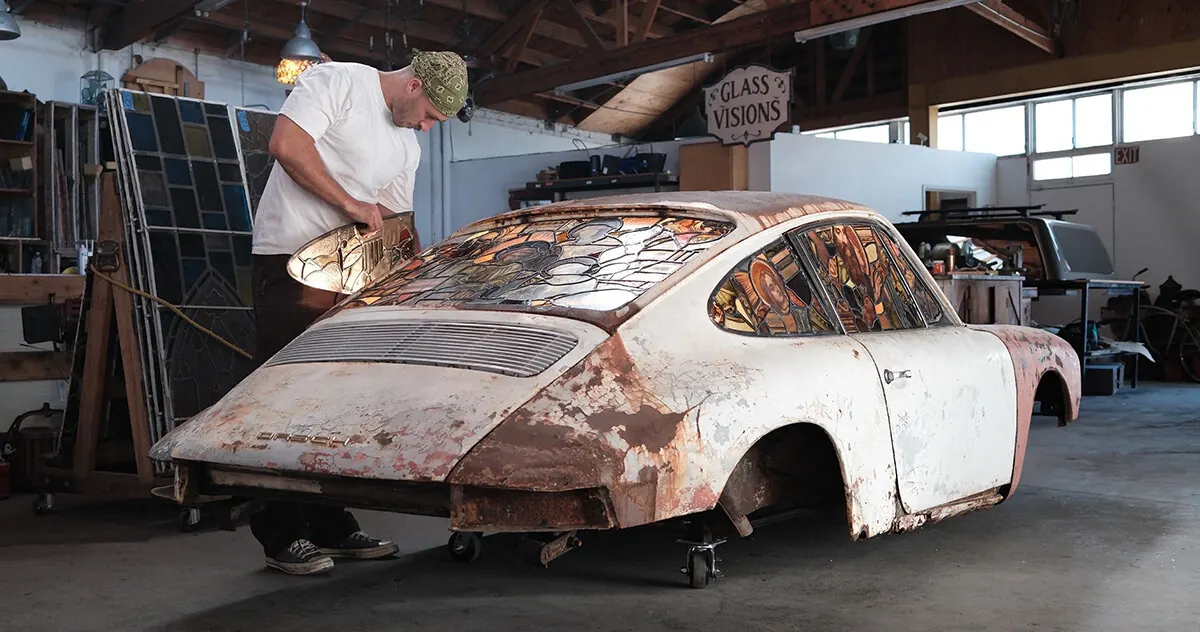
Artist Ben Tuna is redefining the concept of automotive afterlife by transforming wrecked and burned-out Porsche vehicles into luminous art pieces, integrating salvaged stained glass from old churches. Operating from his family’s Glass Visions Studio in Los Angeles, Tuna’s unique practice merges the worlds of automotive ruin and sacred craft, turning discarded car shells into expressive memorials.
Artist’s Background and Evolution
Ben Tuna took over the family’s stained-glass business in 2021, building upon a foundation laid by his father, Mark Tuna, in 1979. While initially focused on restoration and residential commissions, Tuna’s recent work under the moniker “Glass Cowboy” ventures into more experimental territory. His projects explore the intersection of traditional craft and contemporary decay, using weathered car bodies as canvases for intricate stained-glass designs.
Transforming Fire-Damaged Vehicles
Following the devastating Los Angeles fires, Tuna began collecting severely damaged Porsche shells. These vehicles, often reduced to rusted husks, offered a poignant starting point for his artistic interventions. His process involves meticulously stripping the cars down to their bare metal, addressing the toxic residues left by the fires before beginning the glasswork.
One notable project, a 1965 Porsche 356 salvaged from the fires, was transformed into a 700-pound movable sculpture. Tuna incorporated fragments from approximately fifteen salvaged stained-glass windows, many hand-painted in Germany in the late 1800s. These pieces were assembled not according to a fixed narrative, but based on their size, color, and emotional resonance, creating a mosaic of memory and material history within the car’s shell.
Resurrection and Unearthed
Tuna’s work titled “Resurrection” features a corroded Porsche 911 Carrera, stripped of its original components. The car’s damaged openings are reframed with custom metal structures holding hand-cut glass panels. These panels, inspired by cathedral windows, introduce vibrant colors and imagery, casting light across the skeletal remains of a machine once built for speed. The piece derives its power from the stark contrast between the car’s former status and its current state of decay, with the glass adding a sense of ceremony rather than restoring functionality.
In another project, “Unearthed” (2026), Tuna moved beyond stained glass, using thin slices of desert agate collected from the Southwestern United States. These mineral pieces are fitted into the car body, creating a geological glow that contrasts with the ecclesiastical feel of the stained glass. This shift in material introduces a different dimension of time and texture to the artwork.
Smaller Scale Interventions
Extending this artistic concept, Tuna also repurposes detached Porsche doors as wall-mounted pieces. Reduced to fragments, these doors retain their original curves and handles, becoming surfaces for contemplation. The integration of glass or stone transforms them into panels or reliefs, allowing the essence of the car’s design to permeate interior spaces without requiring the full vehicle.
Why This Matters
Ben Tuna’s work offers a compelling narrative for our readers interested in sustainable design, adaptive reuse, and the intersection of art and automotive culture. By giving new purpose to vehicles destroyed by natural disasters and integrating materials with their own rich histories, Tuna highlights themes of salvage, memory, and transformation. His approach challenges conventional notions of value and decay, presenting fire-damaged cars not as scrap, but as canvases for profound artistic expression and reflection on material resilience. The fusion of automotive engineering with ancient craft traditions provides a unique perspective on how we can reimagine discarded objects.
Key facts
| Aspect | Detail |
|---|---|
| Artist | Ben Tuna (Glass Cowboy) |
| Medium | Salvaged stained glass, desert agate, burned Porsche car bodies |
| Notable Projects | Resurrection (Porsche 911 Carrera), Unearthed (Porsche 356), Porsche doors |
| Inspiration | Fire-damaged vehicles, salvaged church windows, desert landscapes |
| Studio Location | Los Angeles, USA |
Source: https://www.designboom.com/art/afterlife-salvaged-stained-glass-burned-porsche-ben-tuna-cars-church-windows/
Source
Designboom Original publication: 2026-07-03T01:30:58+00:00
Related news
Koto launches Haku, a mobile prefab hotel suite built on a wheeled chassis to bypass UK planning restrictions
UK architecture studio Koto has unveiled Haku, a fully mobile prefabricated suite that legally qualifies as a caravan, allowing landowners and hotel…
Read more
HONG Designworks Completes Private Office in Xi’an That Balances Memory, Materiality, and Long-Term Use
The Xi’an office by HONG Designworks integrates a folded steel staircase, retained furniture from a previous workspace, and a restrained purple-gray palette…
Read more
Handwoven Teak and Cord Outdoor Seating Debuts from Masaya and Abril Zepeda
Nicaraguan furniture brand Masaya has introduced two new handcrafted outdoor chairs — a rocking chair and a lounge chair — designed by…
Read more
Place in Mind: Hendricks Churchill Launches Hospitality Group to Revive Historic Properties
The architecture and interior design studio Hendricks Churchill has launched Place in Mind, a new hospitality group focused on acquiring, restoring, and…
Read moreRelated wiki
Adaptive Reuse in Architecture
Reference page for reuse, retrofit, conversion, embodied carbon and design constraints.
Read more