
The Enduring Appeal of Labyrinths: From Ancient Rituals to Contemporary Art
Exploring how the seemingly "useless path" of labyrinths and mazes transforms disorientation into a form of play, ritual, and artistic expression, from land art to urban gardens.
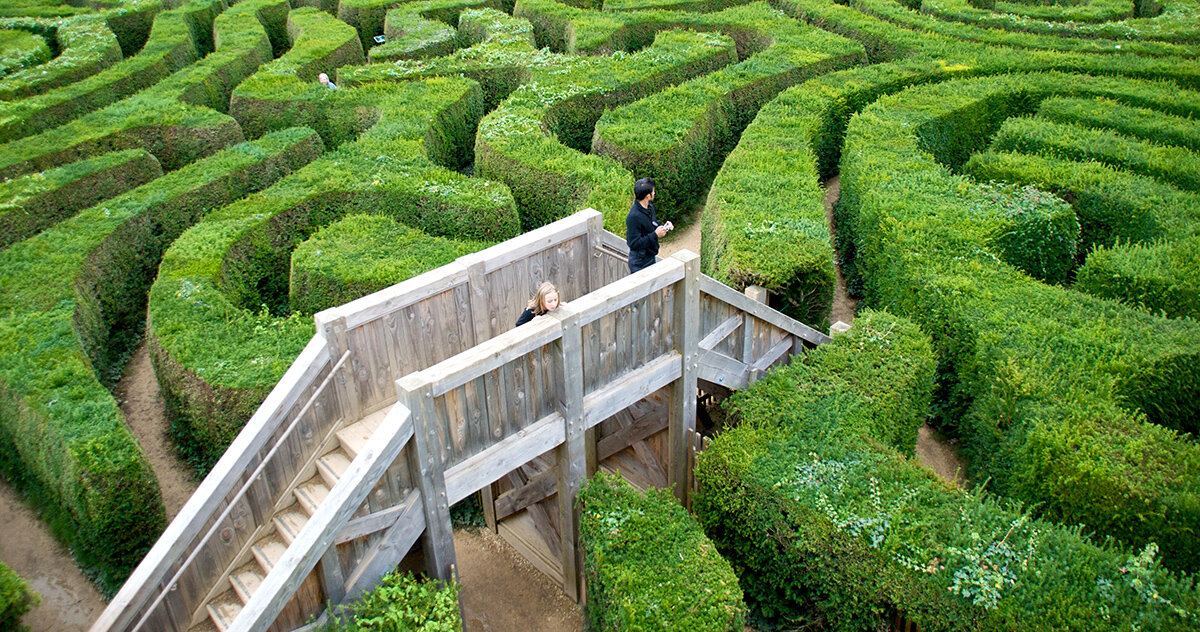
The concept of the labyrinth, a path often designed to disorient and guide rather than simply transport, continues to captivate designers, artists, and the public alike. Far from being mere architectural curiosities, these winding structures offer a profound exploration of movement, perception, and the human experience of being lost and found. From ancient ritualistic pathways to modern art installations, the labyrinth’s enduring appeal lies in its ability to transform disorientation into a deliberate form of play.
Spiral Jetty, the iconic earthwork by Robert Smithson in Utah’s Great Salt Lake, exemplifies this principle. While widely photographed from above, experiencing its 1,500-foot coil of basalt and earth firsthand reveals a different reality. The simple, single-route labyrinth, surrounded by an endless expanse of earth and sky, deliberately erases the sense of direction and scale. Smithson himself noted that scale at Spiral Jetty is experienced through uncertainty, a sensation amplified by the repetitive landscape and the path’s sole destination being its own center—or exit. Upon reaching the middle, visitors find not a vista, but a continuation of blankness, prompting a reversal of course and a re-experience of the journey. Here, the visitor disconnects from conventional reality, dedicating time to an experience of “absolute nothingness.”
Por que importa
Unlike corridors designed for efficient transit, labyrinths invert this logic, making movement itself the primary program. They stretch a potentially short distance into a meandering network, where the destination becomes secondary to the journey. This transforms the space into a playground, a place for unhurried, free time away from demanding tasks. It’s a temporary world where conventional progress is suspended, and visitors enter without the expectation of utility. The inherent playfulness arises from the indirect route, the freedom found in moving towards a point that offers little more than the opportunity to retrace one’s steps.
A crucial distinction often overlooked is the difference between a maze and a labyrinth. Mazes, characterized by branching paths, choices, and dead ends, derive their playfulness from uncertainty and problem-solving. The thrill lies in making decisions, taking wrong turns, and the satisfaction of eventually finding the exit. Classical labyrinths, however, follow a single, continuous path leading to the center and back out. With no decisions to make or wrong turns to correct, the walker is encouraged to move leisurely and meditatively. This choreographed pattern of movement suspends ordinary time, offering a rhythmic and contemplative experience. While mazes invite play through choice, labyrinths encourage it through surrender.
Contexto
The history of labyrinths spans millennia, appearing in ancient Egyptian sites, the myth of the Minotaur, and Roman mosaics. During the Middle Ages, their intricate geometries were incorporated into cathedral floors, serving as a form of pilgrimage and ritual. Later, branching hedge mazes emerged as a popular form of aristocratic garden entertainment. In the early 1970s, artists like Alice Aycock and Robert Morris brought the labyrinth into contemporary art, moving it beyond flat diagrams into immersive, body-centric experiences. Aycock’s “Maze” (1972) used concentric wooden rings to evoke a sense of panic and the urge to escape, while Morris’s “Untitled (Labyrinth)” (1974) replaced gallery circulation with an eight-foot-walled winding route. These works redefined sculpture, making the meandering journey itself, and the sensations of movement and lost perspective, the art.
More recently, the Borges Labyrinth in Venice, designed by Randoll Coate and inspired by Jorge Luis Borges, reopened after restoration. Though technically a maze, its design, viewed from above, resembles an open book with Borges’s name woven into its patterns. Inside, the more than a kilometer of green corridors obscures the overall image, forcing visitors to engage with the immediate path ahead and exchange the certainty of a plan for the pleasure of the journey. Similarly, Franco Maria Ricci’s Labirinto della Masone near Fontanellato, inspired by Borges, features approximately 300,000 bamboo plants forming a vast maze, complete with dead ends and a central pyramid chapel.
These contemporary examples, alongside historical and artistic precedents, underscore the labyrinth’s multifaceted role. It serves as a space for introspection, a playful challenge, and an artistic medium that engages directly with our perception of space and time. The “useless path” of the labyrinth, by embracing disorientation, offers a unique and enduring form of engagement, proving that sometimes, the most profound experiences are found not in reaching a destination, but in the journey itself.
Key facts:
| Feature | Description |
|---|---|
| Definition | Labyrinth: single path to center; Maze: branching paths with choices/dead ends |
| Historical Use | Ritual, meditation, garden design, contemporary art installations |
| Key Examples | Spiral Jetty, Longleat Hedge Maze, Borges Labyrinth, Labirinto della Masone |
| Artistic Impact | Transforms movement and disorientation into the art itself |
The exploration of labyrinths and mazes offers a valuable perspective for architects, urban designers, and artists interested in creating spaces that go beyond mere utility, fostering engagement, reflection, and a sense of playful discovery within the built environment.
Source: designboom – https://www.designboom.com/design/useless-path-labyrinths-disorientation-play-maze-spiral-jetty-borges/
Source
Designboom Original publication: 2026-07-17T21:00:11+00:00
Related news
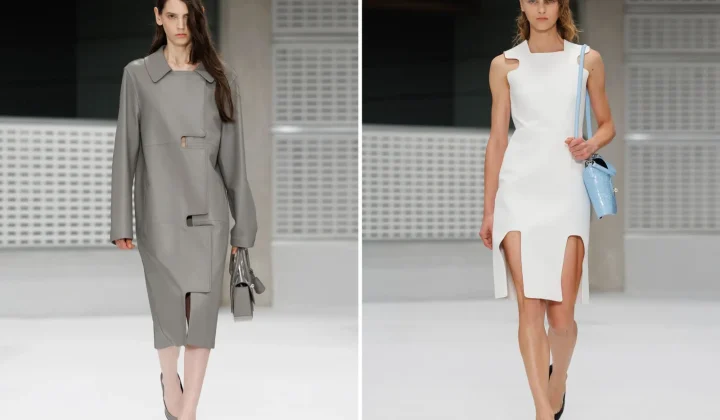
Christopher Kane brings streamlined, heritage-driven vision to Mulberry in London Fashion Week debut
The Scottish designer presented his first collection for the British leather goods house at London Fashion Week, blending sharp tailoring, archival references…
Read more
When Film Directors Become Interior Designers: Guadagnino, Lynch, Anderson and Almodóvar Step Off Screen
From Luca Guadagnino’s Zara Home collection to David Lynch’s Paris club and Wes Anderson’s train carriage, a wave of collaborations is blurring…
Read more
Jesus Mari Lazkano Examines Changing Landscapes Through Painting and Animated Film at Basque Luxury Studio
The Basque artist’s exhibition ‘Azken Natura’ brings together six large-scale paintings and a 22-minute animated film that traces the melting of the…
Read more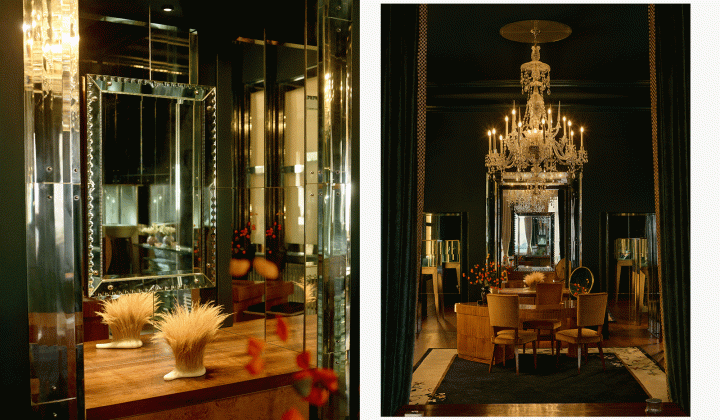
Glenn Spiro opens intimate jewellery atelier in Mayfair with designer Valerie Name Bolaño
The London jewellery house’s new boutique at 26 Bruton Street blends antiques, bespoke furniture and a monochrome palette to create a residential…
Read moreRelated wiki

Adaptive Reuse in Architecture
Reference page for reuse, retrofit, conversion, embodied carbon and design constraints.
Read more