GridType Vol. 1 Examines How Digital Tools Reshape Type Design
A new publication from Slanted Publishers presents ten typefaces developed with an experimental online tool, tracing the influence of digital stencils on contemporary letterforms.
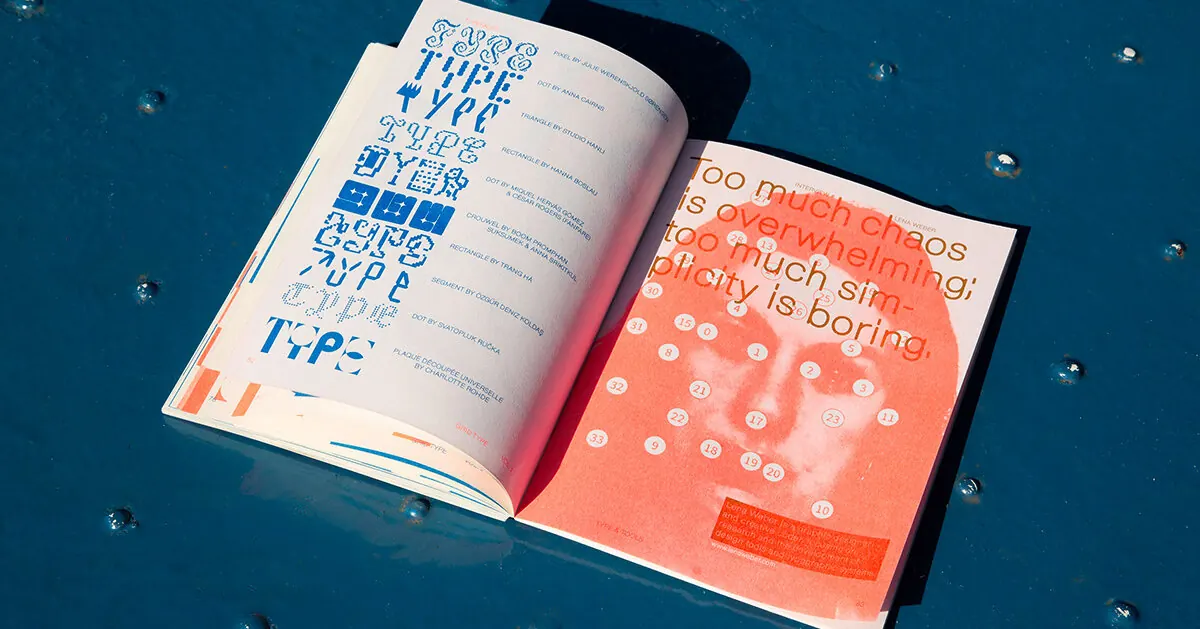
The relationship between design tools and the forms they produce takes center stage in a new book from Slanted Publishers. “GridType Vol.—1: Type & Tools” presents ten typefaces developed with the GridType experimental tool, an online platform that lets users create custom stencils by adjusting grid parameters. The publication, released in 2026, combines type specimens, designer interviews, and historical context to examine how digital methods are influencing typographic expression.
The GridType tool, accessible at grid-type.com, allows designers to generate letterforms by selecting from nine grid types. These grids range from geometric shapes—rectangles, triangles, circles—to configurations inspired by pixel displays and segmented screens. Users can adjust the number of rows and columns, as well as the complexity of the grid, to produce a wide range of typographic variations. The tool’s design draws on the logic of stencil systems, most notably the Plaque Découpée Universelle from the 1870s, a single stencil capable of producing the entire alphabet.
Por que importa
The book itself is a compact 96-page volume, printed in risography by no kiss in Amsterdam. It measures 13.6 × 19 cm and uses open thread-stitching for a tactile, handmade feel. The text is in English, and the paper choice—Holmen bleached and unbleached—emphasizes the risographic process.
Ten designers contributed typefaces to the project: Anna Cairns, Boom Promphan Suksumek & Anna Srikitkul, Charlotte Rohde, Hanna Boslau, Julie Werenskjold Sørensen, Miquel Hervás Gómez & César Rogers (fanfare), Studio HanLi, Svatopluk Ručka, Trang Hà, and Özgür Deniz Koldaş. Each designer used the GridType tool to develop their own typographic language, with the resulting typefaces available for download through the GridType website.
Contexto
Alongside the specimens, the book includes interviews and Q&As conducted by Lena Weber, studio pointer*, and Céline Hurka. These conversations address topics such as how technological development affects typography, the role of designers in building their own tools, and the unexpected outcomes that can arise when experimenting with parameters.
The project situates itself within a longer history of grid-based type design. It references the work of Wim Crouwel, the Bauhaus school, and the Plaque Découpée Universelle. By connecting these historical precedents to contemporary digital methods, GridType Vol. 1 highlights how constraints—whether physical stencils or software parameters—can drive creative discovery.
Que sigue
For designers, architects, and visual communicators, the book offers a practical case study in how tool design shapes output. The deliberate limitation of a grid system becomes a generative device, producing letterforms that would be difficult to conceive through freehand or conventional font software. The project also raises questions about authorship and the role of the designer when the tool itself is part of the design process.
| Key facts | |
|---|---|
| Publication | GridType Vol.—1: Type & Tools |
| Publisher | Slanted Publishers |
| Release date | 2026 |
| Format | 96 pages, 13.6 × 19 cm, risograph printed, open thread-stitching |
| Contributors | 10 designers (see list above) and 3 interviewers |
| Tool | GridType (grid-type.com) – online stencil generator with nine grid types |
The book was edited by Katharina Nejdl, with concept by Nejdl and Céline Hurka. The design was also handled by Nejdl. All images used in the book are courtesy of Slanted Publishers.
Source: Designboom, “GridType Vol.—1 Explores How Digital Tools Generate New Typographic Forms,” https://www.designboom.com/design/gridtype-vol-1-digital-tools-new-typographic-forms-slanted-publishers/
Source
Designboom Original publication: 2026-07-26T01:15:32+00:00
Related news

Handwoven Teak and Cord Outdoor Seating Debuts from Masaya and Abril Zepeda
Nicaraguan furniture brand Masaya has introduced two new handcrafted outdoor chairs — a rocking chair and a lounge chair — designed by…
Read more
Place in Mind: Hendricks Churchill Launches Hospitality Group to Revive Historic Properties
The architecture and interior design studio Hendricks Churchill has launched Place in Mind, a new hospitality group focused on acquiring, restoring, and…
Read more
Adalberto Dias Architects Complete Restoration of Lisbon’s Patriarchal Cathedral and Archaeological Center
The restoration of the Sé de Lisboa by Adalberto Dias Arquitecto integrates a new archaeological center, preserved cloisters, and seven centuries of…
Read more
Vantieghem Talebi’s ‘House of Cards’ Brings Timber Geometry to Belgian Family Home
A new family house in Belgium by US- and Swiss-based practice Vantieghem Talebi uses a steeply pitched, card-house-inspired form clad in Douglas-fir…
Read moreRelated wiki
Adaptive Reuse in Architecture
Reference page for reuse, retrofit, conversion, embodied carbon and design constraints.
Read more