
Lightweight “Half Arch” Bridge by sbp and Snøhetta Opens at Watkins Glen State Park
Schlaich Bergermann Partner and Snøhetta have completed the Sentry Bridge in upstate New York, replacing a 100-year-old stone-clad structure with a 90 percent lighter stainless-steel design that reinterprets the park’s layered history.
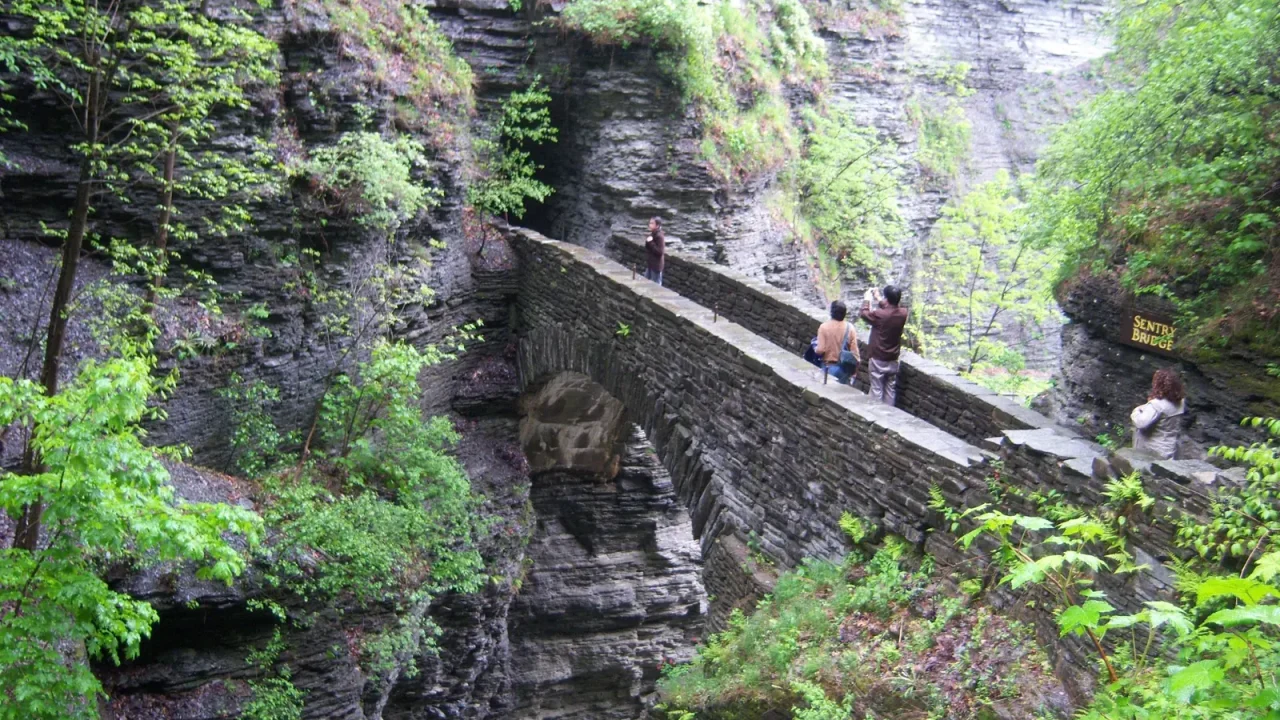
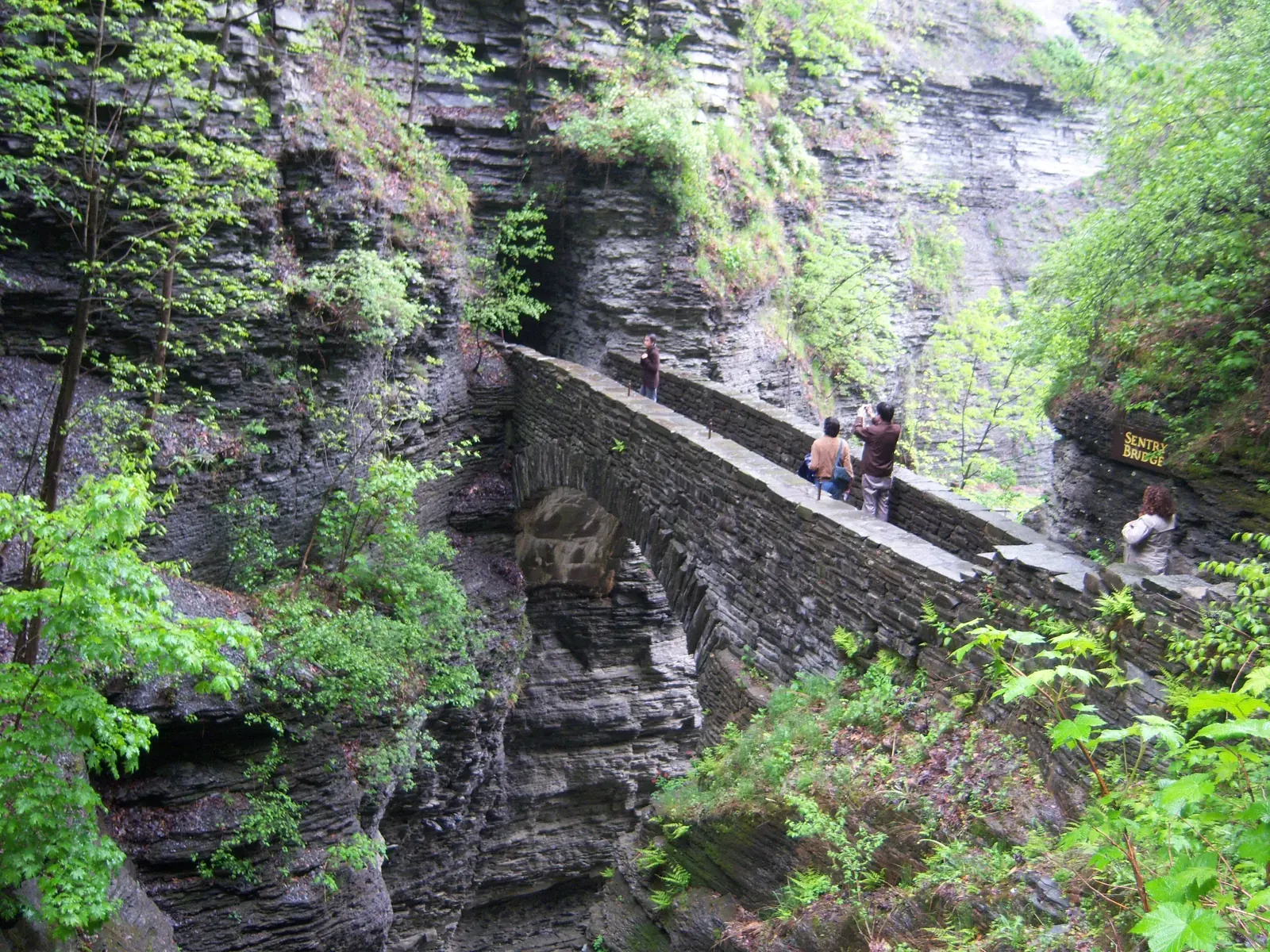
A new bridge in New York’s Watkins Glen State Park has replaced a century-old stone-clad crossing with a dramatically lighter, historically informed structure. Completed this summer, the Sentry Bridge was designed by schlaich bergermann partner (sbp) and Snøhetta in collaboration with the New York State Parks, Recreation and Historic Preservation agency. The 46-foot span, set 54 feet above the water, reinterprets the park’s design history rather than copying the original.
The project began when routine inspections by rappelling masons – the same daredevils who check the gorge’s cliffs for cracks each season – flagged a fissure in the rock near the old Sentry Bridge. The problem presented an opportunity to rethink the crossing entirely.
Design as a Collage of Park History
According to sbp partner Michael Stein, the team never intended to impose a contemporary object on the historic landscape. “It was about finding out why the old bridge was so iconic and to understand and to reinterpret those qualities,” Stein told AN. The designers studied the park’s evolution: early wooden bridges that guided 19th-century tourists, concrete trails built by the Civilian Conservation Corps in the 1930s, and later stone cladding applied to iron structures. Snøhetta project designer Donesh Ferdowsi described the result as “a collage of all of these different stages.”
The new Sentry Bridge uses a shot-peened stainless steel structure, concrete formed from rough sawn hemlock, and a bluestone landing. The design team had to contend with the south side of the gorge, where rock deterioration made a symmetrical arch impossible. sbp developed a “half arch” – an arched beam that bears on the north abutment while the south side is anchored by micro piles drilled 70 feet into the rock. A milled stainless steel ball bearing connection allows the beam to move without developing secondary forces.
90 Percent Lighter for Environmental and Construction Reasons
The bridge weighs 17 tons, 90 percent less than the previous stone-clad span. This lightness was not purely aesthetic. “At the end of the day, it was an environmental strategy and a construction strategy to limit the impact on the gorge in that spot,” Stein said. The entire bridge was assembled on a truck bed in nearby Danville, New York, then lifted into place in a single operation. That approach avoided the need for heavy equipment inside the fragile gorge.
| Key facts | |
|---|---|
| Location | Watkins Glen State Park, New York |
| Design team | schlaich bergermann partner (structural), Snøhetta (architecture and detailing) |
| Span / height | 46 feet long, 54 feet above water |
| Weight | 17 tons (90% lighter than the previous bridge) |
| Completion | Summer 2026 |
Site-Wide Renovations and Ecological Sensitivity
Beyond the bridge itself, the project renovated the tunnels that lead from the visitor center into the forest. Stairs inside the cavernous passages were repaired and brought up to code; drainage was improved. Splintered metal railings were replaced with black locust wood. sbp designed new lighting fixtures hidden from view to illuminate the dark passageway without visual clutter.
The detailing throughout the site follows organic principles. Snøhetta designed railing hardware based on climbing pitons – the same type of equipment used by the rappelling masons who maintain the cliffs. The simple metal joints allow the railing to fit into the rock at any angle, depending on stair orientation. Bronze brackets on the bridge’s guardrail are designed to patina green over time, blending into the natural surroundings.
Preserving the Memory of the Old Bridge
Rather than a plaque or interpretive panel, the design team chose to leave a remnant of the old bridge’s foundation in situ and created a small bronze viewing box. The cast bronze object, placed at a child’s eye level, replicates the old bridge at a 1:1 scale. It was generated from a 3D scan of the rock face and the previous bridge. “Every single stone of the original bridge is etched into this cast,” Ferdowsi said. The box is angled so that looking through it recreates the view of the waterfall with the old bridge in the foreground.
Why This Matters for Architecture and Landscape Readers
The Sentry Bridge project demonstrates how a lightweight, historically literate design can replace a beloved landmark without erasing its memory. The engineering innovation – the half-arch and micro pile system – offers a replicable model for crossing fragile landscapes with minimal impact. The collaborative process between structural engineers, architects, and park officials also provides a case study in balancing preservation, accessibility, and contemporary design.
Source: The Architect’s Newspaper, “schlaich bergermann partner, Snøhetta, and others reinstate a historic bridge in New York’s Watkins Glen State Park,” July 30, 2026. https://www.archpaper.com/2026/07/schlaich-bergermann-partner-snohetta-bridge-watkins-glen-state-park/
Source
The Architect's Newspaper Original publication: 2026-07-30T16:48:23+00:00
Related news

Handwoven Teak and Cord Outdoor Seating Debuts from Masaya and Abril Zepeda
Nicaraguan furniture brand Masaya has introduced two new handcrafted outdoor chairs — a rocking chair and a lounge chair — designed by…
Read more
Place in Mind: Hendricks Churchill Launches Hospitality Group to Revive Historic Properties
The architecture and interior design studio Hendricks Churchill has launched Place in Mind, a new hospitality group focused on acquiring, restoring, and…
Read more
Adalberto Dias Architects Complete Restoration of Lisbon’s Patriarchal Cathedral and Archaeological Center
The restoration of the Sé de Lisboa by Adalberto Dias Arquitecto integrates a new archaeological center, preserved cloisters, and seven centuries of…
Read more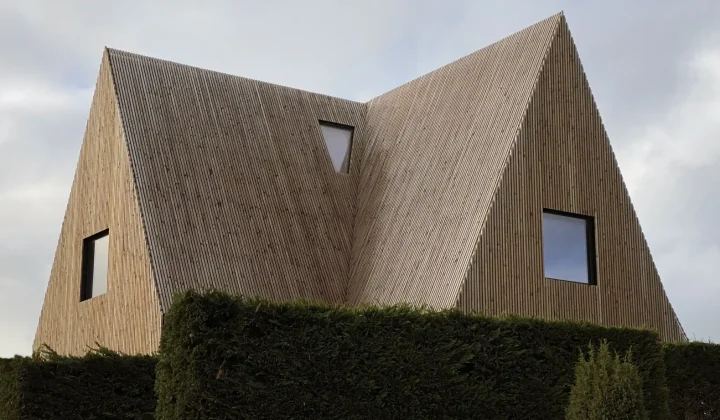
Vantieghem Talebi’s ‘House of Cards’ Brings Timber Geometry to Belgian Family Home
A new family house in Belgium by US- and Swiss-based practice Vantieghem Talebi uses a steeply pitched, card-house-inspired form clad in Douglas-fir…
Read moreRelated wiki

Adaptive Reuse in Architecture
Reference page for reuse, retrofit, conversion, embodied carbon and design constraints.
Read more