
2050+ Transforms a Logroño Parking Lot into a Temporary Sports Landscape
Ippolito Pestellini Laparelli and Erica Petrillo of 2050+ discuss their installation 'Frontones Danzantes' at Concéntrico 2026, arguing that informal sport can challenge surveillance and reclaim urban public space.
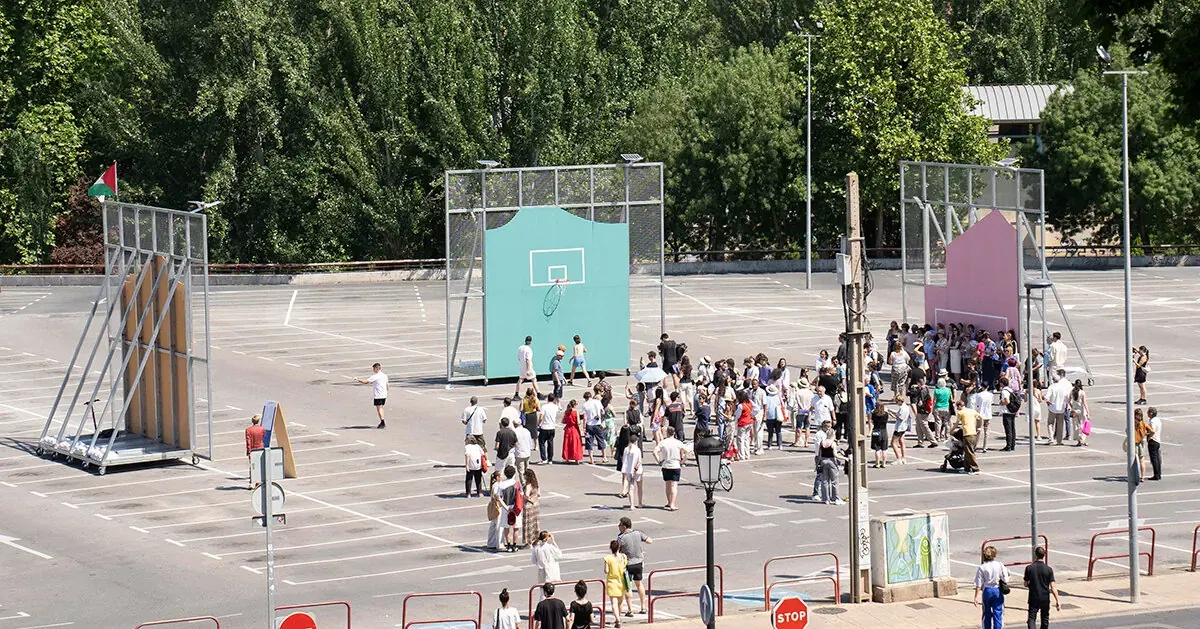
For a few days in August 2026, a parking lot in Logroño, in the Basque Country, stopped functioning as a space for cars. The installation ‘Frontones Danzantes’ (Dancing Frontons), designed by the architecture and research practice 2050+ for the twelfth edition of the Concéntrico festival, turned the Revellín car park into a temporary landscape for Basque pelota, basketball, and football. The project used three mobile walls made from timber panels and steel frames that could be moved, rotated, and recombined, allowing the space to change throughout the festival.
Ippolito Pestellini Laparelli and Erica Petrillo of 2050+ have written a guest essay for Designboom explaining the thinking behind the installation. They argue that the project was a visible demonstration that public space is not a fixed condition but something that can be continually reclaimed and re-signified. By interrupting the everyday logic of the parking lot, the installation temporarily returned a fragment of the city to collective use.
Key facts
| Element | Detail |
| — | — |
| Project name | Frontones Danzantes (Dancing Frontons) |
| Designers | 2050+ (Ippolito Pestellini Laparelli, Erica Petrillo) |
| Location | Revellín car park, Logroño, Basque Country |
| Event | Concéntrico 2026, 12th edition |
| Materials | Timber panels, steel frames |
| Sports accommodated | Basque pelota, basketball, football |
The essay links the temporary intervention to the long history of informal sport in urban space. Basque pelota, the authors note, descended from the 18th-century jeu de paume, never depended on purpose-built stadiums. A church facade, the blank side of an apartment block, or a retaining wall could all become a court. The game required not new architecture but a different reading of the architecture already there.
Informal sport under pressure
The 2050+ team situates the Logroño installation within a broader context of shrinking public space. They argue that cities have long been the backdrop for everyday, informal sport played in streets, squares, and parks, but that these spaces are increasingly under threat from financialization, redevelopment, and growing forms of regulation and surveillance.
Drawing on the work of artist and technologist James Bridle, the essay states that contemporary systems of surveillance extend beyond the sports field into the wider urban environment, shaping how cities are monitored, controlled, and experienced. Public spaces are designed not only through what they allow, but through what they prevent: informal gathering, unplanned occupation, and forms of play that fall outside predetermined uses.
The authors provide specific figures to back the claim. In England alone, 250 school playing fields were lost between 2010 and 2021. In many European cities, less than 10% of public space is designed with children in mind. As accessible play areas vanish, the conditions that support informal, unregulated forms of public life also disappear.
Sport as a social barometer and contract
Through this lens, sport reveals relationships that architecture alone often leaves invisible, the essay argues. Like a social barometer, it exposes the presence or absence of meaningful public space and its overall health. It reveals who has access: whether a playground is genuinely open or fenced and controlled, whether it exists only as an amenity in wealthier areas or also serves as a social valve in less affluent neighborhoods.
The text proposes that sport functions as an alternative social contract. A community, a wall, and a ball are enough to establish an agreement: a set of shared rules, mutual responsibilities, and a temporary commons brought into existence through participation. This social contract does not seek to domesticate competition or depoliticize conflict but redirects it, transforming rivalry into a cathartic ritual that can be expressed and negotiated without violence.
What sustains these urban strongholds against commodification, the authors write, is not only material infrastructure but the network of care that forms around it: the collective willingness to maintain, protect, and keep alive the conditions for play.
Limits of the temporary intervention
The essay is careful not to overstate the impact of the Logroño installation. ‘The intervention of Frontones Danzantes was temporary and, by definition, limited in its scope and radius of action,’ Pestellini Laparelli and Petrillo write. ‘It did not pretend to solve the structural problems endemic to Logroño.’
Its power, they argue, lay in producing a proof of concept and operating at the level of symbols. It created tangible evidence that the city can be otherwise and that alternative uses of public space are possible, restoring agency to those inhabiting it and offering a blueprint that can be restaged elsewhere.
The essay also acknowledges the dual nature of sport. While it can function as a manifestation of the urban commons, it is also a field of immense economic and political power. The text notes that the latest World Cup final was watched by almost 1.5 billion people worldwide, and the tournament mobilizes a global business worth billions. Yet beneath this apparatus, sport remains a popular ritual, capable of creating temporary communities among strangers and giving diasporic communities a renewed sense of connection and belonging.
Why this matters for architecture readers
For an audience interested in architecture, urbanism, and public space, the 2050+ essay offers a compact argument about how temporary interventions can test alternative uses of urban infrastructure. The project does not propose a permanent redesign of the parking lot but uses a low-cost, mobile system to demonstrate a principle: that space designed for one purpose can be re-appropriated for collective life. The essay also connects the installation to wider debates about surveillance, privatization, and the erosion of public space, giving readers a framework for evaluating similar projects in other cities.
Source: Designboom – ippolito pestellini laparelli and erica petrillo of 2050+ on ‘the parking lot that forgot itself’ (https://www.designboom.com/architecture/ippolito-pestellini-laparelli-erica-petrillo-2050-parking-lot-essay/)
Datos clave
| Punto | Detalle |
|---|---|
| Fuente | Designboom |
| Fecha | 2026-08-01T14:15:35+00:00 |
| Tema | ippolito pestellini laparelli and erica petrillo of 2050+ on ‘the parking lot that forgot itself’ |
Source
Designboom Original publication: 2026-08-01T14:15:35+00:00
Related news

Handwoven Teak and Cord Outdoor Seating Debuts from Masaya and Abril Zepeda
Nicaraguan furniture brand Masaya has introduced two new handcrafted outdoor chairs — a rocking chair and a lounge chair — designed by…
Read more
Place in Mind: Hendricks Churchill Launches Hospitality Group to Revive Historic Properties
The architecture and interior design studio Hendricks Churchill has launched Place in Mind, a new hospitality group focused on acquiring, restoring, and…
Read more
Adalberto Dias Architects Complete Restoration of Lisbon’s Patriarchal Cathedral and Archaeological Center
The restoration of the Sé de Lisboa by Adalberto Dias Arquitecto integrates a new archaeological center, preserved cloisters, and seven centuries of…
Read more
Vantieghem Talebi’s ‘House of Cards’ Brings Timber Geometry to Belgian Family Home
A new family house in Belgium by US- and Swiss-based practice Vantieghem Talebi uses a steeply pitched, card-house-inspired form clad in Douglas-fir…
Read moreRelated wiki

Adaptive Reuse in Architecture
Reference page for reuse, retrofit, conversion, embodied carbon and design constraints.
Read more