
Audi Nuvolari Hybrid Supercar Debuts at Monterey Car Week After 405-Day Development Sprint
Audi unveiled the Nuvolari hybrid supercar at The Quail during Monterey Car Week, showcasing a 1,001 PS powertrain and a new design language developed in just 405 days from first sketch to drivable prototype.
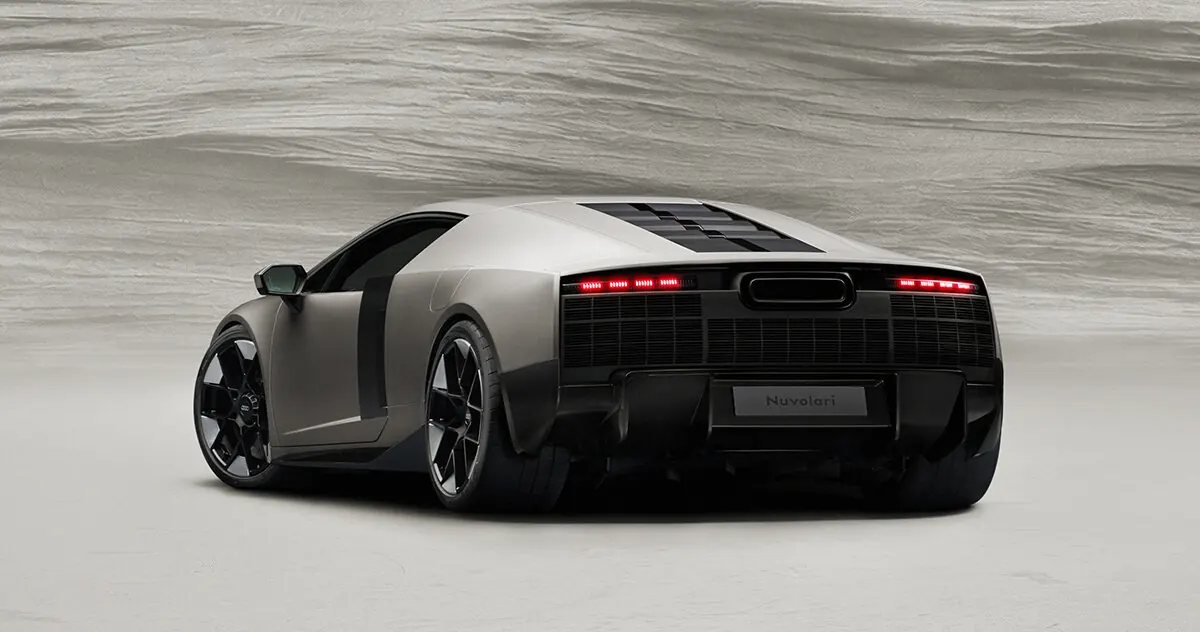
Audi presented the Nuvolari hybrid supercar to the public at The Quail, a key event within Monterey Car Week, bringing a near-production prototype onto a lawn filled with historic racers and rare collector cars. First shown in Antibes, France, in June, the limited-edition model is restricted to 499 examples, with European orders opening later this year and first deliveries scheduled for the first half of 2027.
The number central to the Nuvolari story is 405. That is the number of days that passed between the first design sketch and a drivable prototype, a compressed development cycle that Audi used to test a different approach to vehicle creation. Designers worked directly with teams responsible for vehicle technology and aerodynamics, while powertrain engineers joined the process from the beginning. Development moved through testing facilities in Lapland, southern Spain, Nardò, and Audi locations in Germany. Formula 1 drivers Gabriel Bortoleto and Nico Hülkenberg joined testing once the prototype could be pushed at speed.
Key facts
| Attribute | Detail |
|---|---|
| Development timeline | 405 days from first sketch to drivable prototype |
| Production limit | 499 examples |
| Combined power output | 1,001 PS (736 kW) |
| 0-100 km/h | 6 seconds |
The Nuvolari is the first series-production vehicle to wear Audi’s new design language, giving the project a role beyond its performance figures. Chief Creative Officer Massimo Frascella’s team has reduced the body to taut surfaces and a monolithic mid-engine silhouette, with functional openings integrated into the volume rather than applied as separate graphic elements. Almost every exterior panel is carbon-fiber-reinforced polymer, and the Titanium paint links the car visually with both the Concept C and Audi’s 2026 Formula 1 machine.
Inside, the same reduction principle continues around the driver. The forward section of the cabin stays dark and concentrates the main controls within the driver’s field of view, while a lighter Shadow Dune tone appears behind it. Physical controls remain part of the interface, and anodized aluminum frames the central display. Carbon structure is exposed in the lightweight seats, reinforcing the sense that the cabin was designed around driving position and immediate feedback.
Powertrain and engineering highlights
Behind the seats sits a 4.0-liter V8 biturbo paired with three axial-flux electric motors for a combined 736 kW, or 1,001 PS. The V8 can spin to 10,000 rpm, while the full system sends the Nuvolari from 0 to 100 km/h in 2.6 seconds and on to more than 350 km/h. Audi states those figures will make it the fastest and most powerful production car in the company’s history.
The more interesting engineering sits in the way its different systems interact. Audi calls that system quattro predictive ride. Sensor data feeds a vehicle model that anticipates changes in grip, then adjusts torque distribution and braking while the active aerodynamics shift in parallel. Two electric motors on the front axle can vary torque between the wheels, while the deployable rear wing changes position according to speed and driving mode. A steering-wheel DRS control can flatten the wing on straights, borrowing a visible piece of Formula 1 logic for the road.
Development process and organizational speed
Audi’s speed with the Nuvolari was organizational as much as mechanical. The 405-day timeline relied on a compact project team with shorter decision paths, while the physical program moved quickly from sketching to cold-weather runs, wind-tunnel work, suspension tuning, and high-speed testing. Bortoleto drove the car at Nardò and Hülkenberg tested it in Neustadt an der Donau, feeding race-driver input into a vehicle that Audi already plans to put into customers’ hands.
Seen among the historic coachwork and contemporary exotica at The Quail, the Nuvolari made Audi’s current transition unusually tangible. The car introduces a new visual language while tying the brand’s Formula 1 program directly to a road-going hybrid, and its compressed development process may prove just as influential inside Audi as its performance figures. For all the attention around 1,001 PS, the more revealing number may still be 405.
Why this matters for design and technology readers
The Nuvolari demonstrates how compressed development timelines, cross-disciplinary collaboration, and direct technology transfer from motorsport can produce a production vehicle that redefines a brand’s visual identity. For readers following automotive design, materials science, and hybrid powertrain integration, the project offers a case study in organizational efficiency and design coherence under extreme time pressure.
Source: Designboom – 405 days from sketch to supercar, Audi Nuvolari arrives in Monterey
Source
Designboom Original publication: 2026-08-17T21:13:38+00:00
Related news
Scaffolding as Interior Architecture: Adaptable Systems Challenge the Divide Between Temporary and Permanent
A new article by Jonathan Yeung examines how modular scaffolding systems, from steel frames to Dieter Rams’ shelving, demonstrate that longevity in…
Read more
MIV Architects Proposes Wetland Pavilion That Prioritizes Non-Human Habitats Over Human Comfort
The Spanish firm’s “Nidos de Agua” concept for the Albufera natural park in Valencia aims to rebalance the relationship between building and…
Read more
Nelson Byrd Woltz Begins Construction on Restorative Eagle Courtyard at Walter Reed Medical Center
Construction has started on a redesigned Eagle Courtyard at Walter Reed National Military Medical Center, led by Nelson Byrd Woltz Landscape Architects.…
Read more
London’s listening bar boom reflects a deeper shift in hospitality design and music culture
A wave of Japanese-inspired listening bars is reshaping London’s nightlife, but owners and critics are asking whether the concept can survive commercial…
Read moreRelated wiki

Adaptive Reuse in Architecture
Reference page for reuse, retrofit, conversion, embodied carbon and design constraints.
Read more