
When the Ground Stops Behaving Like Ground: Six Amphibious Homes That Rise and Float With the Water
From the Netherlands to Vietnam and Ecuador, a growing body of residential architecture begins from a different premise: that stable ground is no longer guaranteed. Six projects show how homes can float, rise, and adapt.
Most houses begin with an assumption that rarely has to be stated out loud: the ground will stay where it is. A foundation locks the building to a site, and everything above it is organized around that fixed point. But in flood-prone areas, that agreement becomes uncertain. Water crosses the garden, reaches the walls, and can turn a foundation into one of the home’s biggest vulnerabilities. Across Vietnam, Ecuador, the Netherlands, and the River Thames, a growing body of residential architecture starts from a different premise. Amphibious houses sit on land through ordinary conditions and rise when floodwater arrives, while floating homes live permanently on buoyant foundations. The six projects gathered here move between those conditions at very different scales. They together ask what a home becomes once stable ground is no longer guaranteed.
Key facts
| Project | Location | Type | Key Feature |
|---|---|---|---|
| Formosa by Baca Architects | Buckinghamshire, UK | Amphibious | Concrete base in wet dock; rises 2.5m; survived 2019/2020 floods |
| Floating Bamboo House by H&P Architects | Vietnam | Amphibious/Floating | Bamboo frame, reused plastic drums; 36 sqm prototype for Mekong Delta |
| The Float by Studio RAP | Leiden, Netherlands | Floating | Origami-inspired timber shell, cork exterior; completed 2021 |
| Las Balsas by Natura Futura | Babahoyo River, Ecuador | Floating | Rehabilitation of 7 historic river houses; floodable paths and shared platform |
| Spoorweghaven by MAST | Rotterdam, Netherlands | Floating district | 100+ apartments on prefabricated timber floating bases; proposal stage |
Baca Architects’ Formosa in Buckinghamshire
Baca Architects’ Formosa looks almost conventional from the riverbank in Buckinghamshire, which is part of what makes its engineering so striking. The 225-square-meter house rests inside a wet dock on the Thames and behaves like a fixed building through dry weather. When floodwater fills the dock, a concrete base provides buoyancy and four vertical guideposts keep the structure in position as it rises. Flexible service pipes move with the building, allowing electricity and water connections to travel upward with it. The house can rise more than 2.5 meters, and during the severe floods of 2019 and 2020, Baca says it lifted and settled back down as designed. The decision to make Formosa amphibious also preserves a simple relationship with its garden. Raising the whole building permanently above the projected flood level would have placed the main floor almost a story above the landscape. Here, the entrance and living spaces stay close to the ground until the river changes the section of the house for them. Baca says the system added around 20 percent to the cost of a comparable conventional house with a basement, so the ability to rise still begins with specialized foundations and flood-specific planning.
H&P Architects’ Floating Bamboo House in Vietnam
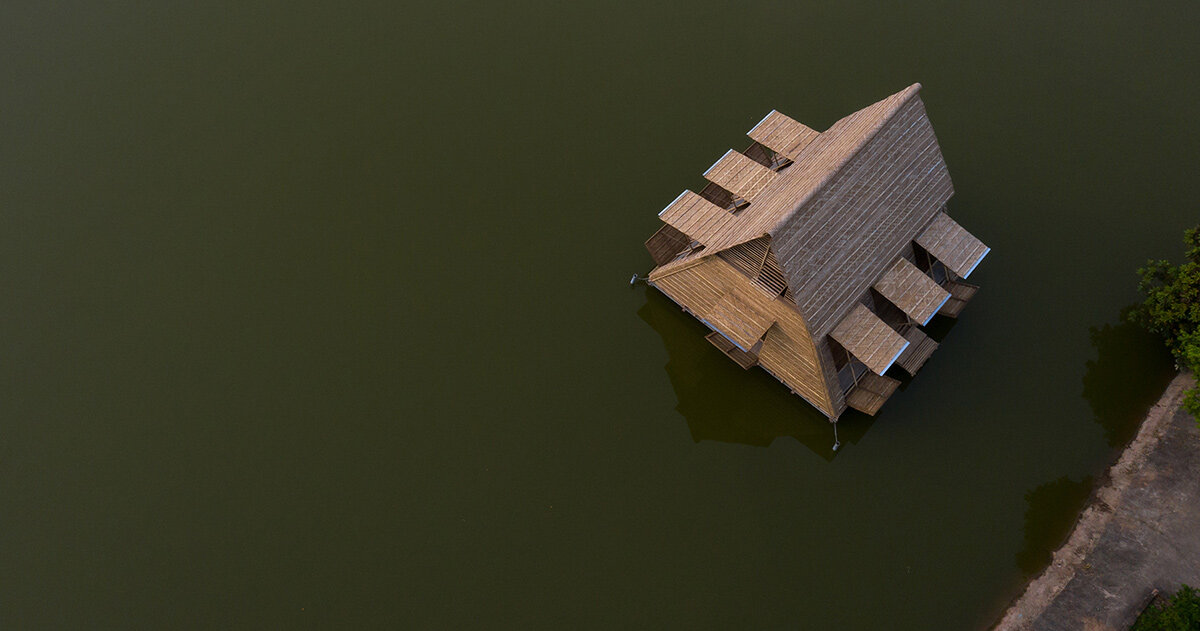
H&P Architects makes that ability to float completely visible in its Floating Bamboo House prototypes in Vietnam. Solid-core bamboo poles form the compact frame, with woven bamboo panels and other lightweight coverings closing the exterior. Beneath the floor, reused plastic drums provide the buoyancy. A broad pitched roof collects rainwater and supports solar energy, while freshwater storage and septic tanks sit near the center of the structure. The first prototype measures just 36 square meters, yet its tall interior gives the small footprint a surprising amount of volume. The studio developed the project as a housing model for river-based communities, especially those connected to the Mekong Delta, where seasonal flooding already shapes settlement and work. Floor panels on the upper level can be removed to open a larger communal space, and H&P imagines multiple houses eventually joining through floating play areas and food-growing rafts. Conceived with households of limited means in mind, the proposal begins with one small home tied together from bamboo and barrels, then lets the domestic footprint spread across the surface of the water.
Studio RAP’s The Float in Leiden
Studio RAP’s The Float in Leiden starts from permanent buoyancy, then gives the familiar houseboat an unexpectedly faceted shell. The studio broke the residence into smaller volumes and rotated them toward the landscape across the canal, filling the gaps with folded wall and roof planes. Solid cork wraps the exterior in a textured brown skin, while cross-laminated timber remains exposed inside. The structural folds draw from origami principles and allow the timber shell to span farther with less material. Completed in 2021, the house makes water feel like an ordinary site condition instead of an event the architecture waits to survive. Its construction still depends on the particular demands of flotation, mooring, weight, and service connections, yet those systems recede behind the experience of rooms facing the canal. By then, buoyancy starts to feel like any other construction constraint, something the architect works through before attention returns to space, material, and view.
Natura Futura’s Las Balsas in Ecuador
Natura Futura’s Las Balsas brings a very different history into the conversation because floating habitation along Ecuador’s Babahoyo River predates the current climate-adaptation debate by generations. Around two centuries ago, more than 250 floating houses occupied the river. By 2010, more than 80 families had been relocated to municipal housing six kilometers away, separating many residents from river-based work and community ties. Roughly 25 floating homes remain today. Natura Futura worked with residents and collaborators to rehabilitate seven existing houses while restoring the riverbank around them. The project treats the river as part of the neighborhood itself. Mobile access points connect the houses to 150 meters of floodable paths and a shared platform, while dry sanitation systems reduce wastewater entering the river. The architecture draws on local timber construction and collective building knowledge instead of introducing an unfamiliar residential model from elsewhere. Las Balsas shifts the chronology of the story: living on water can look futuristic in one context and deeply established in another.
MAST’s Spoorweghaven in Rotterdam
MAST takes the same question to the scale of a district with Spoorweghaven, a proposal developed with BIK Bouw for a disused nineteenth-century dock in Rotterdam. More than 100 apartments would occupy prefabricated timber buildings placed on floating bases and towed into position. Bridges would connect the floating district to the surrounding city, and the project would reclaim an industrial water body for residential use. The proposal remains in development, but it points toward a future where amphibious or floating architecture moves beyond individual houses to become an urban-scale strategy. For architects, planners, and housing authorities in flood-prone regions, the question is no longer whether buildings can float, but how to integrate them into existing infrastructure, zoning, and community life.
Why this matters for Paionia7 readers
For readers following housing, sustainable design, and climate adaptation, these projects offer concrete examples of how residential architecture can respond to rising water levels without abandoning waterfront or riverine sites. The cost premium, regulatory hurdles, and engineering complexity remain significant, but the growing number of built and proposed projects suggests that amphibious and floating homes are moving from experimental to viable. The contrast between high-tech solutions like Formosa and low-cost, locally sourced models like H&P’s bamboo house also shows that the approach is not limited to wealthy countries or custom budgets.
Source: Designboom — https://www.designboom.com/architecture/water-rises-amphibious-homes-float/
Source
Designboom Original publication: 2026-08-19T21:08:45+00:00
Related news
MIV Architects Proposes Wetland Pavilion That Prioritizes Non-Human Habitats Over Human Comfort
The Spanish firm’s “Nidos de Agua” concept for the Albufera natural park in Valencia aims to rebalance the relationship between building and…
Read more
Nelson Byrd Woltz Begins Construction on Restorative Eagle Courtyard at Walter Reed Medical Center
Construction has started on a redesigned Eagle Courtyard at Walter Reed National Military Medical Center, led by Nelson Byrd Woltz Landscape Architects.…
Read more
London’s listening bar boom reflects a deeper shift in hospitality design and music culture
A wave of Japanese-inspired listening bars is reshaping London’s nightlife, but owners and critics are asking whether the concept can survive commercial…
Read more
Performing Colonial Toxicity Exhibition in Valencia Examines Architecture’s Role in Nuclear Colonialism
From 24 October to 1 November 2026, Aguas Internacionales in Valencia hosts Samia Henni’s exhibition on French nuclear testing in the Algerian…
Read moreRelated wiki

Adaptive Reuse in Architecture
Reference page for reuse, retrofit, conversion, embodied carbon and design constraints.
Read more