Contemporary Bookbinding Elevates Craftsmanship into Visible Design Language
A new generation of artists is transforming bookbinding from a hidden craft into a prominent design element, showcasing exposed stitching, sculptural endbands, and innovative structures.
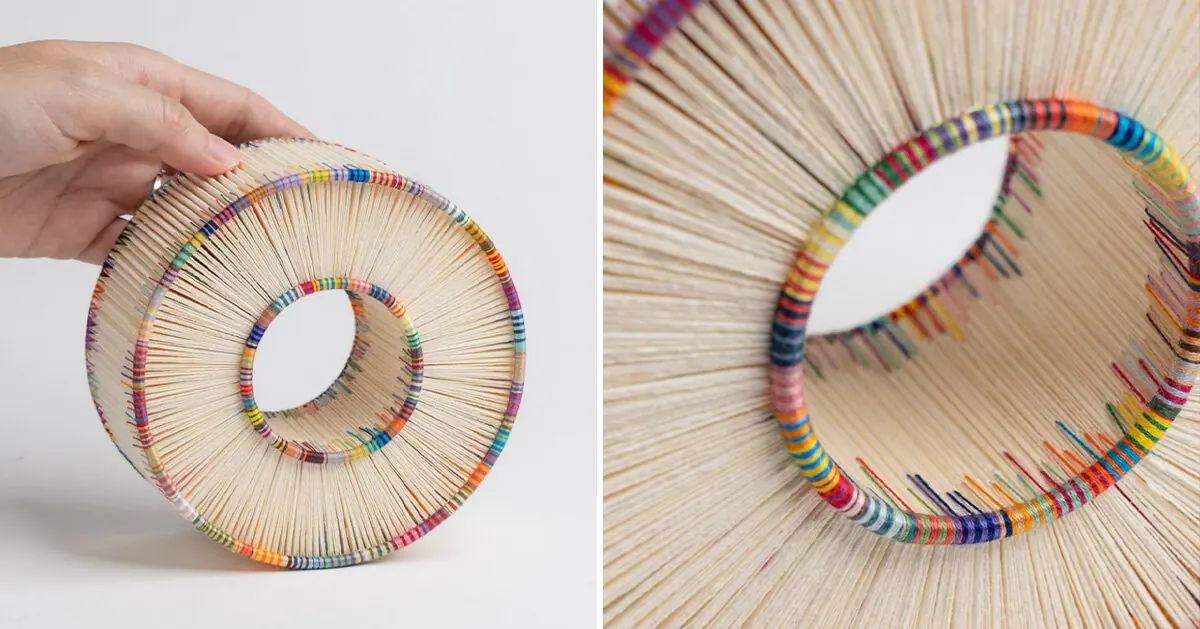
A significant shift is underway in the world of bookbinding, moving the craft from an invisible art form to a central element of design. Traditionally, the highest levels of bookbinding focused on concealing the intricate engineering that held a book together, emphasizing durability and restraint to allow the text to take center stage. However, a new wave of artists and artisans are embracing the construction of books as a visual language, transforming what was once hidden beneath the surface into a deliberate and expressive feature.
The Art of Making Visible
Singaporean artist Adelene Koh exemplifies this trend. Her work, “Endless,” a finalist for the 2026 Loewe Foundation Craft Prize, features a brightly embroidered endband that dramatically escapes the book’s head, looping into space before rejoining the spine. This detail, typically a small structural component, becomes an autonomous sculptural gesture. Koh’s other pieces further reveal the book’s anatomy by using materials like fish-skin parchment, aluminum wire, or vibrantly colored threads for stitching, inviting viewers to examine the construction usually hidden by a cover.
These makers, operating from studios across the globe in cities like Singapore, Chicago, Haarlem, Tokyo, Arezzo, and New York, may differ in style and material, but they share a common impulse: to treat the mechanics of bookbinding as a creative medium. Exposed sewing, floating spines, intricate woven structures, and experimental folds are now compositional elements that turn the codex into an object that rewards close observation and tactile engagement, not just reading. Traditional techniques like Coptic sewing are presented alongside modern innovations such as laser-cut paper, and juxtapositions like translucent vellum meeting industrial aluminum highlight the reimagining of centuries-old structures.
Rethinking Structure and Visibility
Benjamin Elbel, a French bookbinder based in Haarlem, investigates the precise relationship between structure and visibility through his project “Bookbinding Out of the Box.” His bindings are designed to open nearly flat, and by stripping away superfluous decoration, he foregrounds the joints, hinges, and board attachments. Elbel treats the book’s movement and structural components with the same care as its aesthetic appearance.
For Chicago-based artist Karen Hanmer, the binding’s structure carries narrative weight. She begins each book with the text itself, meticulously choosing sewing methods, materials, and construction techniques to echo the themes within the pages. Some of her books feature exposed stitching to visually convey vulnerability, while others employ restrained, traditional leather bindings that reflect the stories they house. Hanmer has spoken about bookbinding as the point where she found a tangible connection to making, a physical engagement that photography could not provide, allowing readers to interact with the object through touch as well as sight.
Thread as a Design Element
Thread, perhaps the most ordinary component of a book, is also undergoing a transformation. Historically, thread’s primary function was to bind folded gatherings of paper into a durable object. It typically remained unseen within the spine, reappearing only as a thin line at the head and tail. Contemporary bookbinders are now using thread on the surface as a means of drawing, adding texture, and creating sculptural forms. Stitches form rhythmic patterns across the spine, and colorful endbands, once purely functional for strengthening the book block, are now enlarged, exaggerated, or extended beyond their practical purpose. Adelene Koh’s work vividly illustrates this shift, with embroidery thread, aluminum wire, and hand-sewn endbands extending outwards from the spine, forming distinct sculptural elements that draw attention to the usually hidden aspects of book construction. This renewed focus on sewing celebrates the visible traces of the making process, where each knot and stitch becomes a record of a decision and an integral part of the finished object.
The Kinetic Book
Beyond sewing, folding techniques are also being explored to redefine how a book moves and interacts with the reader. Hedi Kyle, an American artist and conservator, has challenged the conventional notion of pages turning one after another. Through a diverse array of folded structures, including her influential Flag Book and Blizzard Book, Kyle has transformed the codex into a kinetic object whose meaning unfolds through its manipulation. By closely examining historical bindings, maps, archival enclosures, and conservation techniques, Kyle discovered novel possibilities within familiar forms. A repeated fold can create an expansive landscape, an accordion structure can become an architectural volume, and a book can open in multiple directions simultaneously, prompting readers to navigate space rather than simply progress linearly from beginning to end.
Key facts
| Artist/Artisan | Notable Technique/Contribution | Location |
|—|—|—|
| Adelene Koh | Exposed sculptural endbands, visible stitching with diverse materials | Singapore |
| Benjamin Elbel | Minimalist constructions foregrounding structure and movement | Haarlem |
| Karen Hanmer | Binding structure echoing textual themes, exposed stitching for vulnerability | Chicago |
| Hedi Kyle | Kinetic and folded book structures, transforming the codex through movement | USA |
This evolution in bookbinding highlights a growing appreciation for the tangible and structural aspects of objects, aligning with Paionia7’s focus on design, materials, and innovative craftsmanship. It demonstrates how traditional crafts can be reinterpreted through a contemporary design lens, making the hidden processes of creation visible and integral to the final product’s aesthetic and conceptual value.
Source: Designboom, https://www.designboom.com/design/book-together-closer-look-contemporary-bookbinding/
Datos clave
| Punto | Detalle |
|---|---|
| Fuente | Designboom |
| Fecha | 2026-07-07T20:00:19+00:00 |
| Tema | what holds a book together? a closer look at contemporary bookbinding |
Source
Designboom Original publication: 2026-07-07T20:00:19+00:00
Related news

Handwoven Teak and Cord Outdoor Seating Debuts from Masaya and Abril Zepeda
Nicaraguan furniture brand Masaya has introduced two new handcrafted outdoor chairs — a rocking chair and a lounge chair — designed by…
Read more
Place in Mind: Hendricks Churchill Launches Hospitality Group to Revive Historic Properties
The architecture and interior design studio Hendricks Churchill has launched Place in Mind, a new hospitality group focused on acquiring, restoring, and…
Read more
Adalberto Dias Architects Complete Restoration of Lisbon’s Patriarchal Cathedral and Archaeological Center
The restoration of the Sé de Lisboa by Adalberto Dias Arquitecto integrates a new archaeological center, preserved cloisters, and seven centuries of…
Read more
Vantieghem Talebi’s ‘House of Cards’ Brings Timber Geometry to Belgian Family Home
A new family house in Belgium by US- and Swiss-based practice Vantieghem Talebi uses a steeply pitched, card-house-inspired form clad in Douglas-fir…
Read moreRelated wiki

Adaptive Reuse in Architecture
Reference page for reuse, retrofit, conversion, embodied carbon and design constraints.
Read more