
ecoLogicStudio Puts Algae, Fungi and Bacteria to Work as Building Systems
London studio ecoLogicStudio has spent two decades specifying microalgae, mycelium and cyanobacteria as building components rather than decoration. Its DeepForest³ installation in Milan shows what the approach looks like at room scale — and how much of the performance case still rests on studio-reported figures.
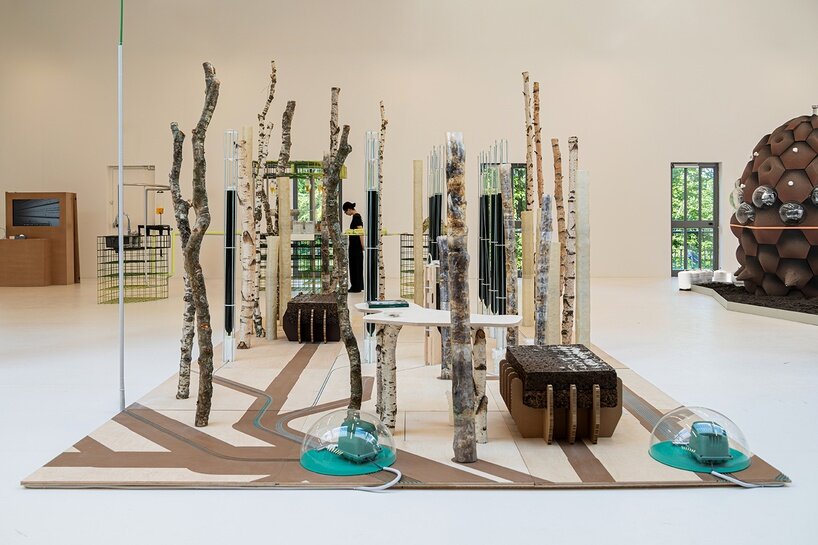
ecoLogicStudio, the London studio co-founded by Claudia Pasquero and Marco Poletto in 2005, installed DeepForest³ on an upper floor of the Triennale Design Museum in Milan, where it was presented as part of the exhibition “We the Bacteria: Notes Toward Biotic Architecture.” The show was curated by Beatriz Colomina and Mark Wigley, whose book of the same name was published by Lars Müller Publishers as a sequel to “Are We Human?”
For readers who specify building services, the installation is less a spectacle than a parts list. The studio has begun naming components after the functions they are meant to replace, and its earlier pavilions supply the numbers behind those names.
A parts list instead of a metaphor
DeepForest³ contains no soil, moss or leaves. It arranges three element types. The studio calls the first “biodegraders”: upright, bark-like shells 3D-printed from algae biopolymers that host living mycelium networks. The mycelium is fed on coffee grounds and develops a sinewy layer that the studio presents as a form of insulation. The second type, “photosynthesizers,” consists of glass vessels holding 50 litres of living cyanobacteria, described as actively capturing CO₂ from the gallery air. The third, “carbon storers,” digests waste material and supports living lichen. Tubes, seams and cords remain visible throughout.
Poletto describes the result as a “fully functional and tangible biotechnological living system, grounded in the metabolic cycles of algae and fungi.” That framing is the studio’s own; no independent measurement of the gallery’s air quality before and after installation was cited in the published account.
Key facts
| Project | Where and when | Stated system |
|---|---|---|
| DeepForest³ | Triennale Design Museum, Milan, 2025 | Algae-biopolymer shells with mycelium, 50 litres of cyanobacteria, lichen |
| Healthcare garden | Nyon, Switzerland | 36 borosilicate glass bioreactors, 350 litres of Chlorella, 150 litres/minute air flow |
| CryoflorE | MUDAC Solar Biennial, 2025, with University of Innsbruck | Cyanobacteria driving currents along embedded copper wiring |
| Urban Algae Folly | EXPO Milano 2015, Future Food District | Spirulina growing inside a triangular-panel canopy |
Two earlier prototypes carry the technical claims
At EXPO Milano 2015, in the Future Food District, the studio built Urban Algae Folly: a canopy of triangular panels with Spirulina, a nutritious microalga, growing inside them. Growth increases in sunlight, thickening the shade; a visitor standing underneath releases CO₂ that feeds the culture. The loop is the point — comfort and cultivation in one envelope.
In Nyon, Switzerland, the studio built what it calls the world’s first biotechnological healthcare garden combining air-purifying algae with medicinal plants. The structure is a circular, tent-like enclosure of semi-transparent fabric. Inside, 36 borosilicate glass bioreactors hold 350 litres of Chlorella cultures, filtering a stated 150 litres of polluted air per minute. The “world’s first” designation is the studio’s characterisation and has not been independently confirmed.
CryoflorE moves the idea from object to grid
With the Synthetic Landscape Lab at the University of Innsbruck, ecoLogicStudio produced CryoflorE, a near-hexagonal model resembling a miniature city of towers filled with cyanobacteria. The organisms capture and channel electrons generated during photosynthesis into electrical currents running along copper wires embedded in the modelled streetscape. It was shown at MUDAC’s 2025 Solar Biennial, Soleil·s. The studio describes it as an initial step toward simulating a city on bio-solar networks — a model, not a functioning installation.
The argument behind the objects
Colomina and Wigley’s book attacks the sterility impulse in contemporary architecture, treating the drive to eliminate bacteria as a threat to human and planetary health. Pasquero’s position is explicit: “we are microbial ecosystems, we are algorithmic networks,” she said, adding that the home becomes an extension of those systems — “our home is our microbiome.” Read against that argument, DeepForest³ is a test case rather than a product.
What remains unverified
The published material reports no measured CO₂ removal rate, no comparison against mechanical ventilation, and no accounting of the light, pumping and nutrient inputs the bioreactors require. Durability of the 3D-printed biopolymer shells is not stated. Contamination control in a healthcare setting — the most demanding of the studio’s applications — is not described. These are normal gaps in design-media coverage, not evidence of failure, but they are the figures an architect would need before treating any of it as a specification.
What to check next
Ask for measured air-quality data against baseline, not design intent. Ask what the algae cultures consume in lighting and pumping energy across a year. Ask how bioreactors are cleaned and how cultures are kept from crashing. Ask for the tested service life and end-of-life route for the biopolymer shells. Until those answers are published, treat the projects as credible prototypes with strong conceptual framing and an open performance question.
Source: designboom, https://www.designboom.com/architecture/how-ecologicstudio-uses-living-organisms-to-build-better-spaces-for-living/
Source
Designboom Original publication: 2026-11-01T21:45:07+00:00
Related news
Jaguar Turns Knightsbridge Flagship Into Architectural Showcase for Type 01
Jaguar has overhauled its Knightsbridge flagship in London, pairing a restaurant by a Michelin-starred chef with a two-car display space that is…
Read more
Milimetrik Architects turns Istanbul’s Rami Library into a 91,000-sqm temporary landscape for family play
AileFest 2026 used modular timber-and-steel pavilions, chromatic gathering nodes and house-shaped book-fair booths to adapt the historic Rami Library courtyard and interiors…
Read more
NEST — The Canopy Village Proposes Elevated Forest Hospitality for Squamish, British Columbia
A concept by Razieh Shams Aalm lifts prefabricated accommodation pods into the forest canopy above Squamish, British Columbia, pairing an elevated structural…
Read more
Herzog & de Meuron to Turn a Former Birkenstock Warehouse Into the Eames Institute Museum in Novato
Herzog & de Meuron and EHDD will convert a 1965 McGraw-Hill warehouse in Novato, California, into the Eames Institute of Infinite Curiosity…
Read moreRelated wiki

Adaptive Reuse in Architecture
Reference page for reuse, retrofit, conversion, embodied carbon and design constraints.
Read more