How to Read a Sustainable Office Case Study
Many sustainable office case studies mix design storytelling with performance claims. Here is a practical way to tell whether a case study shows verified evidence, predicted outcomes, or mainly marketing language.

How to Read a Sustainable Office Case Study
Short answer
Summary box: A useful sustainable office case study should say whether it is describing design intent, projected performance, certification, or measured results in use. The strongest examples explain what was assessed, how it was assessed, and what the claim includes. If a case study relies mostly on broad language such as “green” or “future-proof” without metrics, scope, or verification, it is better read as partial evidence rather than a full sustainability verdict.
A simple test helps: is the document showing evidence, or mainly aspiration? Buildings are part of wider systems of resource use, so careful language matters. A persuasive project story is not the same thing as a demonstrated outcome.
Why these case studies can be hard to judge
Sustainable office case studies often combine architecture, branding, technical claims, and workplace experience in one polished narrative. That does not make them unreliable by default, but it does mean readers should separate what the project aimed to do from what has actually been demonstrated.
It also helps to remember that sustainability is not one single measure. Energy use, material impacts, indoor comfort, and day-to-day operation can point in different directions. A project may look thoughtful in one area while leaving major gaps in another.
Step-by-step: how to evaluate the claims
Identify the claim type first
Many office case studies mix several kinds of claims together. In practice, it helps to sort them into four working categories: design intent, projected performance, certification, and measured operation. These are not interchangeable.
- Design intent explains what the team set out to achieve.
- Projected performance refers to expected outcomes based on analysis, simulation, or other pre-occupancy assessment.
- Certification shows that a project has met criteria within a named framework and scope.
- Measured operation refers to results observed in use.
If the case study does not clearly distinguish among those categories, the risk of over-reading it increases.
Read energy claims with caution
Energy claims are usually the first place to test substance. Look for whether numbers are projected or measured, whether units are given, and whether any comparison uses a stated baseline. Without those basics, a phrase like “low-energy office” is too vague to assess confidently.
It is also worth asking what sits inside the claim boundary. In office buildings, outcomes can vary with occupancy, controls, user behaviour, and operating conditions. Research on office thermal comfort also shows that comfort strategies and energy use are connected rather than separate issues.
Separate materials language from evidence
Material claims are often visually persuasive. Timber, recycled content, exposed structure, and “natural” finishes are easy to photograph and describe. But visible material choices do not by themselves prove low life-cycle impact.
A stronger case study explains what was assessed and how. If the language stays at the level of adjectives, readers should treat the claim carefully. Date-checked note: this article was reviewed against the available source set in 2025, and that set does not include a strong primary methodology source for embodied-carbon accounting. For that reason, this guide avoids detailed claims about specific carbon calculation methods.
Treat comfort claims as evidence questions
Office case studies often link sustainability with daylight, planting, views, fresh air, or calm interiors. Those qualities may matter, but photographs alone do not verify thermal comfort, glare control, acoustics, or indoor air quality.
If a case study discusses comfort, check whether it mentions monitoring, occupant feedback, simulation, or another stated assessment method. Office comfort research also suggests that comfort is adaptive and context-dependent, which is one reason to be cautious about blanket claims of a universally “healthy” or “productive” workplace.
Look for operations, not only design features
Operations are often the missing layer in sustainability storytelling. A building can be carefully designed and still perform differently in use if systems are not tuned well, if occupancy shifts, or if management practices do not support the original strategy.
That makes any mention of follow-up review, performance in use, or ongoing management especially useful. At a wider scale, resource-efficiency discussions also place buildings within larger systems rather than treating them as isolated objects.
Comparison table: claim, symptom, and what to check
| Case-study claim | Symptom of a weak claim | What to check next | Safer reading if evidence is thin |
|---|---|---|---|
| Low-energy office | No units, no baseline, no indication of projected vs measured data | Look for numbers, boundaries, and whether results are in use or pre-occupancy | Treat it as an efficiency ambition, not proven performance |
| Sustainable materials | Reliance on words like “natural,” “green,” or “responsible” alone | Look for stated assessment scope or explained method | Treat it as a design choice with unclear impact |
| Healthy workplace | Photos and mood language stand in for evidence | Look for comfort, air quality, acoustics, glare, or user-feedback methods | Treat it as a workplace intention, not verified wellbeing |
| Powered by renewables | Broad percentage claim with little detail | Look for scope and how the renewable claim is defined | Treat it as incomplete energy-supply information |
| High-performance facade | Technical wording without results | Look for link between facade strategy and stated outcomes | Treat it as a design feature, not evidence of whole-building performance |
| Certified project | Badge or label mentioned without scope or stage | Look for which framework, version, and what the certification covers | Treat it as one layer of evidence, not a total sustainability verdict |
Myth vs reality
Myth: Certification proves the whole building is sustainable
Reality: Certification may be useful evidence, but it still reflects a defined framework and scope rather than a universal verdict.
Myth: Sustainable-looking materials automatically mean low impact
Reality: Appearance and environmental performance are not the same thing. Material claims are stronger when tied to an explained assessment approach.
Myth: Good daylight automatically means good comfort
Reality: Daylight may help, but office comfort also depends on factors such as thermal conditions, glare, and adaptation to local conditions.
Myth: Smart systems automatically reduce energy use
Reality: Results depend on how the building is actually operated, not just on the presence of advanced controls.
Reader examples
Example 1: Strong design story, weak in-use evidence
A case study may describe shading, mixed-mode ventilation, and planted outdoor space, yet provide no post-occupancy information. In that case, the safest conclusion is that the document mainly shows design intent or projected performance rather than verified operation.
Example 2: Certification highlighted, but little else
Another case study may feature a certification badge and a refined interior while giving little detail on measured energy use or material impact. That may still be useful, but it is only one part of the picture.
Example 3: One strong metric, several missing ones
A third case study might give operational energy figures but say very little about comfort, materials, or ongoing management. That is stronger on one dimension, yet still incomplete overall.
Practical checklist
- Classify the claim: intent, projected result, certification, or measured operation.
- Check for units, baseline, and boundaries in energy claims.
- Ask what was actually verified, rather than what was described attractively.
- Separate operational energy claims from material-impact claims.
- Look for a stated method behind comfort claims.
- Check whether operations or follow-up are mentioned once the building is occupied.
- Note what is missing before drawing a broad conclusion.
Common red flags
- Percentage reductions with no stated baseline
- “Green” language without metrics
- Material claims based mainly on appearance or branding
- Comfort claims supported only by photography
- Certification mentioned without saying what it covers
- No distinction between projected and measured performance
- No operational discussion for a building that is already occupied
What to do next
If a case study is incomplete, narrow the conclusion rather than dismissing the project entirely. You can often say that the building appears to pursue certain sustainability goals while also noting that the available evidence is partial.
A practical next step is to compare more than one source:
- Read the architect or project page for stated design strategies.
- Check an institutional source for wider resource-efficiency context.
- Look for technical or scholarly material that explains the performance topic being claimed.
FAQ
Is a certified office building automatically sustainable?
No. Certification can be meaningful, but readers still need to ask what was assessed, what scope was covered, and whether in-use performance is shown.
Why does measured performance matter?
Measured performance shows how a building behaves under real operating conditions. In offices, outcomes can shift with occupancy, control settings, and use patterns.
Are attractive materials enough to prove sustainability?
No. Material claims are more credible when they are tied to a stated assessment approach rather than visual impression alone.
Can comfort be judged from photos?
Not reliably. Images may suggest daylight or spaciousness, but they do not verify thermal, acoustic, or air-quality conditions.
Sources
Related news
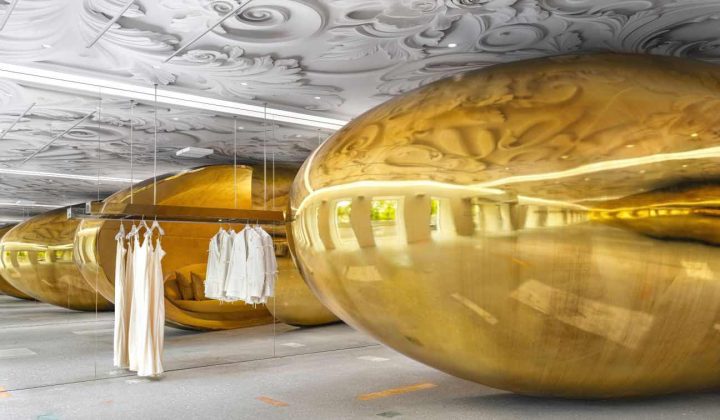
Biomorphic Sculpture Anchors Choux Flagship Store in Moscow by Elena Lokastova
Architect Elena Lokastova designs a two-level retail interior for fashion brand Choux in Moscow, where a gold bean-shaped sculpture and a white…
Read more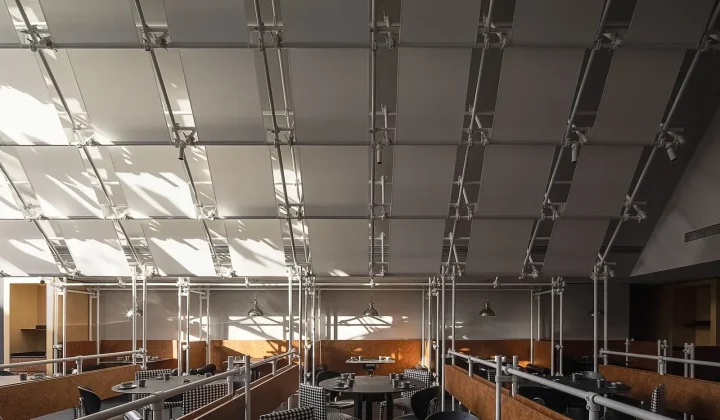
Scaffolding as Interior Architecture: Adaptable Systems Challenge the Divide Between Temporary and Permanent
A new article by Jonathan Yeung examines how modular scaffolding systems, from steel frames to Dieter Rams’ shelving, demonstrate that longevity in…
Read more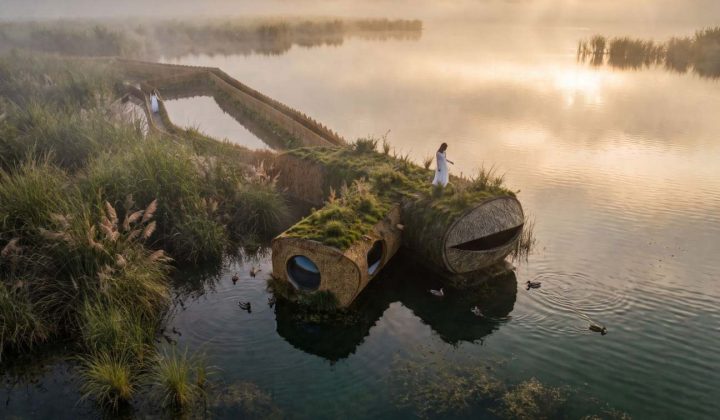
MIV Architects Proposes Wetland Pavilion That Prioritizes Non-Human Habitats Over Human Comfort
The Spanish firm’s “Nidos de Agua” concept for the Albufera natural park in Valencia aims to rebalance the relationship between building and…
Read more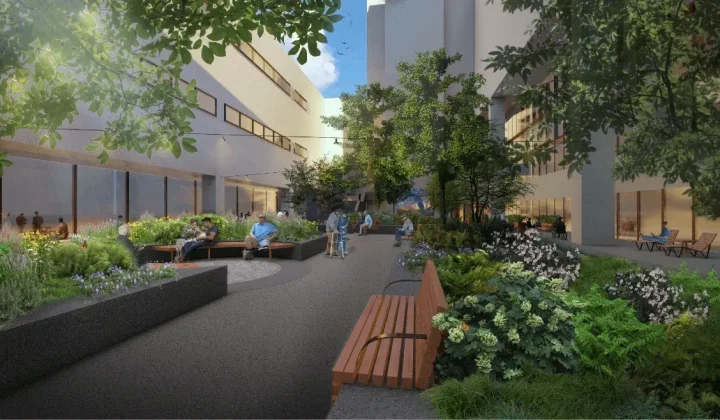
Nelson Byrd Woltz Begins Construction on Restorative Eagle Courtyard at Walter Reed Medical Center
Construction has started on a redesigned Eagle Courtyard at Walter Reed National Military Medical Center, led by Nelson Byrd Woltz Landscape Architects.…
Read moreRelated wiki
Adaptive Reuse in Architecture
Reference page for reuse, retrofit, conversion, embodied carbon and design constraints.
Read more