Privacy Window Film: What Architects Need to Know About Light, View and Limits
A practical breakdown of when reflective, frosted and solar-control films actually work, based on lighting conditions and glazing type – and where they fail.
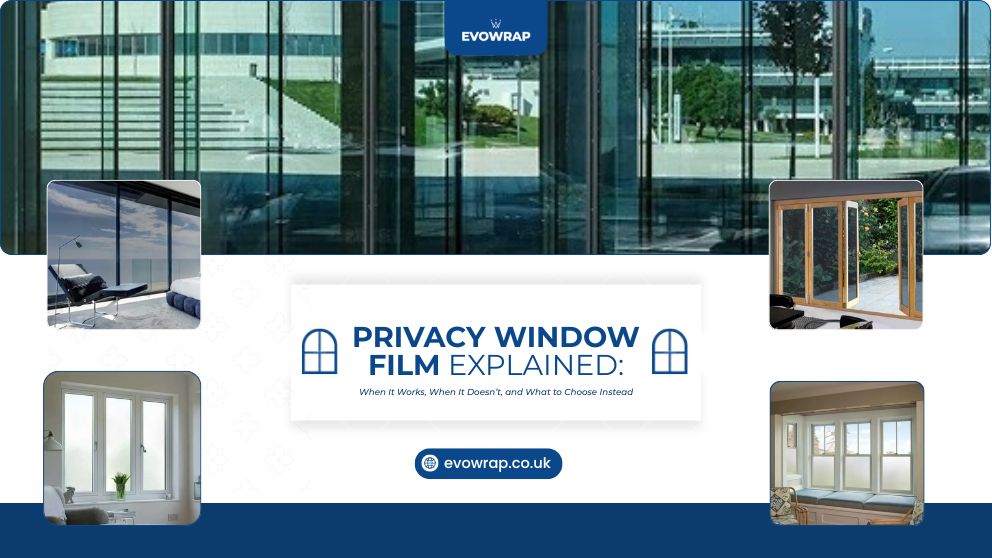
Privacy window film is a common specification for bathrooms, street-facing offices and ground-floor apartments, but its performance depends heavily on lighting conditions and film type. A recent article on Amazing Architecture explains that the popular “one-way mirror” effect of reflective film only works when the outdoor brightness exceeds indoor lighting – a condition that reverses after dark. For architects and interior designers, the distinction between daytime-only privacy and round-the-clock screening is critical when selecting products for different rooms and orientations.
The lighting trap: day vs night
Reflective window film creates a mirror-like surface on the brighter side of the glass. In daylight, that side is typically the exterior, so neighbours see a reflection while occupants look out. At night, with indoor lights on, the balance flips: people outside may see in clearly, while those inside see their own reflection. This is a lighting effect, not a permanent property of the film. The article notes that “standard one way window film does not give reliable night privacy when the room is brighter than outside.” Frosted film, which scatters light, maintains privacy both day and night but eliminates the outward view.
Por que importa
Film types and trade-offs
The article breaks down five main categories: reflective, frosted, patterned, solar-control, and safety/security films. Each offers a different balance of privacy, visibility, daylight, heat control and impact resistance. The table below summarises the key differences.
Key facts
| Type | Day privacy | Night privacy | Outward view | Main limitation |
|---|---|---|---|---|
| Reflective | Strong in suitable light | Weak with lights on | Yes | Requires light balance |
| Frosted | Strong | Strong | No | Removes clear visibility |
| Solar-control | Varies | Not guaranteed | Usually yes | May darken the room |
| Clear safety | Minimal | Minimal | Yes | Protection, not privacy |
Common specification mistakes
The article identifies several errors that occur when film is chosen on appearance rather than performance. These include expecting mirrored film to stay private after dark, selecting film by colour instead of technical data, and assuming UV rejection alone prevents fading. “A UV window film can reduce ultraviolet exposure and slow one major cause of fading. It cannot stop fading because visible light, heat and material quality also contribute,” the source states. Another frequent mistake is treating solar film as a privacy solution without checking its visible-light transmission.
Contexto
Room-by-room guidance
For bathrooms and WC compartments, the article recommends frosted, patterned or opaque finishes. Street-facing living rooms benefit from reflective film combined with curtains or blinds for night use. Home offices can use reflective or lightly tinted solar-control film if glare is a concern. Conservatories require solar-control film selected for orientation and glass type. For low glazing or doors where impact is a risk, rated protective film is the priority, even if it does not add privacy.
Glazing compatibility matters
The article warns that not all films are suitable for every glass type. “An unsuitable high-absorption film may increase thermal stress on certain systems,” it notes. Double-glazed, coated, tinted, toughened or laminated units each have specific film-to-glass compatibility tables. Architects are advised to verify glass construction, condition, orientation and existing coatings before specifying. The source also suggests testing a sample at dusk with the lights on before committing to a reflective product.
For architects and specifiers, the key takeaway is that no single film solves both privacy and visibility at all hours. The best choice depends on the priority: constant screening, daylight retention, heat reduction or impact safety. The full article provides a more detailed comparison of product categories.
Source: Amazing Architecture – Privacy Window Film Explained: When It Works, When It Doesn’t, and What to Choose Instead (https://amazingarchitecture.com/articles/privacy-window-film-explained-when-it-works-when-it-doesnt-and-what-to-choose-instead)
Source
Amazing Architecture Original publication: 2026-07-28T01:13:56+00:00
Related news

SIITUA III to Gather International Researchers on Territory, Urbanism, and Architecture in Lima
The third edition of the International Seminar on Research in Territory, Urbanism, and Architecture (SIITUA III) will take place in Lima, organized…
Read more
Christopher Kane brings streamlined, heritage-driven vision to Mulberry in London Fashion Week debut
The Scottish designer presented his first collection for the British leather goods house at London Fashion Week, blending sharp tailoring, archival references…
Read more
When Film Directors Become Interior Designers: Guadagnino, Lynch, Anderson and Almodóvar Step Off Screen
From Luca Guadagnino’s Zara Home collection to David Lynch’s Paris club and Wes Anderson’s train carriage, a wave of collaborations is blurring…
Read more
Jesus Mari Lazkano Examines Changing Landscapes Through Painting and Animated Film at Basque Luxury Studio
The Basque artist’s exhibition ‘Azken Natura’ brings together six large-scale paintings and a 22-minute animated film that traces the melting of the…
Read moreRelated wiki

Adaptive Reuse in Architecture
Reference page for reuse, retrofit, conversion, embodied carbon and design constraints.
Read more