Suspended Glacier Forms Translate Climate Change into Interactive Installation in Shanghai
Dayuan Design's "Glacier Project" in Shanghai uses recycled materials and visitor interaction to make the abstract concept of climate change a tangible, sensory experience, exploring the interconnectedness of glaciers, oceans, and urban life.
Dayuan Design Studio, in collaboration with ocean conservation nonprofit N.O.C., has unveiled “Glacier Project,” an exhibition and spatial installation in Shanghai that aims to bridge the gap between abstract climate change data and lived human experience. Presented under the theme “Resonance of the Extremes,” the project transforms the distant environmental threat of melting glaciers into a tangible, sensory encounter within the city.
The installation moves beyond mere visual representation, giving physical form to the complex relationship between glaciers, oceans, cities, and human activity. It unfolds across multiple scales, from an outdoor installation to film, sound, artifacts, and a tabletop piece, guiding visitors from the urban landscape into a more intimate engagement with the subject.
Outdoor Installation: Parallel Projections – Glacier Project
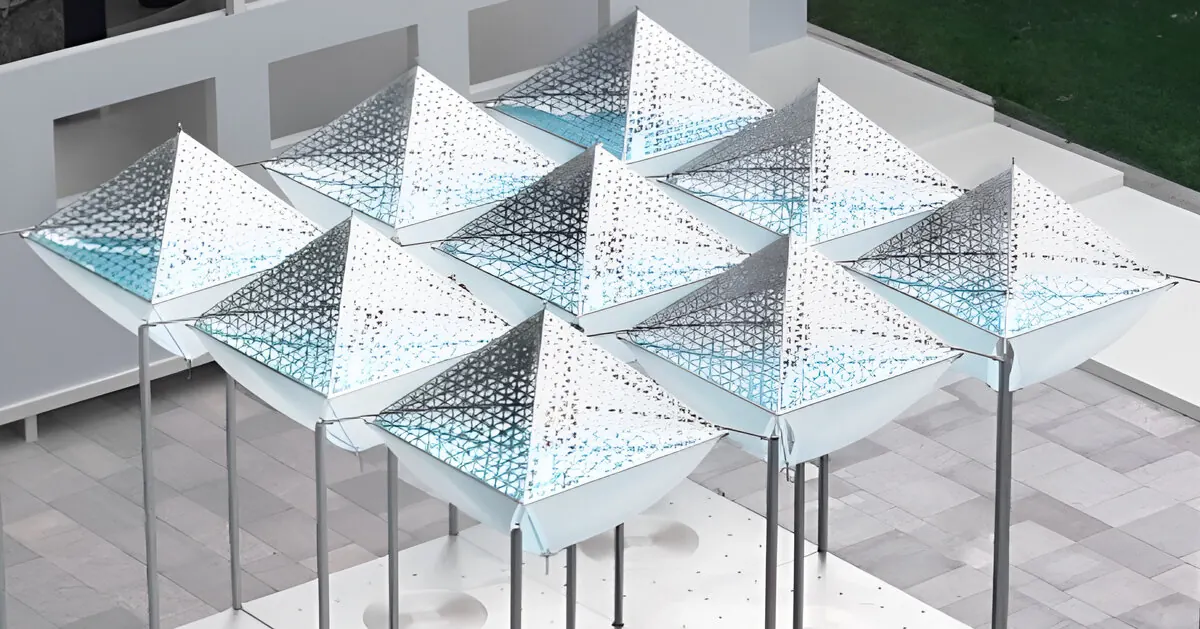
Viewed from a plaza, the outdoor installation features nine suspended geometric forms. These shapes, arranged to evoke a fragmented glacial landscape, reference the visible and submerged aspects of icebergs. Their recurring geometric nature suggests a larger, interconnected glacial system rather than isolated objects, highlighting the dynamic and changing nature of polar environments.
Visitors are invited to interact with suspended components located beneath each geometric form. By pulling these elements, the suspended volumes above contract, fold, and shift. This direct mechanical response, achieved without digital interfaces, creates a tangible link between human action and environmental change, shifting the observer’s role to that of a participant.
Materiality and Sustainability
The material choices for “Glacier Project” underscore its environmental objectives. The installation is designed as a modular system intended for disassembly, transport, and reuse. Primary components include recycled metal, reclaimed waterproof fabric, mirrored stainless steel, and a lightweight structural frame.
Triangular perforations in the metal mesh echo the pores, fractures, and retreating edges of melting glaciers. The increasing size of these perforations from top to bottom allows for greater light transmission, visually transitioning the forms from solidity to fragility. White membrane surfaces mimic the appearance of suspended ice, with changing daylight, air movement, and visitor activity continuously altering shadows and reflections.
The installation also incorporates environmental conditions. Rainwater is channeled through the structure, falling onto metal surfaces and draining through floor perforations. The resulting sound and reflections on wet surfaces integrate weather into the spatial experience, connecting the artwork to broader climatic and hydrological cycles.
Flowing Glacier: A Tabletop Experience
A smaller iteration, “Flowing Glacier,” translates the core themes into a tabletop object for closer observation. This piece uses backflow incense, allowing smoke to descend through a translucent glacial form, mimicking the movement of cold air through valleys or meltwater through crevices. This continuous, small-scale event makes the irreversible passage of time and glacial retreat perceptible.
The sculptural element is crafted using liuli, a traditional Chinese glassmaking technique recognized as intangible cultural heritage. The material’s transparency, light, and permanence contrast with the coldness and vulnerability of glacial ice, merging contemporary environmental concerns with the preservation of cultural continuity.
Exhibition Narrative
The accompanying exhibition, also developed by Dayuan Design and N.O.C., translates research on glaciers, oceans, and climate change into a spatial narrative. The outdoor installation serves as the initial point of contact, leading visitors through spaces dedicated to film, artifacts, sound, and further installations. The exhibition design employs a restrained aesthetic of deep blue volumes and horizontal lines, evoking the sea, glacial strata, and cold light.
Organized as a one-way route through four thematic chapters—Encounter, Remains, Listening, and Resonance—the exhibition progresses from distant observation to sensory engagement and reflection. The “Encounter” chapter, for instance, uses framed openings to align views of the outdoor installation with the surrounding city, prompting contemplation on the artwork’s place within the urban environment.
Key facts
| Aspect | Detail |
|---|---|
| Project Name | Glacier Project |
| Location | Shanghai |
| Designers | Dayuan Design Studio, N.O.C. |
| Theme | Resonance of the Extremes – Climate Change, Glaciers, Oceans, Cities |
| Materials | Recycled metal, reclaimed fabric, mirrored stainless steel, liuli glass |
| Interaction | Physical manipulation of suspended elements |
| Exhibition Scope | Outdoor installation, film, sound, artifacts, tabletop installation |
The “Glacier Project” offers a crucial intervention in how urban populations engage with climate change. By transforming an abstract global issue into a physical, interactive, and sensory experience, it fosters a more personal connection to environmental challenges. The project’s emphasis on sustainable materials and modular design, alongside its integration of traditional craft, demonstrates a holistic approach to design that extends beyond aesthetics to encompass ecological responsibility and cultural preservation. For readers interested in architecture’s role in addressing societal issues, this installation highlights innovative methods for public engagement and the potential for design to foster environmental awareness within urban contexts.
Source: suspended glacier forms translate climate change into an interactive installation in shanghai – Designboom (https://www.designboom.com/art/suspended-glacier-forms-climate-change-interactive-installation-shanghai-dayuan-design/)
Source
Designboom Original publication: 2026-07-03T17:30:30+00:00
Related news
Koto launches Haku, a mobile prefab hotel suite built on a wheeled chassis to bypass UK planning restrictions
UK architecture studio Koto has unveiled Haku, a fully mobile prefabricated suite that legally qualifies as a caravan, allowing landowners and hotel…
Read more
HONG Designworks Completes Private Office in Xi’an That Balances Memory, Materiality, and Long-Term Use
The Xi’an office by HONG Designworks integrates a folded steel staircase, retained furniture from a previous workspace, and a restrained purple-gray palette…
Read more
Handwoven Teak and Cord Outdoor Seating Debuts from Masaya and Abril Zepeda
Nicaraguan furniture brand Masaya has introduced two new handcrafted outdoor chairs — a rocking chair and a lounge chair — designed by…
Read more
Place in Mind: Hendricks Churchill Launches Hospitality Group to Revive Historic Properties
The architecture and interior design studio Hendricks Churchill has launched Place in Mind, a new hospitality group focused on acquiring, restoring, and…
Read moreRelated wiki
Adaptive Reuse in Architecture
Reference page for reuse, retrofit, conversion, embodied carbon and design constraints.
Read more