
How the Venice Architecture Biennale Can Influence Practice Beyond Images
The Venice Architecture Biennale is often discussed through pavilions, installations, and visual impact. A more useful question for practice is what survives the exhibition format and informs methods, material judgment, and the wider debate around cities and resources.

Short answer
Summary: The Venice Architecture Biennale is most useful to practitioners when exhibition ideas become transferable methods, sharper material questions, or better public discussion. Images can shape attention, but practice changes only when ideas can be tested outside the exhibition setting. <!– sources: 1,2,4 –>
Date-checked note: This article does not make event-specific claims about the 2026 Venice Architecture Biennale program, dates, theme, curators, or participants because the verified source set provided here does not include official 2026 Biennale material. It is therefore published as a general analysis rather than 2026 event coverage. <!– sources: 1,2,4,5 –>
Context: why Venice matters beyond the exhibition
Architecture biennales are cultural exhibitions, but they also influence professional conversation through criticism, education, and research. That does not mean every pavilion or installation produces direct change in building delivery. It does mean such events can help define which questions appear urgent and which kinds of evidence or design approaches circulate more widely. <!– sources: 2,4,5 –>
For practice, the key distinction is between visibility and implementation. A project may work well as an installation or argument while still leaving open practical questions about sourcing, durability, maintenance, compliance, or governance. <!– sources: 1,2,4 –>
Where practical influence is most likely to appear
In design methods
Exhibitions can matter through method-making as much as object-making. When curatorial work emphasizes mapping, environmental analysis, research tools, or participatory formats, those approaches may be easier to carry into teaching, publishing, and project development than a single formal image or one-off installation. <!– sources: 2,4 –>
In material scrutiny
Exhibition culture often introduces materials through prototypes, fragments, or staged assemblies. In practice, the more useful questions concern origin, lifespan, maintenance, and end-of-life pathways. The strongest material discussions move from novelty to accountability. <!– sources: 1,2 –>
In systems thinking
UNEP identifies cities as major sites of resource use and environmental pressure. That wider context helps explain why architecture debate increasingly extends beyond form alone toward waste, infrastructure, resource flows, and governance. Within that frame, biennale discourse can support a more systemic understanding of architecture. <!– sources: 1 –>
What to test when exhibition claims aim at practice
A simple decision guide
The most useful question is not whether a project is visually persuasive, but whether its logic can survive outside exhibition conditions. The table below helps separate an effective presentation from a potentially transferable practice idea. <!– sources: 1,2,4 –>
| Biennale signal | What it may show in an exhibition | What would make it more useful in practice | What to verify next |
|---|---|---|---|
| Climate or resource framing | Maps, scenarios, immersive displays | A clear link to adaptation, maintenance, or resource reduction | Whether it connects to real project or urban processes |
| New material proposal | Samples, prototypes, expressive assemblies | Evidence on sourcing, lifespan, repair, and reuse or disposal | Whether the claims are transparent and specific |
| Reuse or retrofit argument | Salvaged elements, before-and-after storytelling | Feasibility, compliance, cost, and operational lessons | Whether it has worked beyond exhibition conditions |
| Social or participatory framing | Workshops, testimonies, public narratives | Ongoing decision structures and accountability | Who made decisions and what changed |
| Digital or research tool | Interfaces, simulations, data displays | A repeatable process others can apply | Data limits, transferability, and use in practice |
A practical list for readers and practitioners
What to ask while reading biennale coverage
- What exact problem is the project trying to address? <!– sources: 1,2,4 –>
- Is the work representational, prototyped, or already implemented? <!– sources: 2,4 –>
- What evidence could still matter after the exhibition closes: data, drawings, maintenance logic, or pilot results? <!– sources: 1,2,4 –>
- Are material or sustainability claims supported by clear evidence rather than branding language? <!– sources: 1,2 –>
- Is there a plausible path from the idea to testing, teaching, specification, or public decision-making? <!– sources: 2,4 –>
Interpretation: what tends to last
Past commentary and scholarship in the supplied source set suggest that the most durable effect of Venice is often methodological or interpretive rather than immediate and physical. What can last is a framework for defining problems, gathering evidence, and positioning architecture in relation to environmental and social systems. <!– sources: 2,4,5 –>
That kind of influence may appear later and elsewhere: in studio briefs, research agendas, critical writing, and the terms used to assess reuse, resilience, and material responsibility. These are meaningful forms of impact, even if they are less visible than exhibition images. <!– sources: 1,2,4 –>
What readers should watch next
Signals worth monitoring
- Whether post-biennale reporting moves from spectacle to implementation. <!– sources: 2,4 –>
- Whether material claims are accompanied by transparent evidence. <!– sources: 1,2 –>
- Whether reuse, repair, or resource-efficiency themes show up in teaching, criticism, or public debate. <!– sources: 1,2,4 –>
- Whether widely discussed projects leave behind methods others can adopt. <!– sources: 2,4 –>
Sources to verify before making stronger 2026 claims
- Official Biennale channels for dates, theme, curators, and participants. <!– sources: 1,2,4,5 –>
- Current Venice-specific reporting rather than a general architecture homepage alone. <!– sources: 2,4 –>
- Project-level documentation for any claim about materials, pilots, or policy relevance. <!– sources: 1,2,4 –>
Bottom line
The Venice Architecture Biennale can influence practice beyond images, but only when its arguments become methods, evidence, or decision tools that others can test and adapt. The most useful reading is neither hype nor dismissal. It is a careful look at what can travel from exhibition space into real architectural work. <!– sources: 1,2,4 –>
Sources
- UNEP: Cities and resource efficiency <!– source:1 –>
- ArchDaily <!– source:2 –>
- What Iran’s absence from the Venice Biennale reveals about art and politics <!– source:3 –>
- What I saw in Venice – Biennale 2021 <!– source:4 –>
- More than just Death in Venice: Irish Pavilion at the Venice Biennale <!– source:5 –>
Related news

Gómez Platero Proposes Four Irregular Towers for Miami Waterfront Site
Uruguayan architecture studio Gómez Platero has unveiled plans for Miami Bay Towers, a mixed-use development with four irregularly shaped skyscrapers on the…
Read more
How Climate-Driven Paver Sealing Extends the Life of Outdoor Architecture in Coastal Florida
A new article from Amazing Architecture highlights the critical role of climate-specific paver sealing in preserving outdoor spaces along South Florida’s coast,…
Read more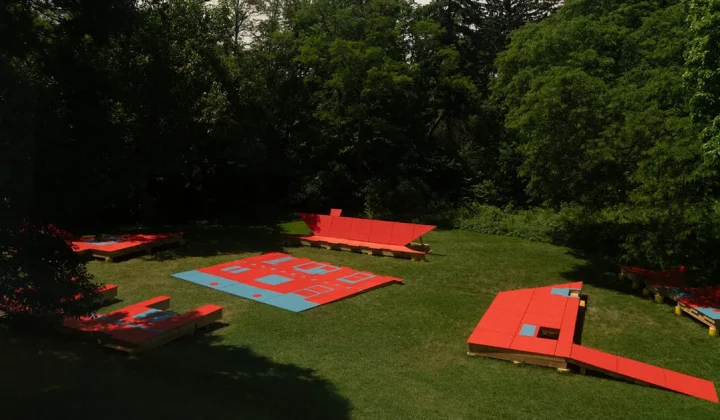
Six Disassembled Facade Fragments Redefine the Ragdale Ring as an Open-Ended Stage
Gluten's winning proposal for the 2026 Ragdale Ring competition in Lake Forest, Illinois, breaks a historic facade into six flat elements scattered…
Read more
Cechvala Architects wraps Bratislava family home in corrugated raw aluminium
Slovakian studio Cechvala Architects has completed RDH, a three-storey family home in Bratislava’s Sihot district, using corrugated raw aluminium cladding across three…
Read moreRelated wiki

Adaptive Reuse in Architecture
Reference page for reuse, retrofit, conversion, embodied carbon and design constraints.
Read more