
Weave Robotics Unveils Isaac 1: A Soft Robot Designed for Household Chores
San Francisco-based Weave Robotics has introduced Isaac 1, a mobile home robot with a collapsible body and fabric shell, designed to tackle domestic tasks like laundry folding and tidying without mimicking human form.
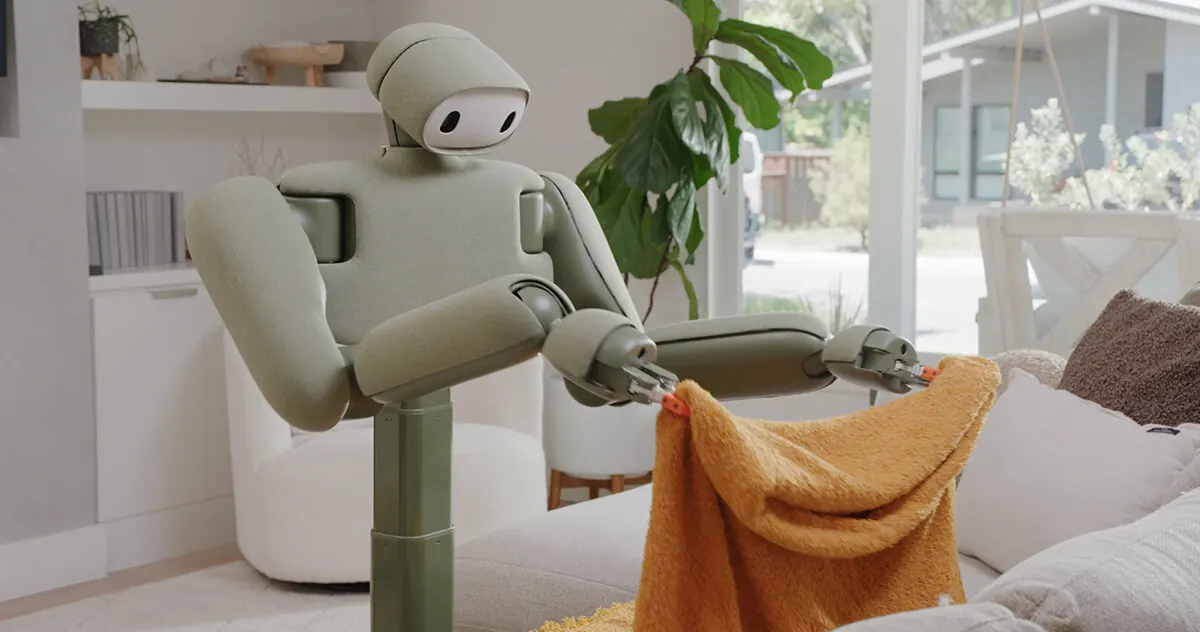
Weave Robotics, a San Francisco-based company, has introduced its latest innovation in home robotics: the Isaac 1. This new machine eschews the common trend of humanoid robots, focusing instead on practical utility for domestic tasks, with a particular emphasis on laundry management and general tidying.
Designed to integrate more seamlessly into living spaces, Isaac 1 features a collapsible body and a soft, removable fabric shell, aiming to appear more like a piece of furniture than a piece of industrial equipment. The robot is built on a wheeled base, allowing it to navigate indoor environments without the complexity of legs.
Home Integration and Design
The Isaac 1 stands between three feet and five feet nine inches tall, adjusting its height based on the task at hand. This adaptability allows it to reach surfaces like beds, counters, and hampers. Its design prioritizes function over form, with a compact footprint of 20.5 by 22 inches, making it suitable for placement within typical home layouts.
The exterior of the robot is wrapped in fabric shells, available in several colors including Sage, Gray, Slate Blue, Terracotta, and Vesper. This design choice is intended to make the robot less intrusive and more aesthetically pleasing in a domestic setting, acknowledging that a robot must coexist with everyday household items and textiles.
Functionality and Operation
The primary function of Isaac 1 is to handle chores such as picking up clothing, managing laundry hampers, folding garments, and putting items away. While designed for autonomous operation, Weave Robotics has incorporated teleoperation support. This feature allows users to step in and guide the robot when it encounters unpredictable situations, a common challenge in the dynamic environment of a home.
Control of the Isaac 1 is managed through a dedicated app, enabling users to schedule chores or summon the robot for immediate tasks. The robot is powered by a battery that offers up to eight hours of operation on a full charge, which takes approximately two hours. These specifications position Isaac 1 as a more practical household appliance rather than a purely experimental device.
Market Availability and Adoption
Isaac 1 is now available for preorder, with initial deliveries planned for the fall of 2026 in California. Wider availability across the United States is anticipated in 2027. The robot is priced at $7,999, with an alternative subscription plan available at $449 per month. This pricing strategy indicates that Isaac 1 is targeting early adopters and consumers interested in cutting-edge home technology.
The development by Weave Robotics represents a shift in the approach to home robotics, moving away from complex humanoid designs towards more specialized, functional machines. The emphasis on soft materials and a non-humanoid form factor aims to address the practical and aesthetic challenges of integrating robots into daily life.
Key facts
| Feature | Detail |
|---|---|
| Robot Name | Isaac 1 |
| Manufacturer | Weave Robotics |
| Primary Tasks | Laundry folding, tidying, object handling |
| Design | Collapsible body, fabric shell, wheeled base |
| Availability | Preorder now, US deliveries fall 2026 |
| Price | $7,999 or $449/month subscription |
The introduction of Isaac 1 by Weave Robotics highlights a growing trend in robotics: creating machines that are not only functional but also designed to be less obtrusive and more integrated into domestic environments. By focusing on specific tasks like laundry and employing a non-humanoid, soft-material design, Isaac 1 aims to offer a more realistic and approachable solution for home automation.
Source: https://www.designboom.com/technology/soft-robot-fold-laundry-weave-robotics-isaac-1/
Source
Designboom Original publication: 2026-07-03T21:00:49+00:00
Related news

SIITUA III to Gather International Researchers on Territory, Urbanism, and Architecture in Lima
The third edition of the International Seminar on Research in Territory, Urbanism, and Architecture (SIITUA III) will take place in Lima, organized…
Read more
Christopher Kane brings streamlined, heritage-driven vision to Mulberry in London Fashion Week debut
The Scottish designer presented his first collection for the British leather goods house at London Fashion Week, blending sharp tailoring, archival references…
Read more
When Film Directors Become Interior Designers: Guadagnino, Lynch, Anderson and Almodóvar Step Off Screen
From Luca Guadagnino’s Zara Home collection to David Lynch’s Paris club and Wes Anderson’s train carriage, a wave of collaborations is blurring…
Read more
Jesus Mari Lazkano Examines Changing Landscapes Through Painting and Animated Film at Basque Luxury Studio
The Basque artist’s exhibition ‘Azken Natura’ brings together six large-scale paintings and a 22-minute animated film that traces the melting of the…
Read moreRelated wiki

Adaptive Reuse in Architecture
Reference page for reuse, retrofit, conversion, embodied carbon and design constraints.
Read more