World Environment Day 2026: Key Takeaways for Architects and Urbanists
A cautious, built-environment reading of World Environment Day 2026: what the day is, where its relevance to cities is clearest, and how architects and urbanists can use it without overstating what the event itself confirms.

World Environment Day 2026: Key Takeaways for Architects and Urbanists
Summary box
– World Environment Day is an established global environmental awareness platform associated with the United Nations Environment Programme.
– From a built-environment perspective, the clearest source-backed link in the available material is the role of cities in resource efficiency.
– That matters because architects and urbanists work inside urban systems where material use, infrastructure, and land-use decisions can shape environmental outcomes.
– The strongest caution for readers is not to overstate what is confirmed for 2026 if official event-specific details are not yet fully available in the verified source set.
What happened
World Environment Day is widely used as a moment to focus attention on environmental priorities, but the verified material available here supports only a limited set of public claims about the 2026 edition itself. What can be said with confidence is that the day provides a useful frame for discussing how design, planning, and urban governance connect to environmental performance. In the built environment, that connection is most defensible when it is tied to resource use in cities rather than to unsourced assumptions about a specific 2026 campaign theme or host programme.
UNEP’s material on cities and resource efficiency offers the clearest official bridge to this audience. It states that cities consume 75 per cent of natural resources, produce 50 per cent of global waste, and emit between 60 and 80 per cent of greenhouse gases. For architects and urbanists, that makes cities a central arena for environmental action even when an annual campaign is broader than building design alone.
A separate scholarly critique of environmental rhetoric around World Environment Day is useful as a reminder that awareness campaigns can be symbolically powerful without automatically producing policy change. That distinction matters for readers in architecture and urbanism, where public messaging, procurement language, design education, and institutional priorities may shift faster than regulations or implementation systems do.
Why it matters
For architects, planners, landscape designers, and city teams, the practical value of World Environment Day lies less in event branding and more in how the day concentrates attention on environmental systems that are already spatial, material, and urban. If cities account for a large share of resource consumption, waste, and greenhouse-gas emissions, then decisions about density, retrofit, infrastructure, public space, and material cycles cannot be treated as peripheral environmental issues.
This is also why a measured reading is important. A global awareness day can shape discourse, but it does not by itself settle technical pathways, local regulations, or project-level trade-offs. The built-environment takeaway should therefore be twofold: first, cities are undeniably central to environmental performance; second, designers should avoid presenting annual campaign language as if it were new binding policy.
What is confirmed
The most solid confirmed point in the source set is UNEP’s framing of cities as a major environmental lever. According to UNEP, urban areas are deeply tied to global resource consumption, waste generation, and greenhouse-gas emissions, and the organization explicitly presents cities as critical to resource efficiency. That is enough to support an article angle focused on architecture and urbanism, even without adding unsupported claims about 2026-specific announcements.
The available scholarly source supports a second confirmed point of interpretation: environmental communication deserves scrutiny. Awareness days can amplify environmental language, but readers should still ask whether the outcome is a durable policy shift, a professional agenda-setting moment, or primarily symbolic messaging. For editorial purposes, that means separating event significance from measurable implementation.
Confirmed relevance for the built environment
| Topic | What is confirmed | Why it matters for architects and urbanists | What to watch next |
|---|---|---|---|
| Cities and resources | UNEP says cities consume 75% of natural resources | Urban design and planning decisions shape demand, form, and infrastructure | Whether future event materials make resource use more sector-specific |
| Cities and waste | UNEP says cities produce 50% of global waste | Construction, demolition, and municipal systems make waste a design issue as well as a governance issue | Whether circularity or waste reduction is explicitly foregrounded |
| Cities and emissions | UNEP says cities emit 60–80% of greenhouse gases | Building stock, transport form, land use, and energy systems are all urban questions | Whether later official materials connect these figures directly to buildings or planning |
| Public messaging | Scholarly critique shows World Environment Day rhetoric can be examined critically | Designers should distinguish awareness, advocacy, and enforceable change | Whether post-event outputs include concrete commitments rather than broad messaging |
What may change
What remains uncertain in this draft is any 2026-specific detail not contained in the verified source pack. That includes event theme wording, host-country framing, official partners, flagship announcements, and any direct mention of architects, buildings, or urban policy in 2026 campaign materials. Those points should be treated as open until primary event documents are available and verified.
That uncertainty does not weaken the article’s core argument, but it does change the framing. At this stage, the strongest publishable approach is an expert explainer on why World Environment Day matters to the built environment in principle, anchored in UNEP’s city-level resource-efficiency case and tempered by a critical understanding of environmental rhetoric.
Key takeaways for architects and urbanists
The first takeaway is that cities remain the most credible scale for interpreting World Environment Day in built-environment terms. UNEP’s framing makes clear that environmental pressure is concentrated in urban systems, which means the professions shaping streets, buildings, infrastructure, and land use have a direct stake in how environmental priorities are discussed and acted on.
The second takeaway is that resource efficiency is a more defensible lens than generic green messaging. For architects and urbanists, that points toward questions of material flows, reuse, retrofit, infrastructure performance, and urban form rather than broad sustainability slogans that may not translate into design action.
The third takeaway is that readers should distinguish discourse from delivery. The scholarly critique in the source set is a useful warning against reading environmental rhetoric as proof of implementation. In practice, the value of the day may lie in agenda-setting, education, and institutional alignment, while the harder work still depends on codes, procurement, finance, and public-sector follow-through.
The fourth takeaway is that World Environment Day does not by itself resolve built-environment trade-offs. It can spotlight priorities, but it does not answer difficult questions around cost, sequencing, retrofit constraints, land politics, or local capacity. Those decisions remain project- and place-specific, even when the environmental framing is global.
What readers should do
- Use city-scale evidence first. When discussing World Environment Day in relation to architecture or urbanism, anchor the conversation in verified city-level environmental pressures rather than in unsourced event summaries.
- Translate the message into one real design question. That may mean looking at material use, waste, retrofit, infrastructure efficiency, or public-space performance instead of keeping the discussion at the level of abstract sustainability language.
- Separate awareness from implementation. Check whether any post-event claims are supported by official policy documents, funding mechanisms, or institutional commitments.
- Avoid overstating 2026 specifics until they are verified. If theme, host details, or sector-specific calls to action are not confirmed by primary event sources, leave them out of public copy.
- Watch for better primary documentation. A stronger update would depend on official event pages, UNEP announcements, or host-country materials that explicitly connect the 2026 edition to cities, buildings, planning, or resource systems.
Sources
- UNEP, Cities and resource efficiency: https://www.unep.org/explore-topics/resource-efficiency/what-we-do/cities
- ArchDaily: https://www.archdaily.com/
- *A Critique of Environmental Rhetoric Used During World Environment Day*, Mississippi State University Libraries: https://doi.org/10.54718/pdwh6861
Related news
Handwoven Teak and Cord Outdoor Seating Debuts from Masaya and Abril Zepeda
Nicaraguan furniture brand Masaya has introduced two new handcrafted outdoor chairs — a rocking chair and a lounge chair — designed by…
Read more
Place in Mind: Hendricks Churchill Launches Hospitality Group to Revive Historic Properties
The architecture and interior design studio Hendricks Churchill has launched Place in Mind, a new hospitality group focused on acquiring, restoring, and…
Read more
Adalberto Dias Architects Complete Restoration of Lisbon’s Patriarchal Cathedral and Archaeological Center
The restoration of the Sé de Lisboa by Adalberto Dias Arquitecto integrates a new archaeological center, preserved cloisters, and seven centuries of…
Read more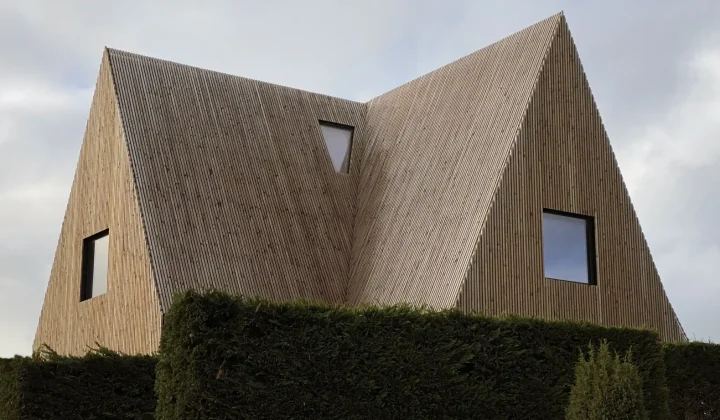
Vantieghem Talebi’s ‘House of Cards’ Brings Timber Geometry to Belgian Family Home
A new family house in Belgium by US- and Swiss-based practice Vantieghem Talebi uses a steeply pitched, card-house-inspired form clad in Douglas-fir…
Read moreRelated wiki

Adaptive Reuse in Architecture
Reference page for reuse, retrofit, conversion, embodied carbon and design constraints.
Read more