
Smiljan Radić Unveils “Circo” Tent Installation for Concéntrico Festival in Spain
Chilean architect Smiljan Radić's temporary "Circo" installation, a twenty-meter circus tent inspired by Chile's traveling circuses, forms a public interior in Logroño as part of Concéntrico 2026.
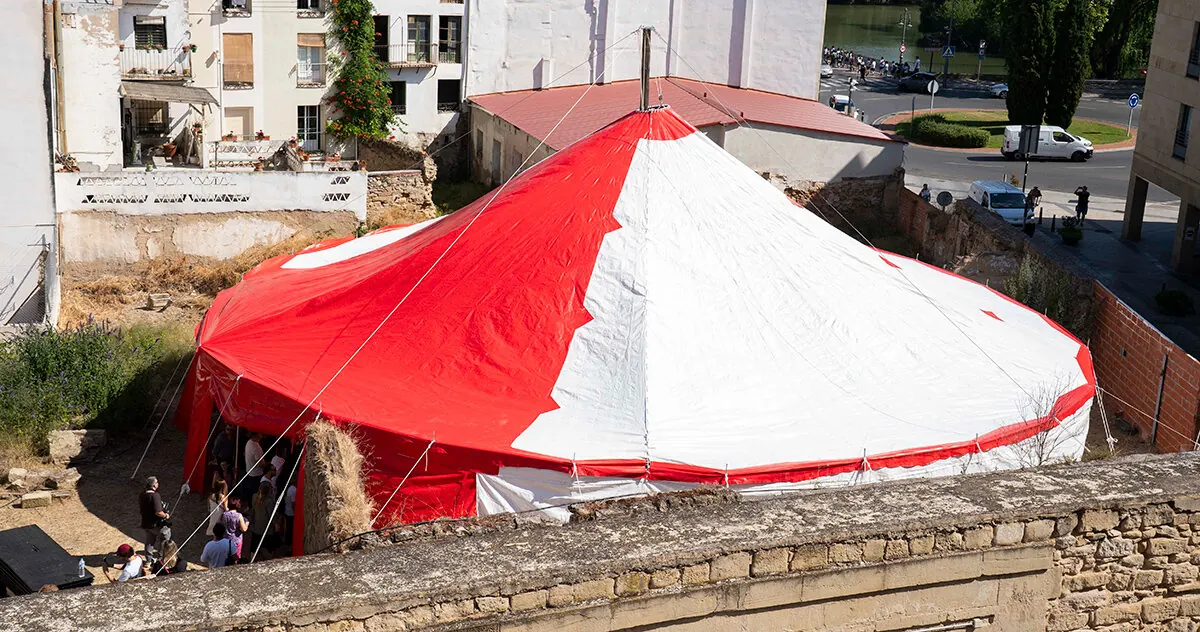
Chilean architect Smiljan Radić has introduced “Circo,” a striking temporary architectural installation in Logroño, Spain, as part of the Concéntrico 2026 festival. The project reimagines the humble circus tent as a dynamic public interior, drawing inspiration from the mobile and transient nature of Chile’s traveling circuses.
A Nostalgic Echo of Chilean Circuses
Radić’s “Circo” is a twenty-meter diameter tent, characterized by its vibrant red and white conical roof that draws the eye upwards. The design is deeply rooted in the architect’s memories of the modest circuses that traverse Chile’s central coast each summer. These ephemeral structures typically occupy neighborhood football fields or empty lots for a few days before departing with minimal trace. Their architecture is defined by directness and economy, often utilizing materials like plastic sheeting—similar to that found on oversized rubble bags—which bear the marks of their journeys, including faded colors and repeated repairs.
In Logroño, this logic of resilience and mobility is translated into a temporary structure that has been relocated and re-colored for its Spanish setting, creating a soft presence within the city.
An Intricate Temporary System
While appearing simple from the exterior, the tent’s section reveals a precisely engineered temporary system. The circular plan is anchored by a central mast, with radial lines extending outward to maintain the canopy’s tension. Red segments are interspersed with lighter fabric, transforming the roof into a dynamic graphic element that shifts with the changing light.
Inside, the space is designed for communal gathering. Folding circus chairs are arranged across the ground, interspersed with screens that project Joris Ivens’ 1963 short film, “Le petit chapiteau.” Filmed in Valparaíso, the seven-minute film introduces a second layer of narrative and atmosphere, creating a dialogue between the physical space and its projected content, evoking memory and constructed ambiance.
Political and Material Resonance
Radić draws a parallel between his “Circo” installation and the work of Chilean artist Eugenio Dittborn. Dittborn famously mailed large, folded paintings around the world in grey envelopes during Chile’s dictatorship years. This comparison imbues the tent with a political and material significance, highlighting its capacity to be packed, transported, opened, and recontextualized, much like Dittborn’s “Pinturas Aeropostales.” This inherent mobility is central to “Circo”‘s conceptual force.
The project effectively brings an architectural form from the periphery of urban experience into the heart of an urban festival. Through the strategic use of fabric and projection, it constructs a room that feels both temporary and fully present, light in its structure yet dense with cultural and artistic references.
Transforming Urban Spaces
Concéntrico has a history of employing temporary installations to alter public perception and movement within Logroño, inviting residents and visitors to engage with plazas, courtyards, and vacant sites in novel ways. Radić’s circus tent aligns perfectly with this mission. It taps into a shared cultural repository of childhood memories, popular entertainment, and architectural experimentation. By transplanting a Chilean circus tent to Spain, “Circo” transforms a borrowed structure into a unique public interior. It not only speaks to the rich history of itinerant performance but also underscores architecture’s potent ability to appear briefly and fundamentally reshape the experience of a place. For its duration, the city gains a fabric room filled with air, projected images, and scattered seating, after which the tent can once again be moved.
Key facts
| Feature | Detail |
|---|---|
| Project Name | Circo |
| Architect | Smiljan Radić |
| Location | Logroño, Spain |
| Festival | Concéntrico 2026 |
| Film Component | Le petit chapiteau by Joris Ivens, 1963 |
| Diameter | 20 meters |
| Inspiration | Traveling circuses of Chile |
The installation matters for Paionia7 readers as it showcases how temporary structures can profoundly impact urban environments, offering new spatial experiences and engaging with cultural memory. It highlights the innovative use of materials and form in contemporary architectural practice within public art and festival contexts.
Source: Smiljan Radić pitches a Chilean circus tent in Spain for Concéntrico 2026 – Designboom (https://www.designboom.com/architecture/smiljan-radic-chilean-circus-tent-spain-concentrico-logrono-circo/)
Source
Designboom Original publication: 2026-06-19T20:00:13+00:00
Related news
Koto launches Haku, a mobile prefab hotel suite built on a wheeled chassis to bypass UK planning restrictions
UK architecture studio Koto has unveiled Haku, a fully mobile prefabricated suite that legally qualifies as a caravan, allowing landowners and hotel…
Read more
HONG Designworks Completes Private Office in Xi’an That Balances Memory, Materiality, and Long-Term Use
The Xi’an office by HONG Designworks integrates a folded steel staircase, retained furniture from a previous workspace, and a restrained purple-gray palette…
Read more
Handwoven Teak and Cord Outdoor Seating Debuts from Masaya and Abril Zepeda
Nicaraguan furniture brand Masaya has introduced two new handcrafted outdoor chairs — a rocking chair and a lounge chair — designed by…
Read more
Place in Mind: Hendricks Churchill Launches Hospitality Group to Revive Historic Properties
The architecture and interior design studio Hendricks Churchill has launched Place in Mind, a new hospitality group focused on acquiring, restoring, and…
Read moreRelated wiki

Adaptive Reuse in Architecture
Reference page for reuse, retrofit, conversion, embodied carbon and design constraints.
Read more