
Affordable Housing Solutions: Design Strategies That Can Scale
Affordable housing at scale rarely comes from one design move alone. This guide explains how density, standardization, adaptive reuse, durable low-resource design, and long-term stewardship models can support affordability—while also showing where design reaches its limits.
Short answer
Affordable housing that scales usually depends on a combination of land, policy, finance, and design rather than a single architectural fix. Design can help by reducing material use, supporting efficient construction, lowering operating costs, and making higher densities or reused buildings more workable, but affordability is also shaped by governance, tenure, and who controls land over time. <!– sources: 1,3 –>
Context
The term *affordable housing* is not universal. Its meaning changes by place, income framework, tenure model, and public policy, which is why comparisons across cities or countries can be misleading if they rely on one fixed definition. Research on affordable housing also stresses that the problem is not only about initial rent or sale price, but about broader social and economic conditions that affect how people live in and sustain housing over time. <!– sources: 3 –>
For built-environment readers, that leads to an important distinction: design matters, but it cannot carry the entire burden of affordability. Resource-efficient urban development can reduce pressure on land, infrastructure, materials, and energy use at city scale, which helps explain why compact urban form and more efficient buildings are often part of affordability discussions. Even so, lower resource use does not automatically guarantee lower housing costs for residents unless delivery and long-term management are aligned with affordability goals. <!– sources: 1,3 –>
Why design matters—and where it does not
Design has the strongest influence where it improves efficiency across the life of a building: simpler building forms, repeated unit types, adaptable layouts, and durable low-maintenance materials can all support more predictable delivery and operation. In dense urban settings, resource-efficient planning can also reduce per-capita infrastructure and transport burdens, strengthening the case for forms of housing that use land more intensively than detached single-use development. <!– sources: 1,3 –>
Its limits are just as important. A well-designed project can still fail to be genuinely affordable if land is expensive, financing is weak, affordability rules expire, or management costs rise over time. In practice, housing scales more reliably when design decisions are paired with long-term stewardship models and public or nonprofit structures that keep affordability from being lost after completion. <!– sources: 3 –>
Step-by-step guide: how to assess scalable affordable housing strategies
1. Start with the local definition of affordability
Before comparing projects, confirm how affordability is being measured: against income, against market rent, through subsidy rules, or through another local standard. Without that step, two projects can look similar in design terms while serving very different households. <!– sources: 3 –>
2. Separate construction efficiency from total housing affordability
Faster or more standardized construction may improve delivery efficiency, but that is not the same as guaranteed affordability for occupants. A credible assessment should distinguish between building-cost savings and the full housing picture, including land, operations, maintenance, and long-term control. <!– sources: 3 –>
3. Look for resource efficiency at building and urban scale
Strategies that use land, materials, and infrastructure more efficiently may support affordability indirectly by reducing waste and improving long-term performance. This is one reason dense urban development, efficient buildings, and coordinated city planning often appear together in discussions of housing futures. <!– sources: 1 –>
4. Check whether the design can be repeated or adapted
Scalability usually depends on repeatability. Standardized layouts, prefabricated components, or adaptable building systems may help projects move beyond one-off prototypes, while adaptive reuse may extend the life of existing structures where conversion is feasible. The question is less whether a strategy is fashionable than whether it can be replicated within real planning, site, and management constraints. <!– sources: 2,3 –>
5. Verify how affordability is preserved over time
A project is more credible when it explains who owns the land, who manages the housing, and what mechanism protects affordability after delivery. Long-term affordability is not only a design issue; it depends on institutional structure, social policy, and ongoing stewardship. <!– sources: 3 –>
Comparing design strategies that can support scale
| Strategy | Best suited for | Potential benefit | Main constraint | What to verify |
|---|---|---|---|---|
| Gentle density | Infill sites and established neighborhoods | Uses existing urban land more efficiently | Local acceptance and policy limits | Whether added density is tied to actual affordability outcomes |
| Standardization or prefabrication | Repetitive unit types and multi-phase delivery | More predictable production and coordination | Not all sites or programs fit repeatable systems | Evidence from completed projects, not only concept claims |
| Adaptive reuse | Existing buildings with viable structure and layout | Extends building life and can avoid full new-build intensity | Feasibility varies widely by building type | Conversion constraints, habitability, and management model |
| Durable low-resource design | Projects with long operating horizons | Can reduce maintenance and resource burdens over time | Upfront choices do not ensure low resident costs by themselves | Whether operational savings benefit residents |
| Public- or nonprofit-led delivery | Sites where long-term affordability is a stated goal | Stronger chance of preserving affordability beyond completion | Depends on governance and sustained support | Ownership, stewardship, and affordability terms |
| Mixed-use or compact urban form | Areas where housing, services, and mobility can be integrated | Supports resource-efficient city form | Compactness alone does not guarantee low-cost housing | Whether access and cost benefits reach target households |
Practical checklist for readers reviewing a housing proposal
- Identify the affordability definition being used before comparing the project with others.
- Ask whether the proposal addresses total housing cost, not only construction method or headline rent.
- Check who owns the land and whether affordability is protected for the long term.
- Look for evidence that the strategy has worked in completed projects, not only in renderings or promotional language.
- Review whether the design supports efficient operation, maintenance, and adaptation over time.
- Be cautious of claims that density, modularity, or sustainability automatically make housing affordable. <!– sources: 1,2,3 –>
Common red flags
Some of the most common red flags are conceptual overreach and missing governance detail. If a proposal treats design as a complete solution, avoids explaining who benefits from cost savings, or presents compactness as proof of affordability, it is worth slowing down. Likewise, a project may sound scalable while remaining highly dependent on site-specific conditions that are hard to reproduce elsewhere. <!– sources: 1,3 –>
FAQ
Can design alone solve the affordable housing problem?
No. Design can improve efficiency, livability, and long-term performance, but affordability also depends on land, income, policy, ownership structure, and management. <!– sources: 1,3 –>
Is higher density always more affordable?
Not necessarily. More efficient land use can support affordability strategies, especially in resource-efficient urban development, but density alone does not guarantee lower housing costs for residents. <!– sources: 1,3 –>
Does modular or prefabricated housing always lower costs?
Not always. It may support repeatability and delivery efficiency in some contexts, but claims about cost or scale should be checked against completed examples rather than treated as automatic. <!– sources: 2,3 –>
Why does long-term stewardship matter so much?
Because affordability can be lost after construction if there is no lasting mechanism to protect it. Ownership, governance, and management are often as important as the design itself. <!– sources: 3 –>
Sources
- UNEP, Cities and resource efficiency
- ArchDaily, Architecture and housing coverage
- IntechOpen, Socioeconomic Influences on Affordable Housing Residents: Problem Definition and Possible Solutions <!– sources: 1,2,3 –>
Related news
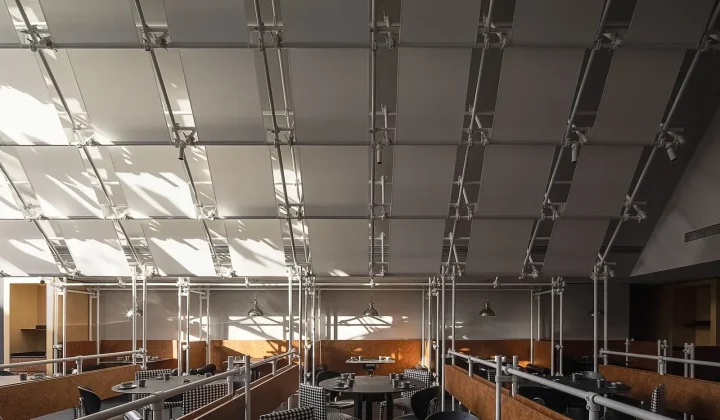
Scaffolding as Interior Architecture: Adaptable Systems Challenge the Divide Between Temporary and Permanent
A new article by Jonathan Yeung examines how modular scaffolding systems, from steel frames to Dieter Rams’ shelving, demonstrate that longevity in…
Read more
MIV Architects Proposes Wetland Pavilion That Prioritizes Non-Human Habitats Over Human Comfort
The Spanish firm’s “Nidos de Agua” concept for the Albufera natural park in Valencia aims to rebalance the relationship between building and…
Read more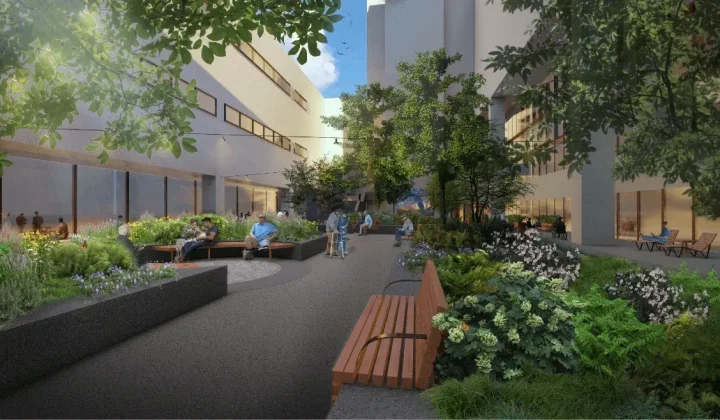
Nelson Byrd Woltz Begins Construction on Restorative Eagle Courtyard at Walter Reed Medical Center
Construction has started on a redesigned Eagle Courtyard at Walter Reed National Military Medical Center, led by Nelson Byrd Woltz Landscape Architects.…
Read more
London’s listening bar boom reflects a deeper shift in hospitality design and music culture
A wave of Japanese-inspired listening bars is reshaping London’s nightlife, but owners and critics are asking whether the concept can survive commercial…
Read moreRelated wiki

Adaptive Reuse in Architecture
Reference page for reuse, retrofit, conversion, embodied carbon and design constraints.
Read more