
Technology & Innovation in Design: what changed and what it means for readers
Design technology now matters less as a story about single breakthrough tools and more as a shift toward tighter links between design decisions, environmental analysis, construction methods, and building operation.
Short answer
The clearest change in design technology is not the arrival of one dominant tool. It is the growing expectation that design decisions connect to environmental assessment, coordination, fabrication, and building operation rather than ending at drawings or visualisation. For readers, that means technology in design is best understood as a chain of linked decisions across a building’s life, not just as software or imagery. <!– sources: 1,2 –>
Summary box
– Design technology now reaches further into construction and building use.
– Environmental and resource questions are more central to technology claims.
– Public discussion often moves faster than verified evidence.
– The safest approach is to ask what a tool actually changes, what has been measured, and what still needs checking. <!– sources: 1,2 –>
Context
The built environment sits inside wider pressures around resource use, urban growth, and environmental performance. UNEP describes cities as central to resource efficiency, which helps explain why design technologies tied to energy, materials, and operations now receive more attention than they once did. <!– sources: 1 –>
At the same time, architecture and design coverage regularly treats digital tools, materials, fabrication, and building systems as part of mainstream practice rather than a specialist side topic. That shift in coverage does not prove uniform adoption, but it does show how broadly innovation is now framed in built-environment discussion. <!– sources: 2 –>
What this article means by technology and innovation in design
Here, the phrase includes several related areas: digital design tools, coordination systems, environmental analysis, fabrication and construction methods, and building systems that generate information after occupation. These categories overlap, but they should not be treated as interchangeable. A strong claim in one area does not automatically prove change across all of them. <!– sources: 1,2 –>
Date-checked note
Date checked: March 2025. This article avoids adoption statistics, software-specific claims, and regulatory assertions because the verified source base provided here does not support them with enough precision. Time-sensitive claims in this field should be checked against current official guidance, named project documentation, or recent expert reporting before publication updates. <!– sources: 1,2 –>
What changed in practical terms
A useful way to understand recent change is to look less at novelty and more at connection. Design is now more often discussed alongside material efficiency, construction logistics, and in-use performance. That does not establish that every practice works this way, but it does suggest a broader change in expectations about what design technology is supposed to help accomplish. <!– sources: 1,2 –>
Design is more closely tied to environmental questions
Because cities are closely linked to resource use, technologies that help teams examine energy, materials, and operational implications have become more relevant to design conversations. The important point is not that digital tools solve environmental problems on their own, but that environmental assessment now sits closer to design decision-making than before. <!– sources: 1 –>
Innovation now includes how projects are made
Discussion of design innovation increasingly includes fabrication, materials, and construction methods, not only representation or concept development. In practical terms, readers should treat production methods as part of the innovation story, especially when claims concern waste, quality, repeatability, or delivery. <!– sources: 2 –>
Building use matters more in technology claims
Technology claims increasingly extend beyond design-stage intent to include monitoring and operation after completion. That broadens the meaning of innovation, but it also raises the standard of proof: a building that can collect data is not necessarily a building that performs better. <!– sources: 1,2 –>
How to assess design-technology claims
1. Start with the problem being solved
Before judging whether a technology matters, ask what it is supposed to improve. Some tools help generate options, some help coordinate information, some support environmental analysis, and some help teams monitor buildings in use. Clarity about the problem makes later claims easier to test. <!– sources: 1,2 –>
2. Separate simulation from measured results
One of the most important distinctions is between projected performance and documented performance. Environmental or operational claims may be based on design-stage analysis, a pilot application, or measured results after occupation. Those are not the same level of evidence. <!– sources: 1 –>
3. Prefer named evidence over trend language
A named building, project team, or technical document is usually more useful than broad language about disruption or transformation. Readers should be cautious when a striking image or headline carries more weight than verifiable detail. <!– sources: 2 –>
4. Treat sustainability language as a starting point, not a conclusion
Environmental claims are especially easy to overread. A tool may support better decisions about materials, energy, or operations without proving that a project is sustainable overall. The key questions are what is being measured, what is outside the boundary, and whether the claim refers to intent or outcome. <!– sources: 1 –>
Where change is most visible
Environmental and resource analysis
This is one of the clearest areas of change because the built environment is closely tied to resource efficiency concerns. Tools and methods that help examine energy, materials, and related impacts now sit more centrally in design discussion than they once did. Their value, however, depends on the assumptions behind them and on careful interpretation of results. <!– sources: 1 –>
Fabrication and construction methods
Innovation in design is also visible in the attention given to how buildings are assembled and delivered. Architecture coverage frequently places materials, fabrication, and construction systems alongside design itself, suggesting that the making of a project is now treated as part of the design-technology landscape. <!– sources: 2 –>
Operational feedback and building systems
Post-occupancy information has become more visible in discussions of innovation because it promises a link between design intent and real building use. Even so, operational data should not be confused with better outcomes unless there is evidence that it changes maintenance, control, comfort, or resource use in practice. <!– sources: 1,2 –>
Comparison table: how to read major technology areas
| Technology area | What readers can reasonably say | What still needs verification | Best kind of supporting source |
|---|---|---|---|
| Environmental analysis tools | They are more central to design discussions tied to resource efficiency | Whether a specific project achieved the predicted result | Official guidance, institutional sources, measured case studies |
| Fabrication and construction methods | They are regularly presented as part of design innovation | Claims about speed, waste reduction, or quality gains on a given project | Technical documentation, project records, independent review |
| Building monitoring and smart systems | They extend technology discussion into building use after completion | Whether monitoring improved actual performance or user outcomes | Measured post-occupancy evidence, official technical guidance |
| Digital coordination systems | They are often described as linking design information to delivery | How widely a method is used and what benefits were realized in practice | Primary documentation, detailed case studies |
| Experimental methods and prototypes | They can show what is possible | Whether they scale beyond a showcase example | Repeated applications, independent reporting |
Practical checklist for readers
- Identify whether the claim is about design, construction, or building operation.
- Ask if the evidence comes from a named project or only from promotional language.
- Check whether the result was predicted, tested in a pilot, or measured after use.
- Look for the boundaries of any environmental claim.
- Treat eye-catching prototypes as examples, not proof of mainstream change.
- Prefer official, institutional, or project-level documentation where possible. <!– sources: 1,2 –>
Red flags to watch for
- A claim of transformation without a named project or document.
- Environmental benefits described without saying what was measured.
- A prototype presented as if it represents common practice.
- Data collection presented as proof of better building performance.
- Broad conclusions drawn from design imagery alone. <!– sources: 1,2 –>
What readers should do next
If you are new to the topic, start by separating the field into three questions: how technology affects design decisions, how it affects construction, and how it affects building use. That simple distinction makes coverage much easier to read critically. <!– sources: 1,2 –>
If you are reviewing a specific claim, look for named evidence and ask whether it concerns projected outcomes or measured ones. That is often the fastest way to tell whether a technology story is substantial or mostly promotional. <!– sources: 1,2 –>
If you are comparing sources, give more weight to official guidance, institutional publications, and detailed project documentation than to generic trend summaries. <!– sources: 1,2 –>
Which facts most need verification?
The claims that most often need extra checking are the ones that sound most definitive: adoption levels, time savings, carbon reductions, cost reductions, and statements that a method is now mainstream. Those claims can be true in a specific context, but they require current, named, and preferably project-level evidence. <!– sources: 1,2 –>
FAQ
What is the biggest real change in design technology?
The biggest visible change is the stronger connection between design decisions, environmental analysis, construction methods, and building operation. <!– sources: 1,2 –>
Does innovation in design only mean digital tools?
No. In current built-environment discussion, innovation also includes materials, fabrication, construction systems, and operational technologies. <!– sources: 2 –>
Do smart systems automatically make buildings better?
No. Monitoring and data collection can support improvement, but they do not prove better outcomes by themselves. <!– sources: 1 –>
Should readers trust sustainability claims attached to new technology?
Only with care. The useful test is whether the claim explains what was measured, what was excluded, and whether the result was modeled or documented in use. <!– sources: 1 –>
Sources
- UNEP, Cities and resource efficiency: https://www.unep.org/explore-topics/resource-efficiency/what-we-do/cities
- ArchDaily: https://www.archdaily.com/
Related news

Handwoven Teak and Cord Outdoor Seating Debuts from Masaya and Abril Zepeda
Nicaraguan furniture brand Masaya has introduced two new handcrafted outdoor chairs — a rocking chair and a lounge chair — designed by…
Read more
Place in Mind: Hendricks Churchill Launches Hospitality Group to Revive Historic Properties
The architecture and interior design studio Hendricks Churchill has launched Place in Mind, a new hospitality group focused on acquiring, restoring, and…
Read more
Adalberto Dias Architects Complete Restoration of Lisbon’s Patriarchal Cathedral and Archaeological Center
The restoration of the Sé de Lisboa by Adalberto Dias Arquitecto integrates a new archaeological center, preserved cloisters, and seven centuries of…
Read more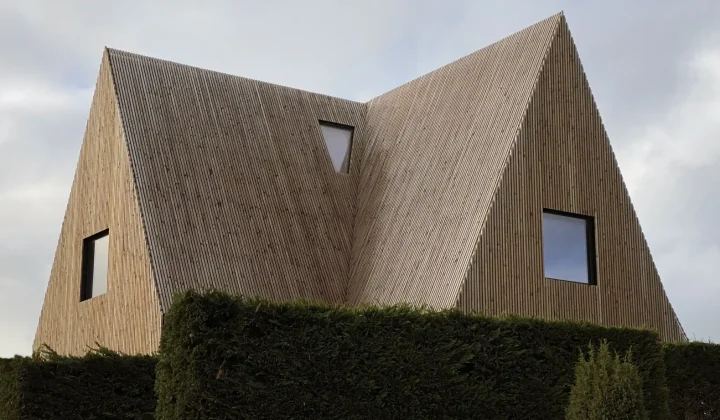
Vantieghem Talebi’s ‘House of Cards’ Brings Timber Geometry to Belgian Family Home
A new family house in Belgium by US- and Swiss-based practice Vantieghem Talebi uses a steeply pitched, card-house-inspired form clad in Douglas-fir…
Read moreRelated wiki

Adaptive Reuse in Architecture
Reference page for reuse, retrofit, conversion, embodied carbon and design constraints.
Read more