
How to Read Biennale Signals for 2027 Architecture Projects
Without a verified 2026 Venice Architecture Biennale primary source in hand, the safest editorial move is to treat the exhibition as a signal-setting platform rather than a fixed forecast. This guide separates what is supported from what still needs checking before readers apply Biennale ideas to 20

Summary
In the absence of verified 2026 event materials, the most defensible way to use the Venice Architecture Biennale is as a lens on architectural discourse, not as a confirmed schedule of ideas that will shape practice next. For 2027 project thinking, the most relevant signals are the ones that also fit documented pressures on cities: resource efficiency, adaptation, reuse, careful material claims, and digital tools used for analysis and communication rather than spectacle alone.
<!– sources: 1,3,4,5 –>
What happened
The Venice Architecture Biennale is widely discussed as a prominent venue for architectural exhibition, representation, and debate. The available scholarly sources support that narrower point through studies of past Venice presentations, including work on augmented representation, technology discourse, and national framing. Those sources are useful for understanding how Biennale ideas circulate, even if they do not prove direct effects on later construction.
Date-checked note
Date-checked note: at the time of this article update, the available source set does not include an official 2026 Biennale page or another primary 2026 program source. For that reason, this article does not state the 2026 edition's official theme, curator, dates, venues, or pavilion details. It focuses instead on the safer question of how readers can assess whether Biennale-era ideas are likely to matter for 2027 projects.
Why it matters
Exhibitions can shape language, priorities, and ways of seeing. Projects, by contrast, move through budgets, regulation, procurement, technical testing, and existing site conditions. The useful question is therefore not whether an exhibition theme is visible, but whether it can travel into briefs, public guidance, design methods, or specification choices.
UNEP's work on cities and resource efficiency gives a strong real-world filter for that question. UNEP describes cities as central to the use of energy, water, land, materials, and food, and argues that better planning, design, and urban management can improve resource efficiency and reduce environmental harms. That makes city-scale performance questions more materially relevant to practice than exhibition ideas that stay at the level of imagery alone.
The historical Venice scholarship in the source set also shows why the Biennale remains worth watching. Past editions have been analyzed through digital representation, mediated spatial experience, and the politics of national or territorial display. Those are not direct forecasts, but they can indicate which questions architecture culture is choosing to foreground.
What is confirmed
From the available sources, three points are supportable. First, cities are major sites of resource use and environmental pressure. Second, past Venice Architecture Biennale material has drawn sustained analysis around representation, technology, identity, and territory. Third, those two facts together justify reading the Biennale as a place where architectural priorities become visible, while avoiding claims that any specific 2026 theme will drive 2027 projects.
Confirmed context vs. claims that still need checking
| Topic | Supported by current sources | Still needs primary 2026 verification |
|---|---|---|
| Venice as a debate platform | Past scholarship supports Venice as a site of exhibition, representation, and disciplinary debate | Exact 2026 framing and official event language |
| Urban resource pressures | UNEP supports the importance of resource efficiency, planning, and design at city scale | Whether 2026 organizers explicitly prioritized those concerns |
| Digital representation | Past Venice research documents digital and mediated forms of architectural presentation | Which 2026 participants, if any, centered those methods |
| National and territorial questions | Scholarship supports the importance of identity and geopolitical framing in past Venice work | Which 2026 national presentations were most discussed |
| 2027 project relevance | It is reasonable to test exhibition ideas against real delivery pressures | Any direct cause-and-effect claim between 2026 content and 2027 built outcomes |
Which signals are worth keeping in view for 2027 projects
The themes below are presented as practical watchpoints, not as confirmed 2026 Biennale findings. They are included because they align with the source-backed pressures facing cities and with recurring areas of architectural debate documented in Venice-related scholarship.
Adaptation and resilience
Where cities face growing environmental pressures, adaptation is not a niche concern. UNEP's framing supports close attention to urban systems, resource use, and environmental performance. For project teams, that makes resilience-related thinking a more credible carry-over signal than purely formal exhibition effects.
Reuse and retrofit
The source set does not verify a 2026 exhibition emphasis on retrofit. It does, however, support the broader logic that resource-conscious urban practice has to engage existing buildings, land, and infrastructure carefully. That is why reuse and retrofit deserve attention as likely tests for whether an exhibition idea can become practical work.
Material claims that can be checked
Material experimentation often appears strongly in exhibition culture. The more useful professional question is whether claims around circularity, impact reduction, or innovation come with documentation robust enough for practice, procurement, or specification. Readers should treat materials messaging as something to verify, not simply repeat.
Digital tools with operational value
The Venice-related scholarly sources include work on augmented and virtual forms of representation. For 2027 projects, the lasting signal is less about spectacle and more about utility: digital tools matter when they improve scenario testing, site understanding, coordination, or public communication.
Place, identity, and public meaning
Past Venice analysis also shows how architecture is presented through national, territorial, and cultural frames. That remains relevant beyond exhibitions because many projects succeed or fail partly through questions of legitimacy, context, and public meaning, not only technical performance.
What readers should do next
If you are deciding whether a Biennale-adjacent idea is worth carrying into 2027 work, use a practical filter rather than a mood-board filter.
A practical checklist
- Check whether the idea appears in public briefs or institutional frameworks. That is a stronger sign of real uptake than exhibition visibility alone.
- Ask whether it can be repeated. A one-off installation and a transferable method are not the same thing.
- Verify technical and environmental claims. Look for named documentation before adopting language around circularity, low impact, or innovation.
- Separate representation from delivery. A compelling visual argument may still lack a route into procurement or construction.
- Watch who carries the idea forward. Universities, public clients, practices, and civic institutions often matter more than exhibition buzz.
What may change
This article should be updated once official 2026 Biennale materials are available. The most likely areas to change are the event's official framing, named participants, pavilion examples, and any claim about which themes were actually dominant in that edition. Stronger claims about 2027 influence would also need later evidence from built projects, procurement documents, policy texts, or institutional programs.
Sources to verify before making stronger 2026 claims
- Official 2026 Venice Architecture Biennale event page
- Official curator statement and theme description
- Official dates, venue structure, and participant information
- Pavilion or exhibitor pages for any examples cited
- Later project, client, or policy evidence showing uptake beyond the exhibition
Sources
- UNEP: Cities and resource efficiency
- Springer Nature Switzerland: *Site Venice Site Biennale: The Manifest.AR Augmented Reality Intervention into the 2011 Venice Biennale*
- Liverpool University Press: Luis Hernan on the tech-boys, utopian futures, and the Venice Architecture Biennale
- Project MUSE: *Virtual Space and National Division: Crow’s Eye View: The Korean Peninsula at the Venice Architecture Biennale (2014)*
Cover image note
Use an image that clearly relates to Venice, architectural exhibition spaces, or Biennale-related urban context, preferably from an official event source where permitted, Wikimedia Commons, Openverse, or a credible architectural stock library. Avoid generic office, laptop, or classroom imagery. Alt text should describe the actual image selected, for example: *Exterior view of a Venice exhibition venue along a canal* if that is what the image shows.
Related news

Armenian Designer Shushana Khachatrian Debuts ‘The Woman’s Chair,’ a Deliberately Uncomfortable Reflection on Social Structures
Armenian designer Shushana Khachatrian's 'The Woman's Chair' uses polished stainless steel and a deliberately unstable geometry to question expectations around comfort, posture,…
Read more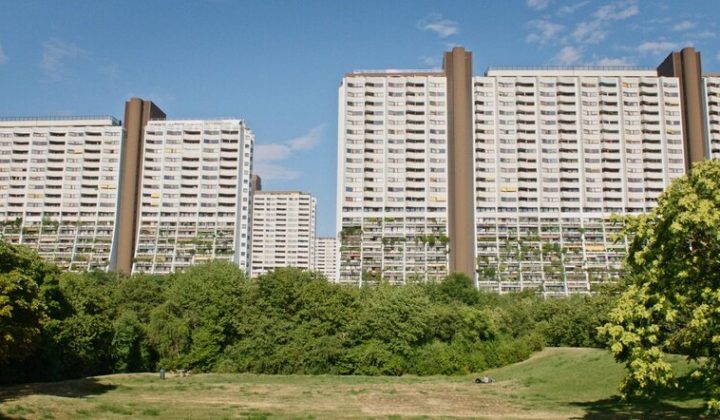
27 Storeys Documentary Revisits Vienna’s Alterlaa and the Utopian Promise of Collective Living
Director Bianca Gleissinger returns to her childhood home in the Alterlaa housing complex to explore how a 1970s social housing project achieved…
Read more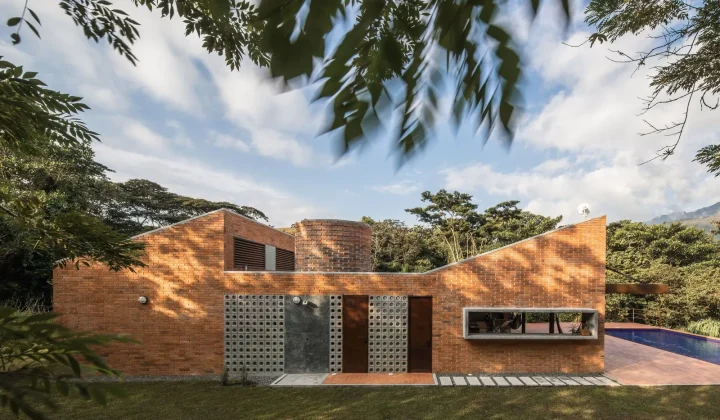
12 Colombian Houses Showcase the Enduring Appeal of Exposed Brick
ArchDaily highlights a dozen Colombian homes that use exposed brick as a structural and aesthetic statement, reflecting the material's deep roots in…
Read more
Behin Ha completes trio of townhouse ADUs on a single Jersey City lot behind a preserved 150-year-old house
The New York-based studio placed three two-bedroom townhouses at the rear of a restored single-family house in Jersey City’s Heights neighborhood, using…
Read moreRelated wiki

Adaptive Reuse in Architecture
Reference page for reuse, retrofit, conversion, embodied carbon and design constraints.
Read more