
Philippe Starck’s Juicy Salif at 35: How a “mental workout” became a design icon
More than three decades after its debut, Starck’s aluminum citrus squeezer remains one of the most debated objects in industrial design – not for its juicing ability, but for what it asks of its users.
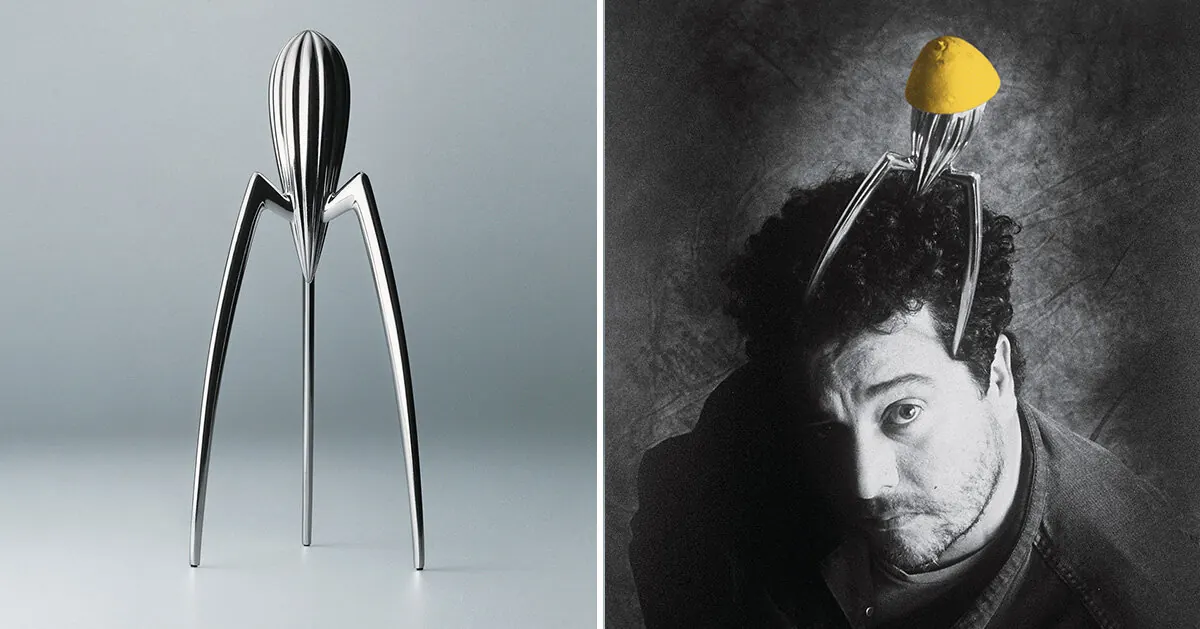
It is one of the most recognisable household objects of the late twentieth century, yet it has never been fully accepted as a practical kitchen tool. Philippe Starck’s Juicy Salif, launched by Alessi in 1990, has spent more than 35 years provoking debate among designers, collectors and everyday users. The aluminium citrus squeezer sits in museum collections, appears in design textbooks and continues to be sold – not because it extracts lemon juice efficiently, but because it challenges the very definition of what a designed object should do.
Key facts
| Fact | Detail |
|---|---|
| Designer | Philippe Starck |
| Manufacturer | Alessi |
| Year of introduction | 1990 |
| Material | Polished aluminium |
| Height | Approximately 30 cm |
| Museum collections | MoMA (New York), Centre Pompidou (Paris) |
The origin story begins in 1988 on the Italian island of Capraia. While dining on fried squid, Starck sketched on a paper placemat. Alessi had commissioned a steel tray, but the designer produced something else entirely: a creature with long, slender legs and a tapered body that resembled a cross between a squid, a spider and a rocket. Alberto Alessi, the company’s head, saw potential in the strange drawing and agreed to put it into production.
The object that emerged from that sketch is unlike any citrus press that came before it. Standing nearly 30 centimetres tall on three elongated legs, Juicy Salif looks less like a kitchen tool and more like an alien organism. Starck described the design as an exercise in “reverse topography” – turning the concave shape of a traditional citrus press into a convex form. The practical benefit was that the raised surface eliminated recessed areas that are difficult to clean. But the visual result was deliberately unfamiliar.
A challenge to modernist orthodoxy
For much of the twentieth century, industrial design was guided by the principle that form should follow function. Louis Sullivan’s dictum had become a near-universal standard. Juicy Salif appeared to ignore that rule entirely. Instead of announcing its purpose at first glance, the object invites interpretation. Is it a sculpture? A toy? A conversation piece? Only after a moment of recognition does the user understand its intended use.
The timing of the launch aligned with a broader shift in design culture. In the 1980s, groups such as Memphis had already begun questioning the austerity of modernism, embracing colour, irony and ornament. Starck was not part of that collective, but Juicy Salif shared the same willingness to reconsider what an object could mean in daily life. It was not the first design to prioritise provocation over pure utility, but it became the most widely known example.
The controversy over performance
The most persistent criticism of Juicy Salif concerns its actual performance as a kitchen tool. Users have pointed out that the three-legged structure can feel unstable when pressure is applied. Juice often runs down the polished aluminium body and drips onto the table. The acidic citrus gradually reacts with untreated aluminium, requiring careful cleaning after each use. There is no integrated filter, so seeds and pulp pass directly into the glass.
Judged solely as a lemon squeezer, Juicy Salif is neither the easiest nor the most efficient option available. Starck has never disputed this. “Juicy Salif is not only about squeezing lemons,” he once remarked. “When someone asks, ‘What is this?’ a conversation begins.” In that framing, the object’s function shifts from extraction to dialogue. If its purpose is measured by juice yield, the design remains open to criticism. If its role is to stimulate conversation, then its longevity begins to make sense.
Legacy and cultural impact
Juicy Salif now appears in the permanent collections of the Museum of Modern Art in New York and the Centre Pompidou in Paris, where it is presented as a landmark in contemporary industrial design. It has inspired countless essays, academic studies, exhibitions and imitations. In 2020, Alessi revisited the project with Juicy Salif Studio No. 3, a limited bronze edition based on one of Starck’s earliest prototypes.
A curious paradox surrounds the object: many owners rarely use it. It occupies countertops, bookshelves and dining tables with the confidence of a small sculpture. Some purchase it despite already owning more efficient citrus squeezers. Others receive it as a gift from people who know its story. The object survives because optimisation is not the only thing people want from the objects around them. They also seek delight, identity, memory and the narratives that come with a thing.
What the story means for design culture
The enduring relevance of Juicy Salif lies in the questions it raises. What if usefulness includes wonder? What if starting a conversation is itself a function? And what if the most playful ideas turn out to be the ones that endure? More than 35 years after its introduction, the object continues to divide opinion. Some still see an impractical kitchen gadget; others see a defining object of late twentieth-century design. Perhaps its greatest achievement is that it reminds us that design is never only about solving problems. Sometimes, its most lasting contribution is to change the questions we ask.
Source: Designboom – ‘first for mental workout and game’: how starck’s iconic lemon squeezer broke the mold – https://www.designboom.com/design/game-philippe-starck-iconic-lemon-squeezer-juicy-salif-alessi/
Source
Designboom Original publication: 2026-07-25T10:00:08+00:00
Related news
Christopher Kane brings streamlined, heritage-driven vision to Mulberry in London Fashion Week debut
The Scottish designer presented his first collection for the British leather goods house at London Fashion Week, blending sharp tailoring, archival references…
Read more
When Film Directors Become Interior Designers: Guadagnino, Lynch, Anderson and Almodóvar Step Off Screen
From Luca Guadagnino’s Zara Home collection to David Lynch’s Paris club and Wes Anderson’s train carriage, a wave of collaborations is blurring…
Read more
Jesus Mari Lazkano Examines Changing Landscapes Through Painting and Animated Film at Basque Luxury Studio
The Basque artist’s exhibition ‘Azken Natura’ brings together six large-scale paintings and a 22-minute animated film that traces the melting of the…
Read more
Glenn Spiro opens intimate jewellery atelier in Mayfair with designer Valerie Name Bolaño
The London jewellery house’s new boutique at 26 Bruton Street blends antiques, bespoke furniture and a monochrome palette to create a residential…
Read moreRelated wiki

Adaptive Reuse in Architecture
Reference page for reuse, retrofit, conversion, embodied carbon and design constraints.
Read more