
World Environment Day 2026: The Imperative of Circular Cities in Design
A careful design-led explainer on circular cities, resource efficiency, and what architects, planners, and readers should verify before accepting circularity claims.

Summary
Circular cities are best understood as an urban design and governance approach that tries to reduce waste, use resources more efficiently, and keep buildings, materials, infrastructure, and public-space systems useful for longer.
For architecture and urban design, the idea shifts attention from a single finished object to the full life of a place: what is built, what is reused, how it is maintained, and what happens when needs change.
The World Environment Day 2026 framing should be treated cautiously until official event materials confirm the theme, host details, and campaign language; this article uses the occasion as a design lens rather than as a confirmed event announcement.
Short Answer
A circular city is not simply a city with better recycling. It is a city planned around resource efficiency, longer building life, reuse, repair, adaptable infrastructure, and design decisions that reduce the need to extract, consume, and discard materials unnecessarily.
In the built environment, circularity becomes practical when architects, clients, planners, and public authorities ask what can be retained, adapted, shared, repaired, or safely recovered before defaulting to demolition, replacement, or one-way material flows.
Why Circular Cities Matter to Design
UNEP’s resource-efficiency work frames cities as a central setting for improving how resources are used, which makes urban design more than a matter of form, density, or image. The design question becomes whether streets, buildings, districts, and infrastructure help materials and assets remain useful over time.
For readers of architecture and design, the circular-city lens is useful because it connects familiar design choices — structure, façade systems, interiors, public realm, servicing, and maintenance access — with broader questions about waste, adaptability, and long-term urban value.
What Changes When a City Thinks Circularly?
A linear approach usually treats construction, occupation, and demolition as separate stages. A circular approach asks designers and decision-makers to connect those stages, so that early choices about materials, assemblies, and spatial flexibility do not create avoidable waste later.
The shift is also cultural. Circular cities depend on everyday systems — repair, reuse, sharing, logistics, maintenance, and procurement — as much as they depend on distinctive buildings or visible environmental features.
| Urban model | How materials usually move | Typical design response | What to verify | Common limitation |
|---|---|---|---|---|
| Linear city | Extract, build, use, discard | New construction and replacement dominate | Whether reuse or retention was considered | Waste is often managed after design decisions are fixed |
| Recycling-led city | Materials are recovered after use where systems allow | Recycling facilities and waste sorting become visible priorities | Whether recycling reduces new material demand | Recycling can still leave demolition and overconsumption largely intact |
| Circular city | Assets and materials are kept useful for longer | Retrofit, repair, adaptability, reuse, and shared systems shape decisions | Whether claims are measured and supported by local systems | Benefits depend on maintenance, logistics, policy, and market capacity |
| Regenerative circular district | Resource loops are linked with ecological and social goals | Public realm, buildings, landscape, and infrastructure are planned together | Whether outcomes are evidenced beyond design intent | The term can become vague without clear boundaries and data |
From Building to City: Where Circular Design Shows Up
At building scale, circular design may involve retaining existing structures, choosing durable components, planning for future change, and making assemblies easier to maintain, repair, remove, or reuse.
At district scale, the idea expands to shared infrastructure, local reuse networks, waste-prevention systems, public spaces that support low-waste everyday life, and logistics that make repair and recovery feasible.
At city scale, circularity depends on policies, procurement habits, land-use decisions, waste systems, and design cultures that reward long-term value rather than treating buildings as short-cycle consumables.
Practical Checklist: How to Read a Circular Design Claim
Use this checklist before accepting a project, district, or city strategy as genuinely circular:
- Identify what is being retained, reused, repaired, shared, or kept in circulation.
- Ask whether the circular claim applies to the structure, façade, interiors, infrastructure, operations, or only to a small component.
- Check whether the project has a plan for maintenance, adaptation, disassembly, or end-of-life reuse.
- Look for evidence that circularity is measured, documented, or independently assessed, not only described in marketing language.
- Ask whether local systems exist to support reuse, repair, transport, storage, and skilled labour.
- Check whether trade-offs are disclosed, including durability, transport, cost, carbon, maintenance, and user needs.
What Circular Cities Are Not
Circularity is not a visual style, a synonym for recycling, or a guarantee that a project is low-carbon or socially beneficial. It is a way of examining material flows, resource use, building life, and urban systems, and it needs evidence to be credible.
A project can use recycled materials and still be weakly circular if it depends on premature demolition, short-lived components, difficult maintenance, or unsupported end-of-life claims.
What Readers Should Watch Next
For a publish-ready version tied directly to World Environment Day 2026, readers and editors should watch for:
- Official World Environment Day 2026 materials confirming the theme, host, and campaign language.
- City circular-economy strategies that explain how reuse, repair, waste prevention, and procurement will work in practice.
- Built-environment case studies that distinguish proposed, modelled, certified, and measured outcomes.
- Technical guidance that connects resource efficiency with building life, maintenance, retrofit, and demolition decisions.
Sources
Related news

Handwoven Teak and Cord Outdoor Seating Debuts from Masaya and Abril Zepeda
Nicaraguan furniture brand Masaya has introduced two new handcrafted outdoor chairs — a rocking chair and a lounge chair — designed by…
Read more
Place in Mind: Hendricks Churchill Launches Hospitality Group to Revive Historic Properties
The architecture and interior design studio Hendricks Churchill has launched Place in Mind, a new hospitality group focused on acquiring, restoring, and…
Read more
Adalberto Dias Architects Complete Restoration of Lisbon’s Patriarchal Cathedral and Archaeological Center
The restoration of the Sé de Lisboa by Adalberto Dias Arquitecto integrates a new archaeological center, preserved cloisters, and seven centuries of…
Read more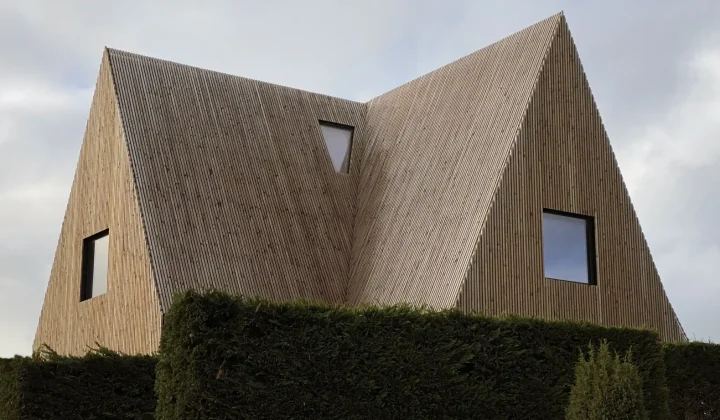
Vantieghem Talebi’s ‘House of Cards’ Brings Timber Geometry to Belgian Family Home
A new family house in Belgium by US- and Swiss-based practice Vantieghem Talebi uses a steeply pitched, card-house-inspired form clad in Douglas-fir…
Read moreRelated wiki

Adaptive Reuse in Architecture
Reference page for reuse, retrofit, conversion, embodied carbon and design constraints.
Read more